
Table of Contents
- Understand Your Utility’s Commercial Lighting Rebate Program
- Assess Your Facility and Identify Eligible Lighting Upgrades
- Lighting Rebate Eligibility Requirements for Your Business
- Complete Your Commercial Lighting Rebate Application
- Occupancy Sensor Rebates for Commercial Buildings
- Commercial Lighting Rebate Processing Time and Payment
- Stack Rebates with Tax Credits and Other Incentives
- Avoid Common Application Mistakes and Denials
- Frequently Asked Questions
Last Updated: October 10, 2026
Understand Your Utility’s Commercial Lighting Rebate Program
Utilities offer commercial lighting rebates to reduce peak demand. LED fixtures and smart controls lower power consumption during expensive peak hours, saving utilities money while earning you rebates.
Every utility runs a different program with varying rebate amounts, eligibility rules, and deadlines.
Visit your utility’s website and search for “commercial lighting rebates” or “energy efficiency incentives.” Most utilities publish program guides with eligible equipment, rebate amounts, and deadlines. If information isn’t online, call commercial customer service and request the program guide, maximum rebate amounts, eligible equipment, pre-approval requirements, and deadlines.
Assess Your Facility and Identify Eligible Lighting Upgrades
Walk through your facility and document your current lighting setup: fixture type (halogen, fluorescent, etc.), quantity, wattage, and coverage areas.
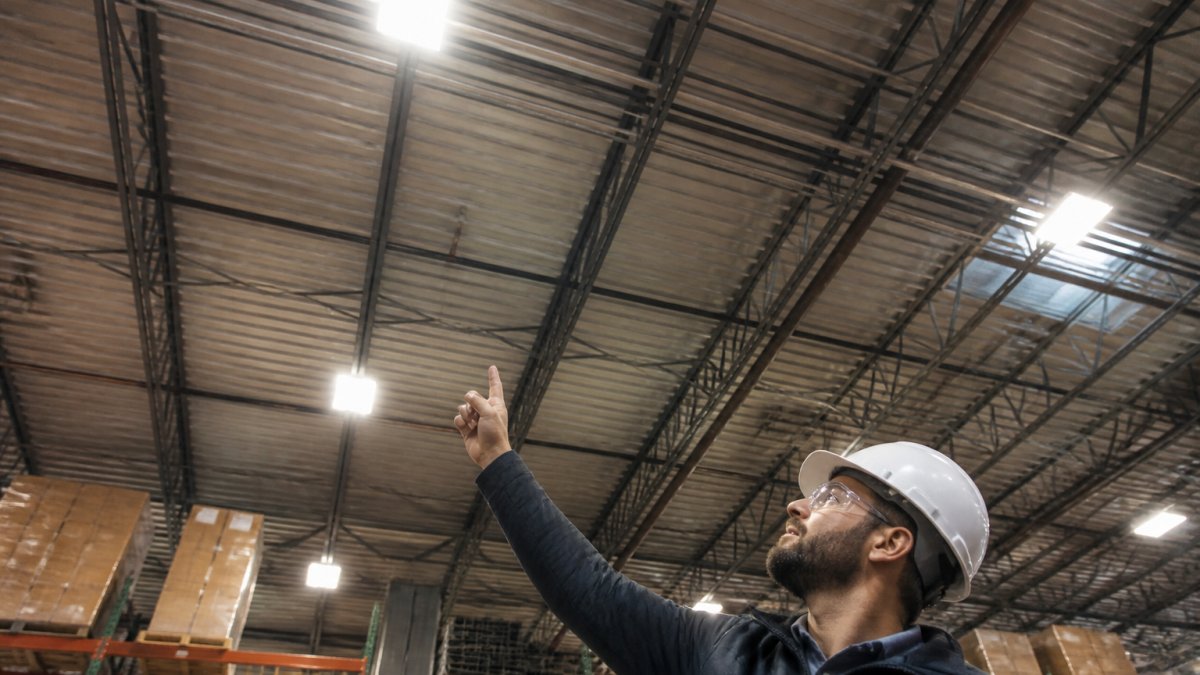
This assessment determines eligibility. Most utilities focus on energy-saving potential and won’t fund upgrades if existing fixtures are already efficient or if demolition is planned.
Common funded upgrades include high-bay warehouse lighting (metal halide/sodium to LED), interior office/retail lighting (fluorescent to LED), exterior parking/security lighting (sodium vapor to LED), and occupancy sensors.
Lighting Rebate Eligibility Requirements for Your Business
Not every business qualifies for every rebate. Utilities set eligibility rules based on facility type, business size, and project scope.
Equipment and Technology Requirements
Utilities specify which lighting products qualify. Rebates cover equipment only, not labor or installation.
Check your utility’s program guide for approved equipment lists, LED wattage requirements (typically 50% less than existing fixtures), color temperature specs, sensor/control requirements, and warranty minimums (often 5+ years).
Facility and Business Qualifications
Most utilities offer rebates to commercial office buildings, retail stores, warehouses, manufacturing facilities, schools, government buildings, and non-profits. Some exclude certain industries or impose revenue/square-footage limits.
Complete Your Commercial Lighting Rebate Application
The application process follows a standard structure: submit documentation, receive approval, complete work, submit proof of completion, and receive payment.
Pre-Approval and Funding Reservation
Most utilities require pre-approval before purchasing equipment to guarantee rebate availability and confirm eligibility.
Submit a completed application form, project description, equipment specifications (model numbers, efficiency ratings), contractor quote, site photos, and utility account number at least 30 days before installation.
Required Documentation and Supporting Materials
Utilities require proof of completion: original equipment invoice, itemized contractor invoice, proof of payment, before/after photos, contractor compliance certificate, and utility account number.
Occupancy Sensor Rebates for Commercial Buildings
Occupancy sensors turn off lights when rooms are empty. Most utilities offer separate rebates for sensor installation due to substantial energy savings.
Typical occupancy sensor rebates cover 50-75% of sensor cost. Sensors must have automatic shutoff within 15 minutes of vacancy, manual override capability, and LED fixture compatibility.
Pair sensors with LED upgrades for maximum incentives. Ask your utility whether they offer separate sensor rebates and include sensors in your project scope if available.
Commercial Lighting Rebate Processing Time and Payment
After submitting completion documentation, the utility enters verification. Understanding the utility’s checks, timeline, and common issues ensures timely payment.
The Verification and Inspection Process
Most utilities conduct a desk review (2-3 weeks) verifying project alignment, equipment compliance, documentation completeness, invoice accuracy, and deadline compliance.
If discrepancies are found, the utility issues a request for additional information (RFI) with 10-30 days to respond. Common reasons: missing photos, mismatched equipment model numbers, non-itemized invoices, or missing account/project ID.
On-Site Inspections
Some utilities inspect projects above $5,000-$10,000. Inspections verify fixture compliance, quantity accuracy, operational status, and licensed installation.
Documentation Checklist for Verification
Before submitting completion documentation, verify you have:
Equipment Documentation
- Original invoice from equipment supplier showing model numbers, quantities, and unit prices
- Specification sheets for each fixture type (showing wattage, lumens, color temperature, efficiency rating)
- Warranty documentation (proof of 5+ year warranty if required)
- Certification or testing reports (if the utility requires ENERGY STAR or DesignLights Consortium certification)
Installation Documentation
- Contractor invoice itemizing labor and materials separately
- Proof of payment (cancelled check, credit card statement, or bank transfer confirmation)
- Certificate of compliance from the contractor
- Licensed electrician’s signature or seal (if required)
Photographic Evidence
- Before photos: Show existing fixtures clearly with date stamp (3-5 representative areas)
- After photos: Show new fixtures installed using the same angles as before photos
- Detail photos: Close-ups of fixture model numbers
- Wide-angle photos: Show project scope
Project Records
- Utility account number and project ID (from your pre-approval letter)
- Signed pre-approval letter or funding reservation confirmation
- Original application and any amendments
- Completion date and project timeline
Timeline from Completion to Payment
| Phase | Duration | What Happens |
|---|---|---|
| Submission window | 30 days after completion | You gather documentation and submit completion forms |
| Desk review | 2-3 weeks | Utility reviews your submission for completeness |
| RFI (if needed) | 10-30 days | You respond to any additional information requests |
| On-site inspection (if selected) | 1-2 weeks to schedule; 1-2 hours on-site | Utility inspector verifies equipment and installation |
| Final approval | 1-2 weeks after inspection | Utility approves your rebate and prepares payment |
| Payment processing | 1-4 weeks | Utility issues check or processes transfer |
| Total elapsed time | 60-120 days | From completion to payment |
Common Verification Rejections and How to Avoid Them
Rejection: Photos don’t clearly show installed equipment.
- Prevention: Take photos in good lighting. Photograph fixture model numbers. Include wide-angle shots. Date-stamp all photos.
Rejection: Equipment model numbers on invoice don’t match the approved application.
- Prevention: Confirm the exact model number before purchasing. Match it to the approved list in your pre-approval letter.
Rejection: Invoices don’t itemize fixtures separately from labor.
Get a Free Property Assessment →
- Prevention: Ask your contractor to provide an itemized invoice showing fixture costs and labor costs separately.
Rejection: Proof of payment is missing.
- Prevention: Keep your cancelled check, credit card statement, or bank transfer confirmation.
Rejection: Contractor certification is missing.
- Prevention: Before the contractor leaves, ask them to sign a statement certifying the work was completed per specifications.
Rejection: Project completion date is after the deadline.
- Prevention: Note the deadline in your approval letter and schedule installation well before it. Contact the utility to request an extension before the deadline passes.
Payment Methods and Timing
Payment arrives through check by mail (1-2 weeks), account credit (1-2 billing cycles), direct bank transfer (3-5 business days), or prepaid card (immediate). Verify the payment method in your pre-approval letter.
What to Do If Your Rebate Is Delayed
If you haven’t received payment 120 days after submission, call your utility’s rebate program contact and reference your project ID and submission date. Request a written status update and timeline for final approval and payment. If the utility can’t explain the delay, ask to speak with the program manager. Keep records of all calls, emails, and dates.
U.S. Department of Energy’s Guide to Commercial Lighting Rebate Programs
Stack Rebates with Tax Credits and Other Incentives
You can combine utility rebates with federal tax credits and other incentives. But stacking isn’t automatic, and not all incentives work together.
Federal Tax Credits for Commercial Lighting
The federal government offers tax credits under Section 179D for energy-efficient commercial building property, including lighting systems. This credit is separate from utility rebates and can be claimed in addition to them.
Key details: up to $1.88 per square foot (as of 2024), eligibility requires 50% energy cost reduction vs. baseline ASHRAE standards. Work with your accountant to determine baseline energy consumption and model savings.
State and Local Incentives
Many states offer state tax deductions, separate rebate programs, and low-interest financing. Check your state’s energy office website or DSIRE for current programs.
Building a Comparison Matrix
To maximize total incentives, create a simple comparison matrix before you apply:
| Incentive Type | Maximum Amount | Eligibility Restrictions | Timeline | Stacking Allowed? | Documentation Needed |
|---|---|---|---|---|---|
| Utility rebate (LED fixtures) | Check program guide | Equipment on approved list; facility type | 30-90 days after completion | Yes, with utility rebates | Invoice, photos, proof of installation |
| Utility rebate (occupancy sensors) | Check program guide | Sensor specs; compatible controls | 30-90 days after completion | Yes, with other utility rebates | Invoice, photos, installation cert |
| Federal tax credit (Section 179D) | Up to $1.88/sq ft | 50% energy savings; commercial building | Tax year of installation | Yes, with utility rebates | Energy modeling; professional certification |
| State tax deduction | Varies by state | State-specific rules | Tax year of installation | Typically yes | State form; energy documentation |
| State rebate program | Varies | State-specific rules | Varies | Check state program | Varies |
Stacking Rules and Restrictions
Utility rebates and federal tax credits almost always stack. Multiple utility rebates can be claimed for different components (e.g., LED fixtures plus occupancy sensors), though some utilities cap total rebates per project. Verify compatibility of utility rebates with state tax incentives and coordinate federal tax credits with your tax professional.
Calculating Total Project Value
Project example: Replace 200 fluorescent fixtures (40W each) with LED fixtures (15W each) in a 50,000-sq-ft office building. Install 30 occupancy sensors.
Example: 200 fluorescent fixtures (40W) to LED (15W) plus 30 occupancy sensors in a 50,000-sq-ft office building.
- Project cost: $34,400
- Utility rebates: $8,750
- Federal tax credit: $6,000
- State incentive: $660
- Net cost: $18,990 (incentives cover 45% of project cost)
Timing and Coordination
Apply for incentives in this order: utility rebate pre-approval (60 days before installation), federal tax credit documentation (work with your energy consultant), state incentives, and tax filing. Budget the full cost upfront, then recover funds through rebates and tax credits over the following 12 months.
IRS Section 179D Energy-Efficient Commercial Building Property Deduction
Database of State Incentives for Renewables and Efficiency
Avoid Common Application Mistakes and Denials
Most denials result from preventable mistakes: incomplete documentation, purchasing before pre-approval, non-approved equipment, missed deadlines, poor photos, or scope mismatches. Avoid denials by reading the program guide, submitting pre-approval 60 days before installation, using only approved equipment, taking detailed photos, keeping all invoices, and responding promptly to utility requests.
The commercial lighting rebate process rewards preparation: understand your utility’s program, assess your facility, apply early, document everything, and stack incentives. Strategic planning transforms a complicated process into a straightforward path to lower energy costs.
NexVolt Energy Group manages the entire rebate coordination process for our clients. We handle utility communication, documentation, and submission. We ensure your project qualifies and your application is complete. We track timelines and follow up on payments. If you want to focus on running your facility instead of navigating rebate paperwork, get a free property assessment and let us handle the incentive coordination for you.
Ready to maximize your rebates? Contact NexVolt Energy Group for a free facility assessment. We’ll identify your rebate opportunities, estimate your total incentives, and manage the entire application process. Let us turn your lighting upgrade into a low-cost efficiency project.
U.S. Department of Energy’s Commercial Lighting Resources
Database of State Incentives for Renewables and Efficiency
American Council for an Energy-Efficient Economy’s Commercial Lighting Guide
Frequently Asked Questions
What information do I need to apply for a commercial lighting rebate?
You’ll need your facility’s energy audit or assessment results, current lighting equipment specifications, quotes from your lighting contractor, proof of business eligibility, and details about the upgrades you plan. Your utility program may also require a one-line electrical diagram, photos of existing fixtures, and documentation of the rebate program you’re applying to. Having this organized before you apply speeds up approval and reduces rejection risk.
How long does it take to receive a commercial lighting rebate?
Commercial lighting rebate processing time typically ranges from 30 to 90 days after you submit your complete application, though some programs process faster. Pre-approval can take 2 to 4 weeks. Post-installation verification and final payment may add another 2 to 6 weeks. Contact your utility directly for their specific timeline, as processing speed varies by program and application complexity.
Can I combine utility rebates with federal tax credits and other incentives?
Yes, you can often stack utility rebates with federal energy tax credits, state incentives, and manufacturer rebates. However, you cannot double-dip, the total incentive amount cannot exceed your project cost. Document all incentives separately and inform your utility and tax preparer about each one to avoid compliance issues and ensure you claim the maximum allowed benefit.
Should I apply for a lighting rebate before or after installation?
Apply before installation. Most utility programs require pre-approval and funding reservation before you purchase equipment or begin work. Some programs allow you to apply during installation if you have a signed contractor agreement, but post-installation applications face strict deadlines and higher rejection rates. Pre-approval protects your funding and ensures the utility confirms your equipment meets their requirements.