
Last Updated: October 25, 2026
Quick Summary
Warehouse lighting costs include both electricity charges and maintenance expenses like lamp replacements and labor. To lower warehouse lighting costs, conduct an energy audit to establish a baseline, calculate your current consumption and rates, assess fixture replacement options, install occupancy sensors and controls, and calculate payback period and ROI before retrofitting.
- Conduct a fixture-level inventory audit capturing location, type, wattage, hours of operation by zone, and maintenance costs.
- Break down your utility bill into energy charges, demand charges, and maintenance costs to understand true operating expenses.
- Install occupancy sensors and dimming controls to use light only when and where needed in your warehouse.
- Calculate payback using four savings categories: energy, demand, maintenance, and other savings like reduced HVAC cooling.
- Apply for utility rebates before signing installation contracts; rebates can reduce payback from 4 years to 2-3 years.
Table of Contents
- Step 1: Conduct a Warehouse Lighting Energy Audit
- Step 2: Calculate Your Current Energy Consumption and Operating Costs
- Step 3: Assess High-Bay Lighting and Fixture Replacement Options
- Step 4: Install Warehouse Occupancy Sensors and Dimming Controls
- Step 5: Understand Warehouse Lighting Retrofit Cost and Financing
- Step 6: Calculate Your Warehouse Lighting Payback Period and ROI
- Step 7: Schedule Your Free Property Assessment
- Frequently Asked Questions
Step 1: Conduct a Warehouse Lighting Energy Audit
A warehouse lighting energy audit is a systematic inspection of your current lighting system to identify waste and cost-reduction opportunities. Done correctly, it produces a fixture-level baseline you can hand to a contractor, rebate reviewer, or CFO, and it determines whether every later savings estimate is credible.
Build a fixture-level inventory first
Walk the floor with a clipboard or tablet and record every fixture, not every “type” of fixture. For each one capture:
- Location ID (aisle, rack row, bay, dock door, office, restroom)
- Fixture type (linear fluorescent, metal halide, high-pressure sodium, LED, induction)
- Lamp and ballast wattage (read the label; a 400W metal halide fixture often draws 450-460W at the ballast)
- Quantity at that location
- Mounting height (this drives whether it is a high-bay or low-bay replacement)
- Control type (manual switch, occupancy sensor, photocell, dimmer, none)
- Condition (working, flickering, dead, missing lens)
Capture operating hours by zone, not by facility
Facility-wide “24/7” assumptions overstate savings in offices and understate them in pick modules. Log hours per zone:
- Receiving and shipping docks (often 10-16 hours, plus door-open periods)
- Storage aisles (often 12-24 hours)
- Packing and staging (often 16-24 hours)
- Offices, break rooms, restrooms (often 8-10 hours)
- Exterior and canopy lighting (dusk-to-dawn, ~4,000-4,400 hours/year in most of the U.S.)
Pull 12 months of utility bills and find the real rate
Your blended “cents per kWh” on the front page of the bill is not the number to use. Break the bill into its components:
- Energy charge ($/kWh, sometimes tiered or time-of-use)
- Demand charge ($/kW of billed peak, often based on the highest 15- or 30-minute interval in the month)
- Power factor or other riders
- Fixed customer charge (does not change with lighting, so exclude it from savings math)
Ask your utility for the interval data behind your billed peak.
Quantify maintenance and replacement cost
Electricity is only part of the operating cost. Build a maintenance line:
- Lamps replaced per year × lamp cost
- Ballasts or drivers replaced per year × part cost
- Labor hours per replacement × fully loaded labor rate (include lift rental and overtime if used)
- Emergency or after-hours call-outs caused by lighting failures
Turn the audit into a one-page baseline
Put the results in one table: zone, fixture type, quantity, watts per fixture, annual hours, annual kWh, annual energy cost, annual demand cost, annual maintenance cost, total annual cost. Every savings claim in this guide should trace back to a row in it.
You can conduct a commercial lighting audit to learn the detailed process and identify specific inefficiencies in your facility’s layout and equipment.
Step 2: Calculate Your Current Energy Consumption and Operating Costs
To truly understand warehouse lighting costs, break down actual consumption.
Start with your utility bill: find the kilowatt-hour (kWh) usage for the past 12 months.
Calculate lighting’s share of your bill:
- Total facility kWh usage per month
- Multiply by your rate per kWh (check your bill for this number)
- Estimate lighting’s percentage (ask your utility or use 30% as a starting point)
- This gives you monthly lighting costs
Beyond energy, factor in maintenance: old fixtures require frequent lamp replacements, ballast repairs, and labor. Track lamp replacement frequency and cost, labor hours on repairs, and downtime or safety incidents from poor lighting. Your true warehouse lighting costs include both electricity and maintenance, that total is what you’re trying to reduce.
Warehouse lighting costs break down into energy charges and maintenance expenses that together determine your true operating cost.
| Cost Component | Includes | Note |
|---|---|---|
| Energy charge | kWh usage × rate per kWh | Check utility bill for actual rate |
| Demand charge | Peak kW × rate per kW × 12 months | Based on highest 15- or 30-minute interval |
| Lamp replacement | Lamps replaced per year × lamp cost | Varies by fixture type and age |
| Ballast or driver replacement | Parts replaced per year × part cost | Old fixtures require frequent repairs |
| Labor and maintenance | Replacement hours × fully loaded rate | Include lift rental and overtime |
| Emergency call-outs | After-hours service costs | Caused by lighting failures |
Step 3: Assess High-Bay Lighting and Fixture Replacement Options
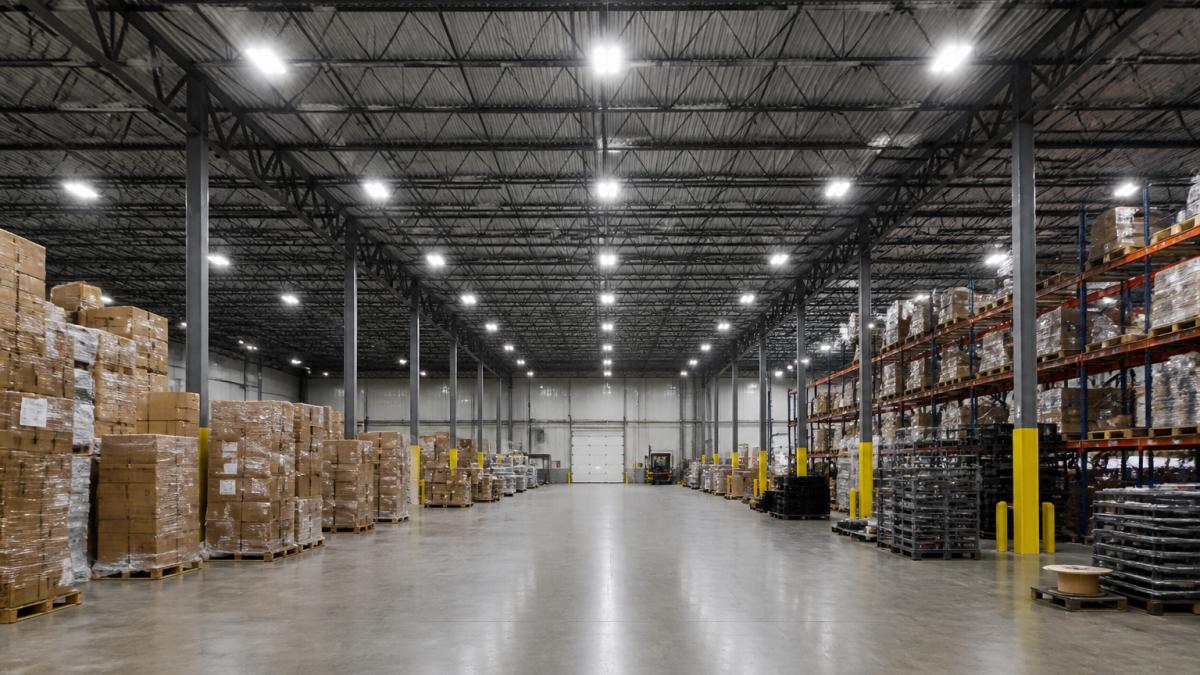
High-bay spaces, typically 20 feet or higher, demand specialized fixtures designed for tall ceilings and large floor areas.
When assessing fixture options, consider:
- Light output (lumens): Ensure new fixtures deliver adequate brightness for your work tasks
- Wattage: Lower wattage = lower electricity bills
- **
- Beam angle: Wider angles cover more area; narrow angles concentrate light where needed
- Durability ratings: Industrial-grade fixtures withstand warehouse dust, temperature swings, and vibration
The LED retrofit for high-bay warehouse guide provides detailed information on fixture types, specifications, and replacement strategies specific to tall warehouse spaces.
Step 4: Install Warehouse Occupancy Sensors and Dimming Controls
Occupancy sensors and dimming systems ensure you’re only using light when and where you need it.
Occupancy sensors and smart controls are among the lighting solutions NexVolt Energy Group offers.
The industrial lighting occupancy sensors benefits guide explains how these systems work, installation considerations, and real-world performance outcomes.
Step 5: Understand Warehouse Lighting Retrofit Cost and Financing
Retrofit projects require upfront investment, but multiple financing paths exist.
Get a Free Property Assessment →
Project costs depend on:
- Facility size and ceiling height
- Number of fixtures to replace
- Control system complexity
- Installation labor and timeline
- Electrical work required
NexVolt Energy Group provides utility rebate program assistance and coordination.
Step 6: Calculate Your Warehouse Lighting Payback Period and ROI
Payback period answers how long until savings cover the retrofit investment. The simple version, project cost divided by annual energy savings, overstates payback because it ignores maintenance savings, demand-charge savings, and rebates. Here is the fuller calculation.
Step 6a: Build the annual savings stack
Calculate savings in four separate lines, then add them:
- Energy savings = (baseline kWh − new kWh) × energy rate ($/kWh)
- Demand savings = (baseline billed kW − new billed kW) × demand rate ($/kW) × 12 months, only count this if your interval data shows lighting is on during the billed peak
- Maintenance savings = (baseline annual lamp/ballast/driver + labor cost) − (new annual maintenance cost)
- Other savings = reduced lift rental, fewer after-hours call-outs, any HVAC cooling reduction from lower fixture heat load (LEDs run cooler, which can trim cooling load in conditioned spaces)
Step 6b: Net out rebates and incentives before you calculate payback
Utility rebates reduce capital cost and shorten payback directly. Structures vary, per fixture, per kWh saved, per kW of demand reduction, and many require pre-approval. Two rules of thumb:
- Apply for the rebate before you sign the installation contract; retroactive applications are frequently denied.
- Model payback both with and without the rebate so you know your downside case.
If a rebate covers 20-50% of project cost, as some programs do, a 4-year payback can become a 2- to 3-year payback. That swing is usually larger than the difference between two fixture vendors.
Step 6c: Calculate simple payback and total cost of ownership
Simple payback (years) = Net project cost after rebates ÷ Total annual savings
Simple payback is useful for screening but ignores what happens after break-even. Total cost of ownership (TCO) over the fixture life is the number your finance team will want:
TCO = Net project cost + (annual energy + demand + maintenance cost × years) − residual value
Compare TCO of the existing system over the same horizon against the new system.
Step 6d: Run the ROI and sensitivity cases
ROI (%) = (Total savings over the horizon − Net project cost) ÷ Net project cost × 100
Do not present a single ROI. Present three cases:
- Base case: your audited rates, hours, and maintenance figures
- Conservative case: 10-20% lower energy savings, no demand savings, no rebate
- Upside case: demand savings included, rebate approved, maintenance savings realized
Step 6e: Plan measurement and verification
Savings are a projection until you measure them. Set up verification before installation:
- Record 12 months of pre-installation utility bills and interval data
- Sub-meter lighting circuits where feasible, or use a control system that logs runtime and energy
- Track maintenance tickets and lamp/driver replacements for the first 12 months
- Compare post-installation bills against the weather- and occupancy-adjusted baseline, not against last year’s raw bills
Do not use your blended all-in $/kWh from the bill summary for savings math. It bakes in fixed charges that do not change when you retrofit, which inflates projected savings and stretches the real payback.
The LED lighting retrofit cost analysis and ROI guide walks you through detailed calculations, accounting for maintenance savings, utility rate changes, and equipment lifespan.
Step 7: Schedule Your Free Property Assessment
NexVolt Energy Group provides comprehensive property assessments as part of its turnkey lighting upgrade services.
NexVolt Energy Group offers free property assessments. Request a free property assessment to get started.
NexVolt Energy Group provides turnkey lighting upgrades, managing the project from assessment through professional installation and verification.
Frequently Asked Questions
How can occupancy sensors reduce warehouse lighting costs?
NexVolt Energy Group offers occupancy sensors and smart controls as part of its lighting-efficiency solutions.
How do you calculate the payback period for a warehouse lighting retrofit?
A payback calculation depends on project costs, energy savings, maintenance savings, and any applicable utility rebates. NexVolt Energy Group can assist with utility rebate coordination.
What is the recommended lighting level for a warehouse?
The Illuminating Engineering Society (IES) recommends 30-50 foot-candles (300-500 lux) for general warehouse areas, with higher levels, 75-100 foot-candles, for detailed picking and packing zones. High-bay LED fixtures deliver uniform illuminance across tall ceilings without the dark spots common with older metal halide lamps. Proper lighting levels improve worker safety, reduce errors, and boost productivity. An energy audit confirms whether your current fixtures meet these standards or if you’re over-lighting (wasting energy) or under-lighting (creating safety risks).
How much can a warehouse save by switching to LED lighting?
LED retrofits typically reduce warehouse lighting energy consumption by 50-70% compared to older metal halide or fluorescent fixtures. For a 50,000-square-foot warehouse running 16 hours daily, annual electricity savings often range from $8,000 to $20,000 depending on local utility rates and fixture density. Additional savings come from reduced maintenance, LED fixtures last 50,000+ hours versus 15,000 hours for older technology, cutting replacement labor and downtime. Utility rebates can cover 30-50% of retrofit costs, making the net investment even lower and improving your payback timeline significantly.
Reducing warehouse lighting costs doesn’t require guesswork. Start with an audit, understand your current spending, explore efficient fixtures and controls, calculate your payback, and move forward with confidence. NexVolt Energy Group specializes in warehouse lighting upgrades that cut energy consumption, reduce maintenance overhead, and improve workplace visibility. Get your free assessment today and discover exactly how much you can save.