Table of Contents
- What Is a Commercial LED Lighting Retrofit?
- Breaking Down LED Retrofit Costs: What You Actually Pay
- Energy Savings and Consumption Reduction
- Calculating LED Retrofit Payback Period and ROI
- Using a Commercial Lighting Energy Savings Calculator
- LED Retrofit Cost-Benefit Analysis: Complete Framework
- LED Lighting Utility Rebates and Tax Incentives
- Is an LED Retrofit Worth It? Real-World Payback Scenarios
- Frequently Asked Questions
Last Updated: October 9, 2026
What Is a Commercial LED Lighting Retrofit?
A commercial LED lighting retrofit is the process of replacing traditional lighting fixtures, typically fluorescent, incandescent, or older high-intensity discharge (HID) lamps, with modern LED technology in an existing building or facility.
Unlike new construction lighting design, you’re working with what’s already in place, which creates both constraints and opportunities. The goal: reduce energy consumption, lower maintenance costs, and improve lighting quality without massive disruption.
At NexVolt Energy Group, the real value isn’t just swapping out bulbs, it’s understanding the full financial picture: what you’ll spend, when you’ll recover it, and what hidden costs most facility managers overlook.
LED retrofit cost analysis is complex because of its many variables. Upfront equipment costs vary by fixture type, ceiling height, and building layout. Labor depends on installation complexity and downtime tolerance. Then come utility rebates, tax incentives, maintenance savings, and operational benefits that compound over time.
This guide walks through every cost category, shows you how to calculate payback period and return on investment, and helps you determine whether a retrofit makes financial sense for your specific situation.
Breaking Down LED Retrofit Costs: What You Actually Pay
Understanding LED lighting retrofit cost begins with separating upfront costs from long-term savings. Most facility managers focus only on equipment and installation labor, a mistake.

Upfront Installation and Equipment
Your initial capital expenditure includes LED fixtures, mounting hardware, and electrical components. Cost per fixture varies by type: standard recessed ceiling lights cost less than high-bay warehouse fixtures, while specialty applications, parking garages, outdoor areas, or spaces requiring specific color rendering, add complexity and expense.
Equipment pricing depends on fixture quality, lumen output, color temperature, and whether you add controls like occupancy sensors or dimming. A basic office fixture replacement costs far less than upgrading a 40-foot warehouse with hundreds of high-intensity fixtures.
The practical reality is that you cannot know your equipment costs without a site assessment. Different facilities have different fixture densities, ceiling heights, and lighting design requirements. NexVolt Energy Group conducts comprehensive property assessments to quantify exactly what fixtures you need and what they’ll cost.
Labor and Specialized Installation
Installation labor often surprises facility managers because it’s rarely as simple as swapping bulbs. Labor costs depend on fixture accessibility, installation complexity, and whether your facility can operate during the work.
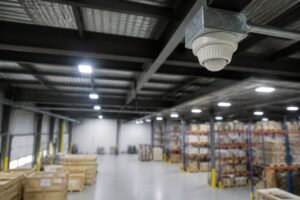
High-bay warehouse lighting requires specialized crews, safety equipment, and extended timelines. Installing fixtures 30 feet or higher means lift equipment, trained technicians, and careful scheduling to avoid production shutdowns. Standard office lighting in accessible ceiling spaces costs far less per fixture.
Some facilities can install during off-hours; others run 24/7 operations where any downtime creates operational costs. Crew expertise, equipment rental, and scheduling constraints make labor the second-largest cost variable in any retrofit.
Hidden Costs: Disposal, Downtime, and Electrical Work
Here’s where most cost analyses fall short: disposal of old fixtures, electrical system upgrades, and operational disruption costs are often ignored, leading to budget surprises mid-project.
Proper disposal of old fluorescent fixtures requires compliance with environmental regulations, fluorescent lamps contain mercury and must go through certified recyclers (the EPA). Old ballasts and electrical components need proper handling too, adding cost and complexity many quotes overlook.
Electrical infrastructure work can be substantial. Older facilities often have aging systems needing upgrades before modern LED controls can be installed, circuit modifications, panel upgrades, or rewiring. Until your facility is assessed, you won’t know if this applies to you.
Operational disruption costs are real but often invisible in traditional analyses. Lost productivity during installation is a cost. Rescheduling critical operations is a cost. For 24/7 operations, even partial downtime compounds quickly.
Energy Savings and Consumption Reduction
The primary financial driver of any LED retrofit is energy reduction. LED technology uses less energy than traditional incandescent and fluorescent lighting for equivalent output, a difference that translates directly to lower utility bills month after month.
Actual energy savings depend on daily operating hours, current utility rates, and how much of your facility you retrofit. A warehouse running lights 16 hours daily sees far greater savings than an office using lights 8 hours daily.
The calculation is straightforward: measure current lighting wattage, estimate LED replacement wattage, multiply by operating hours, and apply your utility rate. In practice, facilities often find consumption drops even more than the wattage reduction suggests, because LED technology also enables better lighting design and control strategies.
Smart lighting controls amplify savings: occupancy sensors eliminate wasted energy in unused spaces, and daylight harvesting dims fixtures when natural light suffices. These controls transform a simple retrofit into an active energy management system.
Calculating LED Retrofit Payback Period and ROI
The payback period is how long it takes for energy savings to equal your upfront investment. Return on investment (ROI) measures the total financial benefit over a specified timeframe, typically five to ten years.
Simple Payback vs. Life Cycle Cost Analysis
Simple payback is the easiest metric: divide total upfront cost by annual energy savings. A retrofit costing $100,000 that saves $20,000 annually has a five-year simple payback.
Simple payback has limits: it ignores maintenance savings, utility rate increases, and the full financial picture. A retrofit with a six-year simple payback might have excellent ten-year ROI once maintenance savings are factored in.
Life cycle cost analysis (LCCA) is more comprehensive, accounting for all costs and benefits over a defined period, typically the 10-15 year fixture lifespan. LCCA includes energy savings, maintenance reductions, utility rate escalation, and end-of-life disposal costs.
LCCA requires more detailed analysis but delivers a far more accurate picture of financial soundness. A facility with high maintenance costs on aging fixtures might justify a retrofit even if energy savings alone wouldn’t.
Using a Commercial Lighting Energy Savings Calculator
A commercial lighting energy savings calculator transforms raw data into actionable projections. These tools take your current lighting specifications, operating hours, and utility rates, then project annual energy consumption and costs for both current and LED scenarios.
The best calculators include variables for occupancy sensors, dimming controls, and utility rebates, showing month-by-month savings projections and letting you adjust assumptions to test scenarios.
NexVolt Energy Group uses detailed energy modeling to quantify your specific savings potential. Rather than generic estimates, we analyze your actual facility layout, fixture inventory, and operating patterns. This precision eliminates guesswork and gives you confidence in your financial projections.
Get a Free Property Assessment →
LED Retrofit Cost-Benefit Analysis: Complete Framework
A complete cost-benefit analysis weighs all costs against all benefits over a defined period. This framework helps you decide whether a retrofit is worth pursuing.
Quantifying Maintenance Savings
Maintenance cost reduction is often the second-largest benefit after energy savings. LED fixtures last longer than traditional lighting, meaning far fewer replacements, less maintenance labor, and reduced inventory costs for bulbs and ballasts.
In a large facility, maintenance savings compound significantly. A warehouse replacing hundreds of fixtures annually might reduce that to a handful. The labor cost difference is substantial. Add in reduced downtime from maintenance activities, and the financial impact becomes clear.
Quantifying maintenance savings requires understanding current maintenance patterns: how many fixtures you replace annually, what that labor costs, and your inventory cost for spares. Multiplied by the analysis period, these numbers represent real financial benefit.
Operational Benefits Beyond Energy
Energy savings and maintenance reductions are primary, but secondary operational advantages matter too. Better lighting quality improves workplace safety and productivity; improved warehouse visibility reduces accidents and increases picking accuracy; better retail ambiance can influence customer behavior.
These benefits are real but harder to quantify than energy savings. A safer facility reduces workers’ compensation claims. Improved picking accuracy reduces fulfillment errors. Better retail lighting might increase dwell time and purchases. These impacts are measurable but require facility-specific analysis.
LED Lighting Utility Rebates and Tax Incentives
Utility rebates and tax incentives reduce your net upfront cost, improving payback period and ROI. Many utilities offer rebate programs for commercial LED retrofits, and federal tax incentives apply in certain circumstances.
Utility rebates vary by region and provider. Some rebate a fixed amount per fixture; others base rebates on wattage reduction or energy savings. A few utilities fund retrofits almost entirely through rebates, making net upfront cost minimal.
Federal tax incentives for energy-efficient lighting are available (Energy Efficient Home Improvement Credit). Specifics change annually, so consult current IRS guidance. State and local incentives vary widely.
The challenge with rebates and incentives is the administrative burden: applications require detailed documentation, energy calculations, and compliance verification. Many facility managers avoid retrofits partly because rebate paperwork feels overwhelming.
This is where NexVolt Energy Group adds substantial value. We manage utility rebate program assistance and coordination as part of our turnkey service, handling documentation, submitting applications, and ensuring you capture every available incentive.
Is an LED Retrofit Worth It? Real-World Payback Scenarios
Whether a retrofit makes financial sense depends on your situation.
Consider a typical warehouse: 50,000 square feet, high-bay fixtures at 30+ feet, operating 16 hours daily.
At 16 hours daily, that’s 3,504,000 kilowatt-hours annually. At $0.12 per kilowatt-hour, that’s roughly $420,000 in annual energy savings.
If upfront costs (equipment, installation, electrical work) total $250,000, simple payback is roughly six months. Over ten years, total benefit exceeds $4.5 million.
This scenario illustrates why large facilities with high operating hours see compelling retrofit economics. The numbers justify the investment decisively.
A smaller scenario: 5,000 square foot retail store, standard ceiling fixtures, operating 12 hours daily.
At 12 hours daily, that’s 153,000 kilowatt-hours annually.
If upfront costs total $15,000, simple payback is under a year. Over ten years, total benefit exceeds $200,000.
The broader point: LED retrofit economics are almost always positive for commercial facilities.
Understanding LED lighting retrofit cost analysis removes the guesswork from one of the most impactful facility upgrades you can make.
NexVolt Energy Group specializes in turning that complexity into clarity.
Get a free property assessment and discover exactly what your LED retrofit could deliver. Visit NexVolt Energy Group to schedule your evaluation today.
| Cost Category | Impact on Total Cost | Variables Affecting Price |
|---|---|---|
| Equipment (fixtures, controls) | 40-50% | Fixture type, lumen output, quantity, controls |
| Installation labor | 25-35% | Ceiling height, accessibility, crew expertise, downtime |
| Electrical upgrades | 10-20% | System age, infrastructure needs, code compliance |
| Disposal and recycling | 2-5% | Fixture quantity, material type, local regulations |
| Contingency and miscellaneous | 5-10% | Project complexity, site conditions, unforeseen issues |
LED retrofits typically deliver positive ROI for most commercial facilities. The real value comes from understanding your specific cost structure and capturing available utility rebates.
Start with a detailed facility assessment that quantifies your current lighting specifications and operating patterns. This single step eliminates guesswork and gives you confidence in financial projections.
Frequently Asked Questions
How do you calculate the payback period for an LED retrofit?
Divide your total upfront investment by your annual energy and maintenance savings. For example, if a retrofit costs $50,000 and saves $10,000 per year, the payback period is 5 years. Account for both energy bill reductions and lower maintenance costs like lamp replacements and ballast failures. This simple payback method ignores inflation and electricity rate changes; use life cycle cost analysis for a more comprehensive view across 10-20 years.
What costs should be included in a commercial lighting retrofit analysis?
Include fixture and lamp costs, installation labor, electrical upgrades, smart controls integration, and often-overlooked expenses like disposal of old fluorescent ballasts and lamps, facility downtime during installation, and any rewiring needed for occupancy sensors or dimming capabilities. Also factor in maintenance savings from reduced lamp replacements and ballast failures. A complete cost-benefit analysis captures both capital expenditure and operating expenditure to show true total cost of ownership.
How much can a business save by switching to LED lighting?
Energy savings can be substantial on lighting costs, depending on current fixture type, operating hours, and facility size. A warehouse running lights 16+ hours daily sees faster payback than a retail space with 12-hour operation. Beyond energy, LED retrofits reduce maintenance labor by eliminating frequent lamp and ballast replacements, often cutting maintenance costs significantly. Real savings depend on your specific energy rates, current wattage consumption, and how much you currently spend on lighting maintenance.
How do utility rebates affect LED retrofit project costs?
Many utilities offer rebates when you meet their efficiency standards. These incentives significantly reduce your net upfront investment and accelerate payback periods. However, rebate programs vary by utility and region, have specific requirements, and involve application deadlines. Working with an experienced partner who handles rebate coordination, documentation, and verification removes administrative burden and ensures you capture available incentives without project delays.