
Table of Contents
- What Commercial LED Lighting Installation Involves
- Step 1: Conduct an Industrial Lighting Audit Checklist
- Step 2: Calculate Your ROI and Payback Period
- Step 3: Coordinate LED Lighting Rebate Programs
- Step 4: Plan Your Lighting Design and Layout
- Step 5: Execute the Turnkey Installation Process
- Working with Energy Efficiency Consultants
- Common Installation Mistakes to Avoid
- Frequently Asked Questions
Last Updated: September 20, 2026
What Commercial LED Lighting Installation Involves
Commercial LED lighting installation replaces traditional HID or fluorescent fixtures with modern LED technology in industrial, warehouse, retail, or office environments. It’s a comprehensive upgrade including assessment, design, utility coordination, professional installation, and smart controls integration.
The scope includes property audit, ROI analysis, rebate coordination, custom lighting design, and certified installation. Results: reduced energy consumption, lower maintenance, improved visibility, often with minimal upfront cost via utility incentives.
Smart controls, occupancy sensors and dimming systems, multiply energy savings by automatically adjusting lighting based on actual usage. High-bay warehouses, distribution centers, parking structures, and retail spaces see dramatic improvements in operational costs and workplace safety.
Step 1: Conduct an Industrial Lighting Audit Checklist
An industrial lighting audit identifies every fixture, documents current wattage and condition, and establishes baseline energy consumption. You can’t optimize what you don’t measure.
Start by cataloging your existing lighting inventory:
- Fixture type and wattage (HID, fluorescent, metal halide)
- Mounting height and spacing
- Age and maintenance history
- Current lighting levels (measured in foot-candles or lux)
- Problem areas (dark zones, excessive heat, flickering, frequent replacements)
Walk your facility systematically, noting high-bay fixtures (30+ feet overhead) and usage patterns: heavy-traffic areas (loading docks, assembly lines) versus intermittent-use spaces (storage, hallways). This influences installation complexity and safety requirements.
Document maintenance costs, ballast replacements, bulb changes, as these expenses disappear with LEDs and directly impact ROI.
Photograph problem areas and take baseline lux readings. This before-and-after comparison proves the upgrade’s impact on visibility and safety, justifying the project to stakeholders.
Step 2: Calculate Your ROI and Payback Period
ROI calculation requires hard numbers for your CFO or board.
Pull 12 months of utility bills and isolate the lighting portion (typically 20-40% of total facility electricity) to establish baseline annual spending.
LED retrofits typically reduce lighting energy by 40-70%. Using a conservative 50% estimate: if you spend $24,000 annually on lighting electricity, you save $12,000 per year.
LED fixtures last 50,000+ hours versus 10,000-20,000 for HID/fluorescent, reducing ballast and bulb replacements. Maintenance labor typically drops 60-80%. If you spend $3,000 annually on maintenance, expect to save $2,000 per year.
Total annual savings: $12,000 (energy) + $2,000 (maintenance) = $14,000.
Divide total project cost by annual savings to find payback in years. A $35,000 project with $14,000 annual savings pays back in 2.5 years.
Utility rebates cover 20-50% of project cost, dramatically accelerating payback. A $17,500 rebate (50% of $35,000) shrinks payback to 1.25 years.
Create a simple spreadsheet: baseline cost, LED cost, rebate amount, net investment, annual savings, payback period, and 10-year total benefit. This document becomes your business case.
Step 3: Coordinate LED Lighting Rebate Programs
Utility rebate programs can cover 20-50% of your commercial LED lighting installation cost.
Most utilities offer $15-50 per fixture or $0.50-1.50 per watt saved. The math compounds quickly in large facilities.
Rebate programs require documentation, pre-approval, and post-installation verification. Professional coordination simplifies this process.
The process: pre-approval (submit specs before installation), installation (with documented labor and materials), and verification (utility inspector confirms work matches specifications). Some utilities require pre-approval before ordering equipment.
Search “[your state] commercial LED rebate” on your utility’s website or contact them directly. Some states offer state-level programs that stack with utility incentives.
Required documentation: existing fixture inventory (type, wattage, count), proposed LED specs, labor estimates, proof of purchase, and photos of existing and installed fixtures.
Rebates reimburse after installation is verified. Budget for full cost upfront; expect rebate checks within 4-8 weeks post-verification.
Step 4: Plan Your Lighting Design and Layout
Lighting design optimizes light distribution, color temperature, control zones, and automation strategies for your specific operational use.
Photometric analysis maps light levels and identifies brightness needs: loading docks need 50 foot-candles; storage areas need only 20. Professional 3D modeling accounts for ceiling height, reflectance, and beam patterns, preventing costly over-lighting while ensuring safety compliance.
Color temperature affects safety and operations: cooler light (4000-5000K) enhances visibility and alertness in industrial settings; warmer light (3000K) suits retail/office environments. High-bay warehouses benefit from 5000K; offices from 4000K.
High-bay fixtures (30+ feet overhead) require precise beam angles and lumen output. A 40-foot warehouse with 150-watt HID fixtures might convert to 60-watt LEDs with superior distribution. Wrong fixture selection creates dark spots or glare that wattage cannot fix.
Control System Integration: The Multiplier Effect
Occupancy sensors and dimming systems automatically reduce lighting in unoccupied zones or during daylight hours, multiplying your energy savings beyond the hardware upgrade alone. This is not optional if you want to maximize ROI.
Occupancy sensors (PIR or microwave) reduce lighting energy by 15-25% in low-traffic areas. Sensor sensitivity and timeout duration matter, professional commissioning ensures proper calibration.
Get a Free Property Assessment →
Daylight harvesting sensors dim fixtures when natural light is sufficient, reducing output by 30-50% in spaces with consistent daylight access.
Dimming systems reduce energy use by roughly 50% at 70% output, extend fixture lifespan, and improve visual comfort.
Control zoning groups fixtures by usage pattern: high-traffic areas separate from intermittent-use spaces. A warehouse might have three zones: loading dock (always on), active storage (occupancy-controlled), and inactive storage (occupancy-controlled with longer timeouts).
Network-based controls allow remote monitoring, schedule adjustment, and malfunction alerts. This visibility often reveals unexpected usage patterns that create additional savings.
Design Specifications to Document
Your lighting design should specify: fixture type/wattage/lumens per zone, color temperature, mounting height/spacing, beam angle, control type, sensor placement, dimming range, and building system integration. This prevents installation surprises and ensures rebate documentation is complete.
Step 5: Execute the Turnkey Installation Process
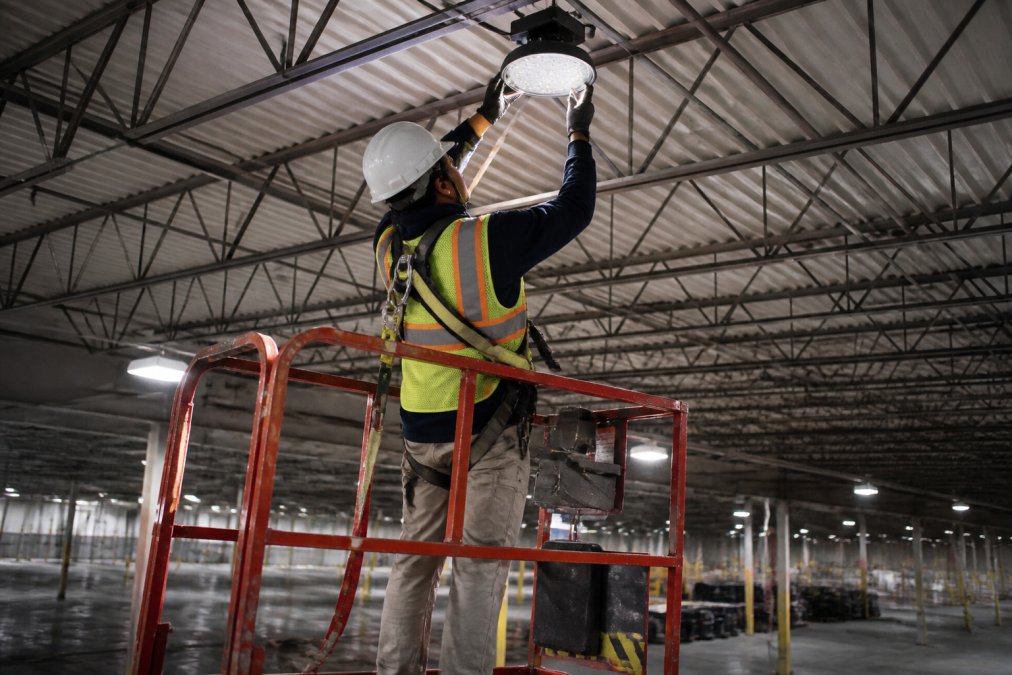
Turnkey installation manages the entire execution from permitting through final verification, eliminating contractor coordination and operational scheduling.
Regulatory Compliance and Safety Standards
The National Electrical Code (NEC) Article 410 governs LED fixture installation, requiring proper grounding, circuit protection, and junction box sizing. Older facilities often need electrical upgrades before LED installation can proceed.
Local building codes typically require permits for commercial lighting work, including electrical plans and proof of licensed contractor involvement. Skipping permits disqualifies you from rebate programs.
Title 24 (California) sets minimum efficacy requirements and mandates occupancy sensors and daylight harvesting in specific space types. Even outside California, Title 24 represents the most stringent standard and is increasingly referenced by other states.
DesignLights Consortium (DLC) Qualification is required by most utility rebate programs. Only DLC-qualified fixtures are eligible for rebates. Installing non-qualified fixtures disqualifies your entire project from incentive programs.
OSHA requirements apply to installation work, particularly high-bay installations. Your contractor must carry current OSHA compliance documentation and workers’ compensation insurance.
Compliance Checklist for Facility Managers
Before installation begins, verify these compliance items:
- Permits: Confirm electrical permit is issued and on-site. Inspections required before energizing fixtures.
- Contractor Licensing: Verify current state/local licenses, workers’ compensation, and $1M general liability coverage.
- DLC Qualification: Confirm all fixtures appear on the DLC Qualified Products List.
- Electrical Plans: Review circuit diagrams, panel upgrades, and grounding specifications.
- Local Code Compliance: Contact your building department for additional requirements.
- Rebate Pre-Approval: Submit specifications to your utility before installation begins.
- Safety Plan: Request contractor’s site safety plan including fall protection and equipment certification.
- Post-Installation Verification: Schedule utility inspection before final payment.
Installation Timeline and Operational Coordination
A 50,000 sq ft warehouse typically takes 2-4 weeks. Multi-shift facilities require careful scheduling to minimize operational disruption.
Coordinate with operations at least three weeks in advance, identifying lowest-traffic periods. Clear communication prevents surprises.
For 24/7 facilities, phased installation by zone minimizes impact. Install one section at a time, keeping other areas fully operational. This approach extends the timeline but eliminates facility-wide disruption.
Post-Installation Verification and Documentation
After installation is complete, verification ensures compliance and supports your rebate claim.
Your contractor should provide:
- As-built electrical plans showing actual installation
- Fixture inventory with serial numbers and DLC certification numbers
- Photometric reports showing light levels in key areas (before and after)
- Control system commissioning reports confirming sensor calibration and dimming functionality
- Electrical inspection sign-off from the local authority having jurisdiction
- Utility rebate documentation package (photos, specifications, performance data)
Utility verification typically occurs within two weeks of completion.
Rushing the compliance phase to accelerate installation creates liability and forfeits rebates. A few extra days of permitting and pre-approval prevents months of rework and financial loss. Non-compliant installations may require fixture replacement at your expense.
Working with Energy Efficiency Consultants
Energy efficiency consultants bridge the gap between facility management and technical expertise. They speak both languages, operational constraints and engineering specifications.
Common Installation Mistakes to Avoid
The biggest mistake is underestimating fixture complexity. Not all LED fixtures are created equal. Cheap LEDs often have poor beam distribution, color consistency issues, or premature failure. Specification matters. Your consultant should recommend fixtures with proven track records in similar facilities.
Rushing the design phase to accelerate installation often results in suboptimal lighting layouts. A few extra days of planning prevents months of regret. Proper photometric analysis identifies problem areas before crews arrive.
Frequently Asked Questions
What is the typical ROI for commercial LED lighting retrofits?
ROI depends on your facility size, current fixture age, operating hours, and local utility rates. Most warehouses and distribution centers see payback within 3-5 years through energy savings alone, with some achieving 2-3 years when utility rebates reduce upfront costs. LED fixtures typically last 25,000-50,000 hours, dramatically reducing maintenance labor compared to older high-intensity discharge bulbs that require frequent replacement.
Do commercial LED lighting installations qualify for utility rebates?
Yes. Most utilities offer rebate programs for commercial LED conversions, especially for high-bay and warehouse fixtures. Rebates typically cover 20-50% of fixture and labor costs, depending on your state and utility provider. The rebate application process involves submitting project documentation, photometric analysis, and energy audit results. Working with an energy efficiency consultant streamlines this process and ensures you capture every available incentive.
How disruptive is a commercial LED lighting installation for a 24/7 facility?
Professional installation teams can phase the work to minimize downtime. High-bay fixtures in warehouses are typically replaced section-by-section or during off-peak hours. A turnkey installation process includes scheduling coordination with your operations team to work around production schedules. Expect 1-3 weeks for a large facility, depending on fixture count, building height, and electrical modifications needed. Occupancy sensors and smart controls are installed after fixtures are in place.
What happens if the electrical system needs upgrades before LED installation?
A comprehensive facility assessment identifies any electrical issues upfront. If your building requires panel upgrades, rewiring, or safety corrections, that scope is identified and quoted separately before installation begins. Many facilities bundle these upgrades into their rebate applications to reduce out-of-pocket costs. Your energy efficiency consultant can advise on phasing strategy to manage budget and timeline.