Table of Contents
- What Is a Commercial Lighting Energy Audit?
- Benefits of a Lighting Energy Audit for Your Facility
- Step-by-Step Commercial Lighting Audit Process
- Understanding Commercial Lighting Retrofit ROI
- Utility Rebate Programs for Lighting Upgrades
- How Rebates Integrate Into Your Audit
- Common Rebate Categories and Application Mechanics
- The Pre-Approval Requirement: Why Timing Matters
- Federal Tax Incentives: Section 179D and Energy Tax Credits
- Rebate Application Workflow: What to Expect
- Avoiding Rebate Disqualification
- Stacking Incentives for Maximum Savings
- Commercial Energy Audit Checklist for Facility Managers
- Industrial LED Lighting Installation Best Practices
- Post-Audit Implementation and Ongoing Monitoring
- Building Your Implementation Roadmap
- Pre-Installation Verification: Confirming Audit Specifications
- Managing Installation Disruption
- Monitoring Installation Quality
- Post-Installation Performance Verification
- Rebate Claim Submission and Verification
- Ongoing Optimization: Year 1 and Beyond
- Common Post-Installation Issues and Solutions
- Frequently Asked Questions
Last Updated: September 25, 2026
What Is a Commercial Lighting Energy Audit?
A commercial lighting energy audit is a comprehensive assessment of your facility’s lighting systems to identify inefficiencies, waste, and upgrade opportunities. An auditor evaluates your current fixtures, energy consumption patterns, and operational costs to create a roadmap for improvement. This involves measuring light output, analyzing utility bills, documenting fixture age and condition, and calculating potential savings from upgrades.
Benefits of a Lighting Energy Audit for Your Facility
A commercial lighting energy audit delivers advantages such as visibility into hidden costs, identification of safety gaps from older fixtures, access to utility rebate programs, a prioritized implementation roadmap backed by data, and reduced carbon footprint for corporate sustainability goals.
Step-by-Step Commercial Lighting Audit Process
A thorough commercial lighting energy audit follows a structured methodology to ensure nothing gets missed and results are actionable.
Phase 1: Pre-Audit Preparation and Site Assessment
Gather baseline information: 12 months of utility bills, facility floor plans, and documentation of recent lighting work. The auditor conducts a site walkthrough to understand layout, operating hours, and lighting zones, photographing fixtures, noting condition, and documenting issues like flickering lights or dark areas. This phase establishes scope, entire facility or specific zones.

Phase 2: Detailed Lighting Inventory and Performance Measurement
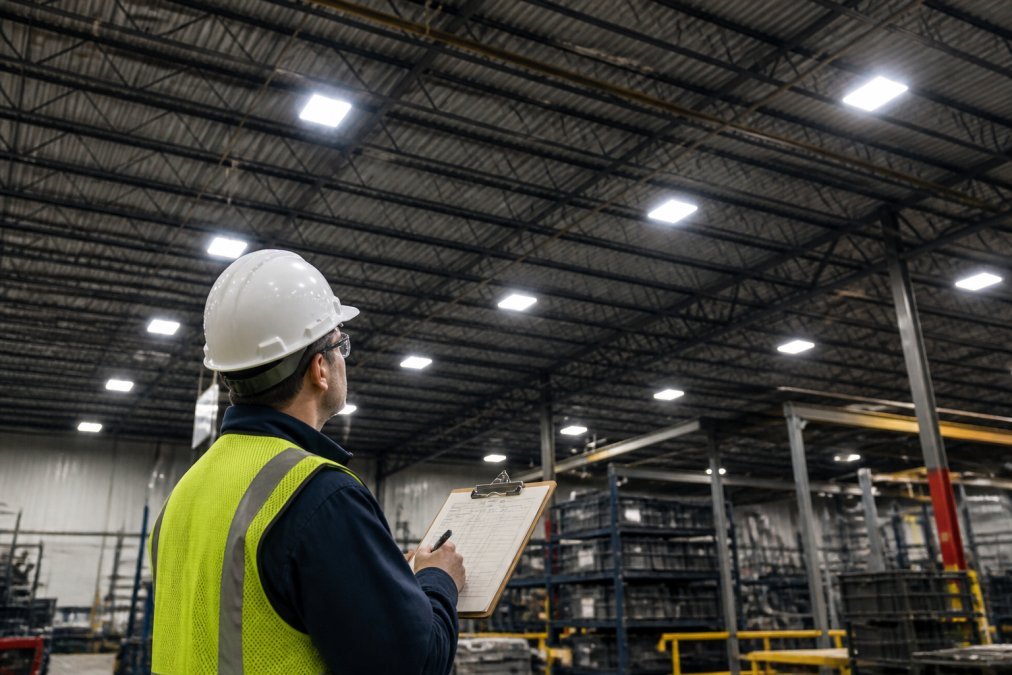
The auditor documents every fixture (type, age, wattage, lamp count, mounting height, condition, light output in foot-candles) using light meters and thermal imaging cameras. For high-bay warehouses, fixture performance directly affects worker safety and productivity. The auditor analyzes usage patterns to determine which zones operate 24/7 versus business hours only, critical for calculating savings from occupancy sensors and smart controls.
Phase 3: Energy Consumption Analysis and Waste Identification
The auditor calculates current energy consumption and identifies waste sources: overlighting, inefficient placement, outdated ballasts, lights in unoccupied spaces, and lack of daylight harvesting. This reveals the gap between current and optimized spending, your savings opportunity.
Understanding Commercial Lighting Retrofit ROI
LED fixtures can offer a longer lifespan compared to traditional bulbs, which can contribute to reduced replacement labor and facility downtime (Purchasing Energy-Efficient Light Bulbs).
Smart controls can amplify returns. Occupancy sensors and dimming systems can contribute to reduced energy consumption.
Utility Rebate Programs for Lighting Upgrades
Utility rebate programs can offset a portion of retrofit costs. A professional audit should identify which programs your facility qualifies for before recommending upgrades, this shapes the entire retrofit strategy.
How Rebates Integrate Into Your Audit
Some utilities offer rebates only for specific fixture types or control technologies. When you request a commercial lighting energy audit, ask whether the auditor will:
-
Map your facility to active utility programs. Your location determines which programs apply. The auditor should identify all programs your utility and state offer.
-
Pre-qualify your facility. Some programs have eligibility thresholds (minimum facility size, building type restrictions). Pre-qualification prevents recommending upgrades you can’t claim.
-
Structure recommendations around rebate requirements. If a program requires LED fixtures rated for 50,000+ hours, the audit should specify that standard.
-
Document baseline conditions for rebate applications. Utilities require proof of existing conditions before retrofit. The audit should photograph and measure current fixtures in a format that satisfies rebate documentation requirements.
Common Rebate Categories and Application Mechanics
LED Fixture Upgrades, $15-$50 per fixture or $0.50-$1.50 per watt saved. High-bay fixtures often qualify for higher rebates. Requires pre-approval and post-installation documentation.
Occupancy Sensors, $25-$75 per sensor. Application timelines vary 30-90 days.
Daylight Harvesting Systems, $500-$2,000 per zone. Longest approval timelines (60-120 days). Audit should include daylight analysis.
Smart Lighting Controls and Dimming, $1,000-$5,000 per facility. Often require ongoing monitoring data.
High-Efficiency Ballasts, $10-$25 per ballast, though programs are being phased out.
Get a Free Property Assessment →
The Pre-Approval Requirement: Why Timing Matters
Most utility rebate programs require pre-approval before installation begins. The utility reviews your application, verifies eligibility, and issues a rebate authorization number. You then have a period to complete installation and submit proof. Confirm the auditor’s timeline for delivering the final report and rebate application support.
Federal Tax Incentives: Section 179D and Energy Tax Credits
Section 179D of the Internal Revenue Code allows a deduction of up to $1.88 per square foot (as of 2024) for commercial building energy-efficient property, including lighting systems. Your retrofit must be part of a comprehensive energy-efficient project and meet the 50% energy savings threshold. Your auditor should calculate projected savings and document 179D qualification. For a 50,000-square-foot facility, a 179D deduction could be worth $94,000 in tax savings. Work with your tax advisor and auditor to confirm eligibility and documentation requirements.
Rebate Application Workflow: What to Expect
- Pre-approval application submitted.
- Utility issues pre-approval. You receive authorization number and rebate amounts.
- Installation occurs. Contractor must follow audit specifications.
- Post-installation documentation submitted. Includes receipts, invoices, photos, and proof.
- Utility processes claim. Rebate issued as check or bill credit.
Avoiding Rebate Disqualification
Common mistakes that result in denied claims: installing before pre-approval, substituting equipment, missing deadlines, incomplete paperwork, or using unlicensed contractors. Ask the auditor to explain rebate requirements upfront and provide a written documentation checklist.
Stacking Incentives for Maximum Savings
You can combine utility rebates, federal tax incentives, and state/local grants. A professional auditor will structure recommendations to maximize total incentive capture.
Commercial Energy Audit Checklist for Facility Managers
Use this framework when requesting proposals or planning your assessment:
- Facility square footage and layout documented
- 12 months of utility bills provided
- Current lighting fixture inventory completed
- Light output measurements taken across all zones
- Operating hours and usage patterns recorded
- Maintenance logs reviewed for repair frequency
- Occupancy patterns documented (24/7, seasonal, shift-based)
- Current rebate program eligibility assessed
- Energy consumption calculated for existing system
- Retrofit options evaluated with cost-benefit analysis
- ROI projections provided for each option
- Implementation timeline and installation disruption estimated
- Rebate application strategy documented
- Post-installation monitoring plan established
Industrial LED Lighting Installation Best Practices
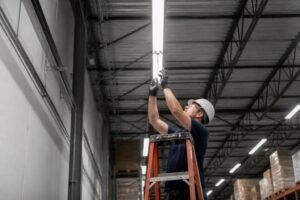
Installation execution matters. Key practices: schedule around operations, position fixtures per audit specs, calibrate occupancy sensors, integrate controls correctly, ensure code compliance, and train staff. High-bay installations require specialized equipment and safety protocols for working at 30+ feet.
Post-Audit Implementation and Ongoing Monitoring
The audit report is delivered and approved. Now comes the critical phase: turning recommendations into installed reality without disrupting operations, exceeding budget, or losing projected savings.
Building Your Implementation Roadmap
A professional audit should include realistic implementation strategy: phasing, timeline, operational impact, contractor criteria, and budget contingency. When selecting a contractor, verify licensed electrician status, insurance and bonding, facility type experience, and utility rebate familiarity.
Pre-Installation Verification: Confirming Audit Specifications
Hold a pre-installation meeting with the contractor, facility manager, and auditor. Review fixture specifications, sensor placement, control system configuration, timeline, safety protocols, and rebate documentation. Provide a marked-up facility plan with exact fixture and sensor locations. Document existing conditions with photos and measurements, critical for rebate claims and quality disputes.
Managing Installation Disruption
Coordinate installation timing with your production schedule, customer traffic, and staffing. A retail facility might schedule retrofits during off-hours; a warehouse might retrofit during shift changes. Budget for temporary lighting during retrofit in areas where it’s necessary. Notify employees and customers about upcoming work.
Monitoring Installation Quality
Your facility manager should walk the retrofit area daily, checking that fixtures are installed per audit specifications, sensors are positioned correctly, wiring is routed safely, work areas are cleaned up, and safety protocols are followed. Before the contractor leaves each day, test installed fixtures and controls.
Post-Installation Performance Verification
Track your first full month of energy use post-retrofit and compare it to the same month from the prior year. If actual consumption is significantly higher than projected, investigate: Are occupancy sensors functioning? Are smart controls operating as programmed? Are any fixtures not working? Has facility usage changed?
Rebate Claim Submission and Verification
Post-installation documentation is critical for rebate claims. Most utilities require completed rebate application forms, pre-approval authorization numbers, receipts and invoices, before and after photos, and proof of installation. Submit rebate claims within a reasonable timeframe after installation completion. Some utilities require a third-party verification inspection. Rebate processing takes time.
Ongoing Optimization: Year 1 and Beyond
After 12 months of operation, conduct a performance review comparing actual energy savings to audit projections. Review maintenance logs for frequently failing fixtures or sensors. Assess occupant satisfaction with light levels. Identify optimization opportunities: can you adjust sensor sensitivity, modify dimming curves, or expand the retrofit to other facility areas?
Common Post-Installation Issues and Solutions
Sensors triggering too frequently or not at all, Sensor sensitivity needs adjustment. Work with your contractor to fine-tune settings based on actual occupancy patterns.
Frequently Asked Questions
What is included in a commercial lighting energy audit?
A comprehensive commercial lighting energy audit evaluates your entire lighting system, including fixture inventory, wattage consumption, illumination levels, and operational patterns. The auditor measures energy waste, identifies inefficiencies, assesses maintenance costs, and documents opportunities for LED retrofit and upgraded controls like occupancy sensors and dimming systems. The final audit report includes energy consumption analysis, cost-benefit projections, and recommendations ranked by ROI potential.
How do utility rebate programs for lighting help reduce upfront costs?
Utility rebate programs for lighting offset a portion of your retrofit investment by reimbursing you for energy savings achieved through LED upgrades and advanced controls. Rebate amounts vary by utility provider and equipment type, but they can cover 20-50% of project costs. Working with an experienced partner who handles rebate coordination, documentation, and verification ensures you capture all available incentives without administrative burden or delays.
How long does a professional commercial lighting energy audit take?
The duration of a commercial lighting energy audit depends on facility size, complexity, and ceiling height. Most auditors schedule during operating hours and work around your facility’s schedule to minimize disruption to your business operations.
What is the typical payback period for a commercial lighting retrofit?
Payback periods for commercial lighting retrofit projects depend on your current energy consumption, local electricity rates, and the scope of upgrades. High-use facilities often see faster payback due to greater energy savings. Adding occupancy sensors and smart controls can accelerate ROI by reducing operational costs and extending fixture lifespan, further improving your return on investment.