
Table of Contents
- What Utility Rebate Application Support Services Do
- Commercial Lighting Rebate Requirements You Need to Know
- How to Prepare Your Utility Rebate Application Checklist
- Understanding the Utility Rebate Processing Timeline
- Why Professional Support Increases Your Approval Rate
- Common Mistakes That Delay or Deny Rebate Applications
- Handling Denials and Filing an Appeal
- Frequently Asked Questions
Last Updated: September 21, 2026
What Utility Rebate Application Support Services Do
Utility rebate application support services manage the paperwork and coordination required to secure financial incentives for energy-efficient upgrades, acting as an intermediary between your facility and utility companies.
Proper rebate coordination includes verifying eligibility, compiling documentation, submitting applications to correct utility programs, and tracking approval status from start to finish.
Commercial Lighting Rebate Requirements You Need to Know
Commercial lighting rebate eligibility depends on equipment specifications, facility income level, and utility program rules. Most programs require Energy Star-certified LED fixtures, with rebate amounts varying by fixture type, quantity, and local utility incentive structure.
Many utility rebate programs, particularly those tied to federal funding like LIHEAP (Low Income Home Energy Assistance Program), have income limits based on household or business owner income.
Your account information must be current and verified with accurate billing statements and account numbers; outdated or mismatched details are among the most common reasons applications get delayed or denied.
Documentation verification before submission confirms lighting specifications meet technical requirements and your facility qualifies under program rules. Missing or incomplete documentation is the single largest cause of application rejection.
How to Prepare Your Utility Rebate Application Checklist
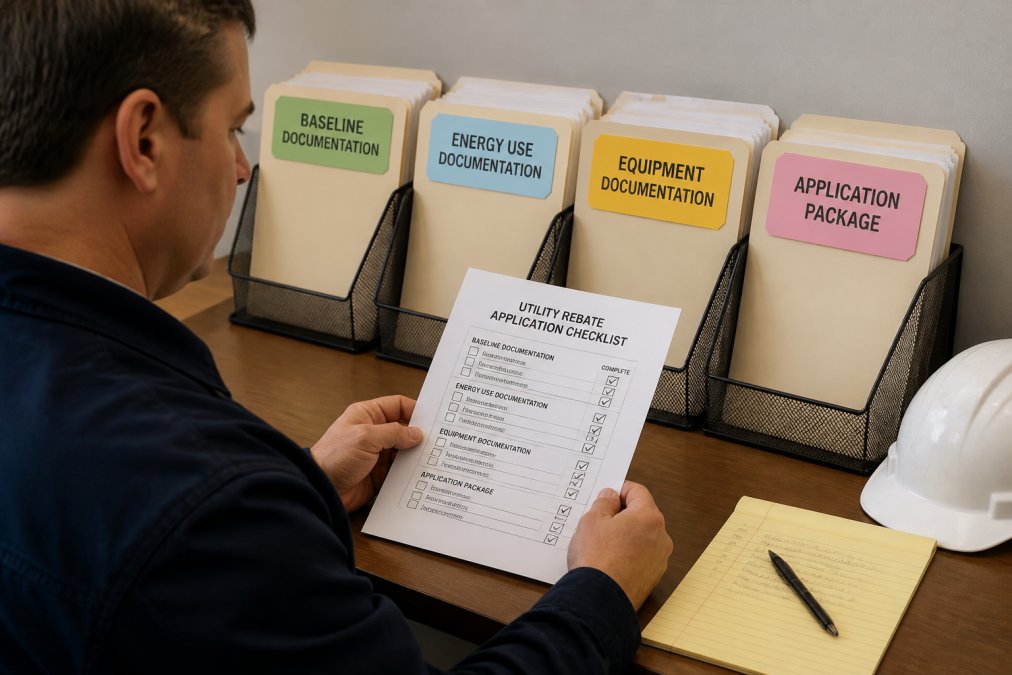
Preparing a utility rebate application requires systematic organization using a phased checklist approach that mirrors how utility reviewers evaluate applications.
Phase 1: Establish Your Baseline Documentation (Week 1)
Gather proof of your current facility status before selecting equipment to prevent delays and incomplete baseline verification.
Account verification documents:
- Current utility bill (dated within 60 days) showing your account number, facility address, and service type
- Previous 12 months of billing statements organized chronologically
- Confirmation call to your utility’s customer service to verify account number, facility status, and no service interruptions
Proof of authority to apply:
- For property owners: property tax statement or deed showing your name and facility address
- For tenants: signed lease agreement or letter from building owner authorizing you to apply for rebates on the facility
- For non-profits or government facilities: board resolution or official authorization letter designating who may apply for rebates
Income documentation (required for most programs):
- Last two years of federal tax returns (personal or business, depending on facility type)
- Current year profit-and-loss statement or business financial statement (if applying before tax filing)
- For non-profits: most recent IRS Form 990 or audited financial statement
- For schools or government facilities: budget documentation showing annual operating expenditure
Organize these into a single folder labeled “Baseline Documentation.” This folder becomes your reference point for every program you apply to.
Phase 2: Document Your Current Energy Use (Week 1-2)
Energy baseline documentation:
- All 12 months of billing statements organized chronologically
- Highlighted kilowatt-hour (kWh) usage for each month on a summary sheet
- Current lighting inventory: count of existing fixtures by type with approximate wattage per fixture
- Facility square footage and primary use
Phase 3: Gather Equipment and Technical Specifications (Week 2-3)
Equipment documentation:
- Manufacturer specification sheets (cut sheets) for every LED fixture you plan to install
- Energy Star certification label or equivalent efficiency rating documentation
- Wattage comparison: old fixture wattage vs. new fixture wattage clearly stated
- Installation method documentation and quotes from electricians
Phase 4: Compile Your Application Package (Week 3)
Organize all documentation in the exact sequence your utility program requires to prevent requests for reorganization.
Standard application package sequence:
- Completed application form (signed and dated)
- Energy baseline summary sheet (one page)
- Proof of authority to apply (deed, lease, or authorization letter)
- Income verification documentation (tax returns or financial statements)
- Current utility bill (within 60 days)
- 12 months of billing statements (organized chronologically)
- Technical specification sheet
- Equipment manufacturer cut sheets and Energy Star certifications
- Electrician quotes
- Installation timeline and project schedule
Create a cover sheet listing every document included with page numbers to signal completeness and reduce requests for clarification.
Common Organization Mistakes to Avoid
Failing to highlight key information: Highlight specific lines on income documents and billing statements (income amount, facility address, account number, kWh usage) to speed review and reduce errors.
Understanding the Utility Rebate Processing Timeline
Most utility rebate applications take 30 to 60 days from submission to approval decision, though some extend to 90 days or more.
Pre-approval reviews screen for completeness and basic eligibility in 7 to 14 days.
Technical verification confirms fixtures are Energy Star-certified, installation methods comply with safety codes, and projected energy savings meet program thresholds, typically taking 14 to 21 days.
Final approval occurs after technical verification passes, with the utility calculating your rebate based on kilowatt-hour savings, fixture quantity, and program caps, typically issuing it within 30 days of project completion.
Why Professional Support Increases Your Approval Rate
Professional support services know each utility’s specific requirements, documentation standards, and which mistakes cause delays.
Pre-submission quality control confirms all documentation is complete, technical specifications align with program requirements, and your facility meets eligibility criteria, catching errors before submission.
Utility staff may contact the professional support service directly rather than the facility manager, accelerating resolution.
Common Mistakes That Delay or Deny Rebate Applications
Mismatched account information is the most frequent error. A single digit wrong in your account number or an address that doesn’t match utility records exactly adds 14 to 21 days to processing time.
Incomplete income documentation leads to denial. Outdated tax returns, incomplete financial statements, or unclear income documentation forces the utility to request clarification, often restarting the review process.
Technical specifications that don’t meet program requirements cause immediate rejection. Non-Energy Star-certified fixtures or installation methods that don’t comply with engineering standards require resubmission with corrected specifications.
Get a Free Property Assessment →
Outdated or missing billing statements create verification problems. Utility bills older than 60 days may be rejected, and missing consecutive months prevents accurate baseline energy usage calculation.
Failing to provide proof of residency or business location ownership results in outright denial. This documentation is mandatory, not optional.
Handling Denials and Filing an Appeal
Denials are not final. Most utility rebate programs allow appeals or resubmission with corrected information.
Understanding Your Denial Letter
When a utility denies your application, they must provide a written explanation. Read the denial letter carefully and identify the specific reason code or category.
Common denial categories and what they mean:
Incomplete documentation: The utility received your application but one or more required documents were missing, illegible, or didn’t match the program’s specifications. Examples include: outdated utility bills (older than 60 days), missing income verification, or incomplete technical specifications. This is the most reversible denial type.
Income exceeds program limits: Your household or business income is above the maximum threshold for the program you applied to. Income limits vary by program and sometimes by geographic area. This denial may be reversible if you apply to a different program with higher limits, but it is not reversible within the same program.
Technical specifications do not qualify: Your proposed equipment does not meet the program’s energy efficiency standards, or your installation method does not comply with the utility’s engineering requirements. This requires equipment substitution or installation method changes.
Account not in good standing: Your utility account has an unpaid balance, service interruption history, or other compliance issue. This must be resolved with the utility before reapplication.
Ineligible facility type: Your facility type (residential, commercial, industrial, agricultural) does not qualify for the program you applied to. This denial is not reversible within the same program but may be reversible if you apply to a different program designed for your facility type.
Duplicate application: You or another party already applied for rebates on this facility within a specified timeframe (typically 12 months). Most programs allow only one rebate per facility per program cycle.
Locate the specific denial reason in your letter. If unclear, call the utility’s customer service line and ask for clarification.
Appeal Procedures by Program Type
Appeal processes differ by program type: utility-administered, state-administered, or federally funded. Identify your program type and follow the corresponding appeal pathway.
Utility-administered programs (most common):
Most commercial lighting rebate programs allow informal appeals where you resubmit corrected documentation and request reconsideration, with no formal appeal hearing or external review process.
Timeline: Most utilities allow 30 to 60 days from denial to submit an appeal. Check your denial letter for the specific deadline.
Process: Prepare a cover letter addressing the specific denial reason, including missing documents or revised specifications as applicable.
Denial-Specific Resubmission Strategies
If denied for incomplete documentation:
Identify which documents were missing or incomplete. Resubmit with a cover letter referencing your original application number and explicitly stating which documents are new or corrected.
If denied for income exceeding limits:
If denied for technical specifications:
If denied for account not in good standing:
When to Escalate Beyond Standard Appeal
Request supervisory review: Ask to speak with a supervisor in the utility’s rebate program department and request that a different reviewer examine your application.
Documentation for Future Applications
Keep a copy of your denial letter and all appeal correspondence to avoid repeating mistakes in future applications.
Frequently Asked Questions
What documentation is required for a utility rebate application?
Most utility rebate applications require proof of residency, billing statements showing account numbers, energy efficiency measure specifications, and sometimes income verification. Documentation verification ensures you meet eligibility criteria. Professional support services review your complete file before submission to catch missing items, reducing rejection risk and accelerating approval timelines significantly.
How long does the utility rebate processing timeline typically take?
Processing timelines vary by program and utility provider, typically ranging from 30 to 90 days after submission. Incomplete applications cause delays of weeks or months. Professional utility rebate application support services track your enrollment status throughout the process and follow up with providers, ensuring your application moves forward without stalling.
Can utility rebate support services help if my application was denied?
Yes. Professional services analyze denial reasons, identify documentation gaps or eligibility issues, and guide you through appeals procedures. Many denials stem from correctable errors in the original submission. Support providers understand program requirements deeply and can reframe your application or provide additional evidence that addresses the utility’s concerns, significantly improving your chances on appeal.
How do professional services increase the success rate of lighting rebates?
Experts understand each utility’s specific requirements, energy efficiency measure standards, and documentation expectations. They prepare complete, compliant applications the first time, verify eligibility upfront, and maintain communication with providers throughout processing. This expertise reduces rejections and speeds approvals.