Table of Contents
- LED Lighting Upgrade Cost Breakdown: What You’re Actually Paying
- Upfront Costs: Fixtures, Installation, and Labor
- Energy Efficiency and Long-Term Operational Savings
- Commercial LED Lighting Rebate Programs and Tax Incentives
- LED Retrofit ROI Calculation and Payback Period
- Hidden Costs and Factors That Affect Total Upgrade Cost
- Residential vs. Commercial Lighting Requirements and Cost Differences
- Frequently Asked Questions
Last Updated: October 2, 2026
LED Lighting Upgrade Cost Breakdown: What You’re Actually Paying
LED retrofits seem straightforward: replace old fixtures, cut energy bills. But the actual LED lighting upgrade cost breakdown is more complex. You’ll encounter fixture costs, installation labor, electrical work, rebates, and hidden costs that emerge mid-project.
This guide breaks down what you’ll pay at each stage of an LED retrofit, payback timelines, and what facility managers typically miss in ROI calculations.
Key insight: upfront cost isn’t total cost. Energy savings, rebates, and maintenance reductions compound over years. You need the full picture before committing.
Upfront Costs: Fixtures, Installation, and Labor
Your LED lighting upgrade cost starts with three components: the fixtures themselves, the labor to install them, and any electrical infrastructure work required to make it happen.
Fixture and Material Costs
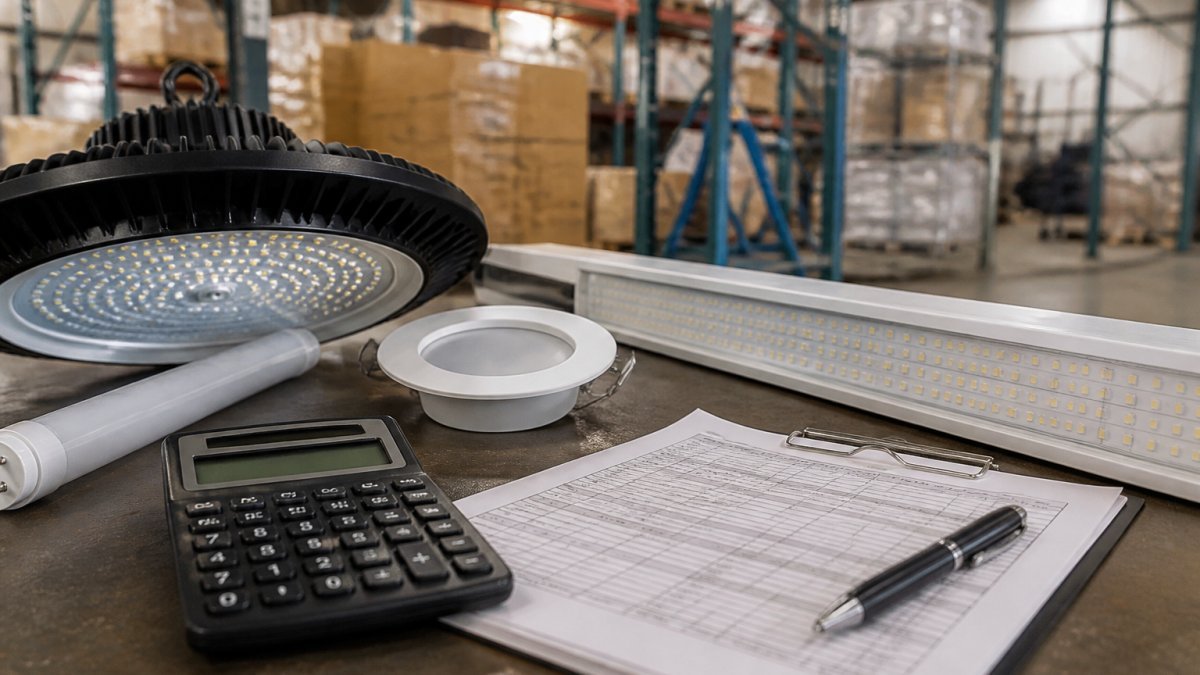
LED fixture prices vary by type, lumen output, and controls. Basic commercial fixtures cost less than specialized high-bay fixtures for 40-foot ceilings. Fixture costs typically represent 40-50% of total project cost before labor.
High-bay fixtures cost more due to higher lumen output and temperature tolerance requirements. A 15,000-lumen fixture with occupancy sensors costs more than a basic 5,000-lumen replacement, but operational savings justify the difference.
Fixture quality affects long-term maintenance. Quality fixtures rated 50,000+ hours require fewer replacements than cheaper 25,000-hour fixtures, reducing hidden maintenance costs.
Professional Installation Labor
Labor costs depend on fixture quantity, height/accessibility, and electrical system complexity.
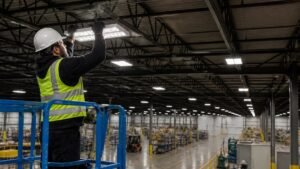
Licensed electricians are required for commercial installations. Work includes disconnecting old fixtures, running wiring, mounting new fixtures, configuring controls, and testing.
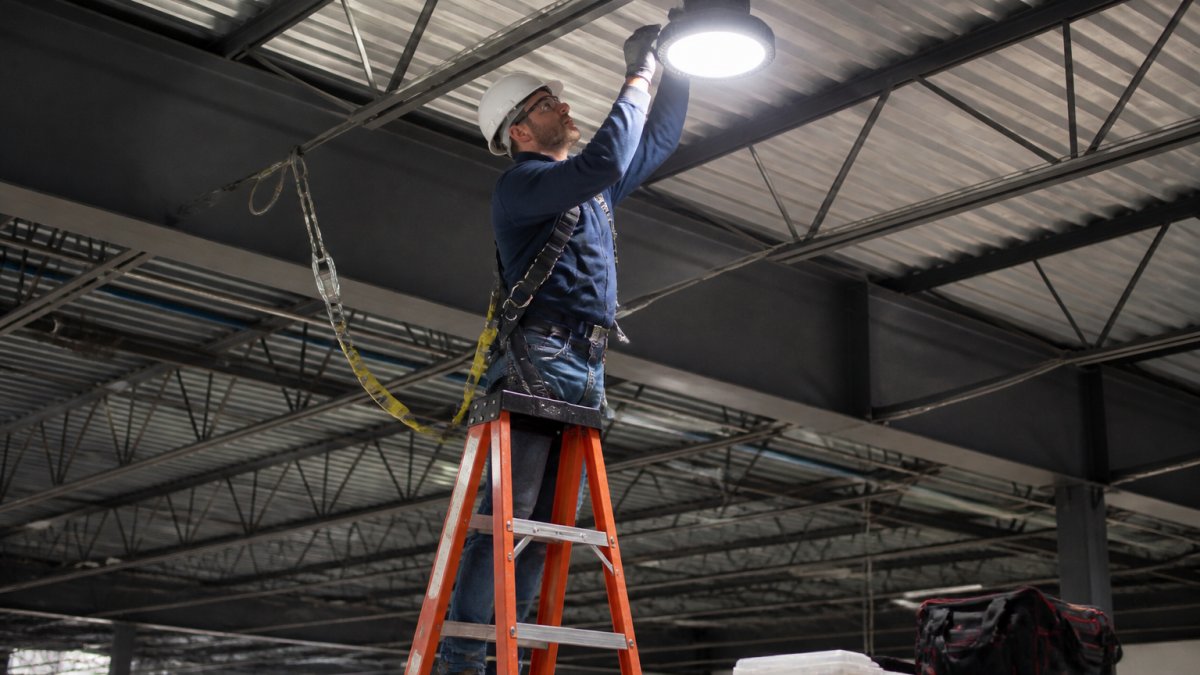
Accessibility is the cost driver. Ground-level fixtures cost less than high-bay fixtures requiring lifts and harnesses. 24/7 facilities incur higher labor costs due to off-hours or shutdown coordination.
DIY vs. Professional Installation Cost Comparison
Professional installation guarantees code compliance, proper wiring, and warranty coverage. DIY installations risk fire hazards, code violations, and insurance gaps.
DIY works only for small retail with accessible fixtures or simple 1-to-1 replacements. Most jurisdictions require licensed electrician sign-off for commercial work.
Professional installation completes in days versus weeks of owner work, minimizing operational disruption.
Energy Efficiency and Long-Term Operational Savings
The real value of an LED lighting upgrade cost isn’t what you pay upfront, it’s what you stop paying in energy bills and maintenance over the next decade.
Kilowatt-Hour Consumption and Monthly Energy Bills
LED fixtures consume 75-85% less energy than incandescent or fluorescent equivalents (Saving American Families and Businesses Money through Lighting Efficiency). A 400-watt metal halide fixture replaces with 120-150 watt LED, saving 2,500-3,000 kilowatt-hours annually per fixture.
A 100-fixture warehouse retrofit saves 250,000-300,000 kilowatt-hours annually. At $0.12/kWh, that’s $30,000-36,000 in annual savings.
Energy savings are predictable and measurable, fewer watts in means fewer kilowatt-hours on the meter. You can model and verify savings.
Smart controls amplify savings: occupancy sensors, daylight harvesting, and dimming controls increase energy savings by 15-30% beyond LED fixtures alone, though they add upfront cost.
Maintenance Cost Reduction and Fixture Lifespan
Traditional fixtures last 10,000-20,000 hours (2-5 years in 24/7 facilities). LED fixtures rated 50,000+ hours last 12-15+ years.
Longer lifespan reduces replacement cycles, labor costs, downtime, safety risks, and waste.
Maintenance cost reduction is substantial but often invisible in ROI.
LED fixtures generate less heat and require no ballast maintenance. Traditional fixtures need ballast replacement every 5-7 years.
Commercial LED Lighting Rebate Programs and Tax Incentives
Most commercial LED retrofits qualify for utility rebates and federal tax incentives, dramatically reducing out-of-pocket LED lighting upgrade cost.
Federal and State Tax Credits
Federal tax incentives under Section 179D allow commercial property owners to deduct energy efficiency improvements, reducing taxable income (Energy efficient commercial buildings deduction). Specifics change annually.
A $50,000 LED retrofit might deduct $8,000-12,000, reducing tax liability immediately.
State incentives vary and change annually. Work with accountants or energy consultants to identify available credits and depreciation schedules.
Federal, state, and utility incentives change constantly. Consult your utility or an energy consultant to identify what applies to your project.
Utility Company Rebate Coordination
Most utilities offer $100-200 per fixture rebates for commercial LED retrofits, reducing out-of-pocket cost dollar-for-dollar.
A 100-fixture retrofit could receive $10,000-20,000 in utility rebates (20-40% of project cost).
Rebate programs require fixtures meeting efficiency standards, licensed contractor installation, and documentation submission.
Rebate coordination requires identifying programs, ensuring compliance, submitting documentation, and tracking status.
LED Retrofit ROI Calculation and Payback Period
ROI is compelling: upfront cost minus rebates, divided by annual energy savings, gives payback period. After that, savings are pure profit.
Get a Free Property Assessment →
Step-by-Step ROI Calculator
ROI calculation:
- Total project cost = Fixtures + labor + electrical work
- Net cost = Total cost − (utility rebates + tax incentives)
- Annual energy savings = (Old wattage − new wattage) × fixtures × operating hours × $/kWh
- Annual maintenance savings = (Replacement cost + labor) × (frequency reduction)
- Total annual savings = Energy savings + maintenance savings
- Payback period = Net cost ÷ Total annual savings
Example: 100-fixture retrofit costs $50,000; rebates cover $15,000; net cost $35,000. Annual savings: 250,000 kWh at $0.12/kWh ($30,000) + $2,000 maintenance = $32,000 total.
After 1.09 years, savings are pure profit. Over 12 years, you recover your investment 11 times.
Variables affecting payback: electricity rate, operating hours, fixture wattage, and labor costs. High-rate, long-hours facilities see faster payback.
Typical Payback Timelines for Industrial and Commercial Facilities
Typical payback periods: 24/7 warehouses 1-2 years; retail 2-3 years; offices 3-4 years. Rebates accelerate payback to 1-2 years.
Adding occupancy sensors, daylight harvesting, or smart controls reduces payback to 6-12 months by increasing annual savings 15-30%.
Hidden Costs and Factors That Affect Total Upgrade Cost
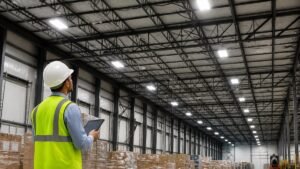
This is where most facility managers underestimate their LED lighting upgrade cost. The fixtures and labor are obvious. The hidden costs surprise you mid-project.
Electrical Work and Infrastructure Updates
Existing electrical infrastructure may need upgrades. Older buildings often require wiring, breaker, or panel work before LED installation.
Common issues: undersized conduit, outdated breaker panels, or non-code wiring. These add cost and timeline.
Modern facilities need minimal work; older buildings may require panel upgrades, conduit replacement, or rewiring. These costs emerge during pre-installation assessment.
This is why a professional assessment matters. An electrician can identify infrastructure issues before work starts, giving you accurate total cost estimates. DIY planning often misses these issues until installation is underway.
Smart Controls, Occupancy Sensors, and Integration Costs
Smart controls, occupancy sensors, daylight harvesting, dimming controls, networked monitoring, add cost but multiply energy savings.
For a 100-fixture retrofit, adding occupancy sensors costs $5,000-10,000. Adding networked controls costs $20,000-30,000.
The decision depends on your operating profile. A warehouse with variable occupancy benefits from occupancy sensors.
Integration costs also matter. Smart controls need to communicate with your building management system or a cloud platform.
Disposal and Recycling Costs for Old Fixtures
Your old fixtures need to go somewhere. Disposal isn’t free, and improper disposal creates environmental and liability issues.
Old fluorescent fixtures contain mercury (the EPA). Proper disposal requires licensed hazardous waste handling. Improper disposal is illegal. Costs for professional disposal typically run $5-15 per fixture, depending on fixture type and quantity. For a 100-fixture retrofit, that’s $500-1,500 in disposal costs.
Metal halide and other high-intensity discharge fixtures contain mercury as well. Same disposal requirements. Same costs.
Some recyclers accept fixtures for free if they can recover valuable materials.
The point: factor disposal into your total cost. It’s not huge, but it’s real.
Residential vs. Commercial Lighting Requirements and Cost Differences
The LED lighting upgrade cost for a residential space differs fundamentally from commercial retrofits.
The economics differ too. Residential retrofits rarely qualify for utility rebates or tax incentives.
Your LED lighting upgrade cost isn’t just the price tag on fixtures and installation.
NexVolt Energy Group specializes in turning that math into reality.
| Cost Component | Typical Range | Notes |
|---|---|---|
| LED Fixtures (per unit) | $100-300 | Varies by type and lumen output |
| Installation Labor (per fixture) | $50-150 | Depends on height and accessibility |
| Electrical Work | $2,000-10,000 | Infrastructure upgrades if needed |
| Occupancy Sensors (per fixture) | $50-100 | Optional but increases savings |
| Disposal/Recycling | $5-15 per fixture | Hazardous waste handling required |
| Utility Rebates | 20-40% of cost | Reduces net out-of-pocket expense |
| Typical Payback Period | 1-3 years | Varies by operating hours and rates |
Frequently Asked Questions
How much can I save by switching to LED lights?
Savings depend on your current fixture type, facility size, and operating hours. LED lighting upgrade cost reductions typically come from lower kilowatt-hour consumption (LEDs use 75-80% less energy than incandescent bulbs) and dramatically reduced maintenance costs due to longer fixture lifespan. Commercial facilities often see 30-50% reductions in energy bills. Combined with utility rebates and tax incentives, total savings over 5-10 years frequently exceed initial capital expenditure. Your actual savings require a property assessment to calculate baseline energy consumption and project ROI.
What factors influence the total cost of a commercial LED lighting upgrade?
Key factors include fixture type and quantity, installation complexity (ceiling height, electrical infrastructure), labor costs, smart controls and occupancy sensors, utility rebates available, and any required electrical work. High-bay warehouse installations cost more than retail spaces due to specialized equipment and safety requirements. Existing wiring condition, voltage compatibility, and ballast bypass needs also affect pricing. Professional assessment identifies all cost drivers specific to your facility.
How do utility rebates impact the net cost of an LED retrofit?
Utility company rebate programs can offset 20-40% of material and installation costs, significantly reducing your net capital expenditure. Rebates vary by region and utility provider. Many programs require professional installation and specific fixture specifications. NexVolt Energy Group handles rebate program coordination, managing applications and documentation so you don’t navigate the process alone. After rebates and tax incentives, many commercial facilities achieve LED retrofits with little to no upfront cost, recovering the remaining investment through operational savings within 2-4 years.
What is the typical payback period for industrial LED lighting projects?
Payback periods typically range from 2-5 years for industrial facilities, depending on operating hours, energy rates, and rebate availability. Facilities running 24/7 (like distribution centers and warehouses) see faster payback due to higher kilowatt-hour savings. After payback, the remaining 15-20+ years of fixture lifespan generates pure operational savings. ROI calculations must account for maintenance cost reduction, since LED fixtures require less frequent replacement and have lower total cost of ownership than legacy systems.
Are there federal or state tax incentives for commercial LED upgrades?
Yes. The federal Energy Tax Credit (Section 179D) allows businesses to deduct costs for commercial building energy-efficient property improvements, including LED retrofits. Specific incentive amounts and eligibility depend on energy efficiency ratings and compliance with current standards. State and local programs vary; some jurisdictions offer additional tax credits or accelerated depreciation schedules. Professional energy consultants verify your project’s eligibility and ensure proper documentation for IRS compliance. Combined with utility rebates, tax incentives substantially reduce net upgrade cost.
How do smart controls and occupancy sensors affect installation costs?
Smart lighting controls and occupancy sensors add upfront material and installation costs but accelerate ROI by reducing energy consumption further. Occupancy sensors eliminate wasted kilowatt-hours in spaces used intermittently (like meeting rooms, parking garages, and storage areas). Dimmability and smart integration enable fine-tuned illumination matched to operational needs. While these systems cost more initially, the operational expenditure savings often justify the investment within 2-3 years, especially in large facilities with variable occupancy patterns.
What are the long-term maintenance cost savings of LED lighting?
LED fixtures have significantly longer lifespan (50,000-100,000+ hours vs. 1,000-2,000 hours for incandescent) and require far fewer replacements. This reduces labor costs, replacement material expenses, and facility downtime. For 24/7 operations like warehouses and distribution centers, the maintenance cost reduction is substantial. Over a 10-year period, LED systems typically save 60-70% on maintenance expenses compared to legacy fixtures. Lower heat dissipation also reduces HVAC operational costs, adding to total savings.
Can LED retrofits be installed without shutting down my facility?
Yes, professional installation can be scheduled to minimize operational disruption. Experienced teams work in phases, section by section, allowing your facility to continue operations during upgrades. For 24/7 operations, installation can occur during lower-activity periods or in zones that don’t impact core processes. High-bay fixture replacement typically requires temporary lighting adjustments but not facility shutdown. Discuss scheduling flexibility and downtime minimization during your property assessment with NexVolt Energy Group.