Table of Contents
- What Smart Controls for Industrial Lighting Actually Do
- Lighting Control System Risks and Benefits
- Industrial LED Lighting Energy Savings: Real Numbers
- Occupancy Sensor Installation Best Practices
- Integration with Building Automation Systems
- Retrofitting Legacy Industrial Facilities
- ROI Calculation and Payback Timelines
- Cybersecurity for Connected Lighting Systems
- Frequently Asked Questions
Last Updated: September 28, 2026
What Smart Controls for Industrial Lighting Actually Do
Smart controls for industrial lighting automatically adjust brightness, color temperature, and on/off cycles based on occupancy, ambient light levels, and preset schedules. Unlike traditional fixed lighting systems, these systems respond to real-time conditions, eliminating wasted energy when spaces are unoccupied and optimizing visibility when workers need it most.
The biggest win isn’t always the technology itself, it’s the data. Once you see how much energy certain zones consume during specific hours, you can make smarter decisions about staffing, equipment placement, and maintenance scheduling.
Lighting Control System Risks and Benefits
The benefits of a modern lighting control system are straightforward: reduced energy consumption, lower maintenance costs, and improved workplace safety through consistent, optimized illumination. But the risks deserve equal attention, especially in industrial settings where reliability and cybersecurity matter.
Benefits you’ll see:
- Automatic dimming and scheduling eliminate manual adjustments
- Occupancy sensors prevent lights running in empty spaces
- Centralized management across multiple buildings from one dashboard
- Longer LED fixture lifespan due to optimized operation
- Better data on energy patterns for future planning
Risks to plan for:
- Connected systems require cybersecurity measures to prevent unauthorized access or control
- Legacy electrical infrastructure may need upgrades before installation
- Initial setup and commissioning demand skilled technicians
- Sensor calibration errors can lead to inconsistent lighting or unnecessary adjustments
- Vendor lock-in if proprietary protocols limit future upgrades
Industrial LED Lighting Energy Savings: Real Numbers
Common scenarios show different payback profiles:
High-bay warehouse with 24/7 operation: Switching from traditional metal halide or high-pressure sodium to LED with occupancy sensors and daylight harvesting typically reduces consumption by 50-70%. A 50,000-square-foot facility running 8,760 hours annually can cut annual lighting energy use significantly.
The most cost-effective retrofits target the spaces with the highest baseline consumption and longest operating hours. A 24/7 warehouse saves more than a part-time retail space, even if both install identical systems.
Occupancy Sensor Installation Best Practices
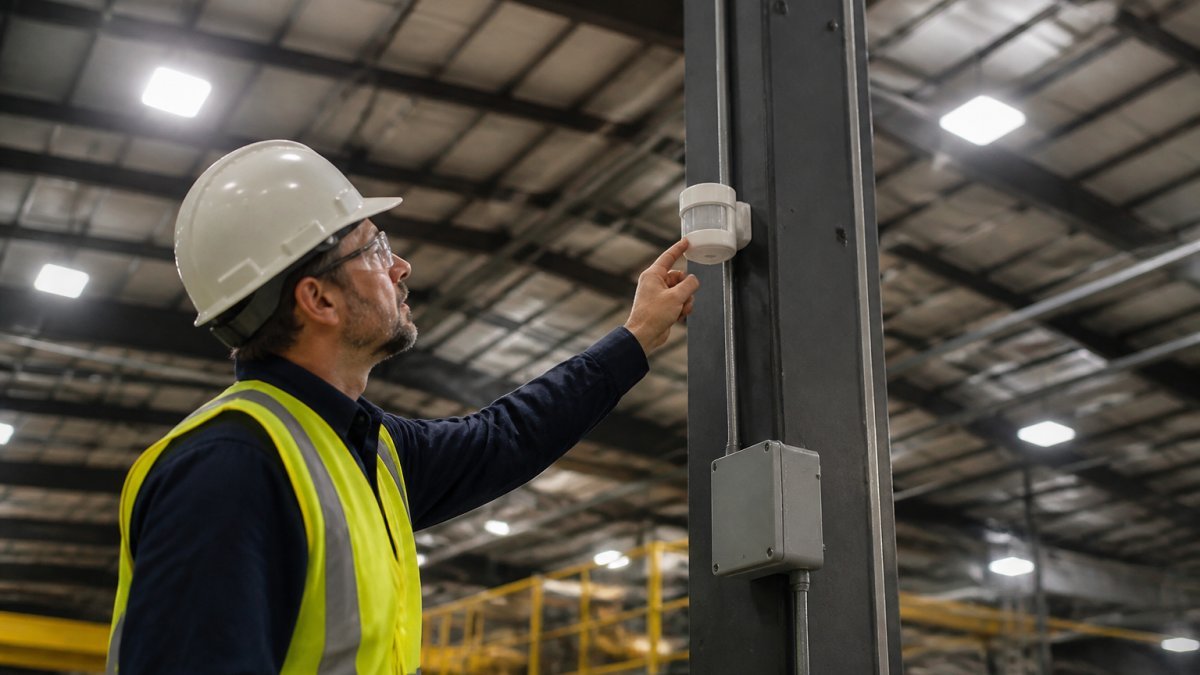
Occupancy sensor placement determines whether your system works or fails. Sensors positioned incorrectly will miss motion or trigger false activations, leading to frustration and manual overrides that defeat the entire purpose.
Installation fundamentals:
-
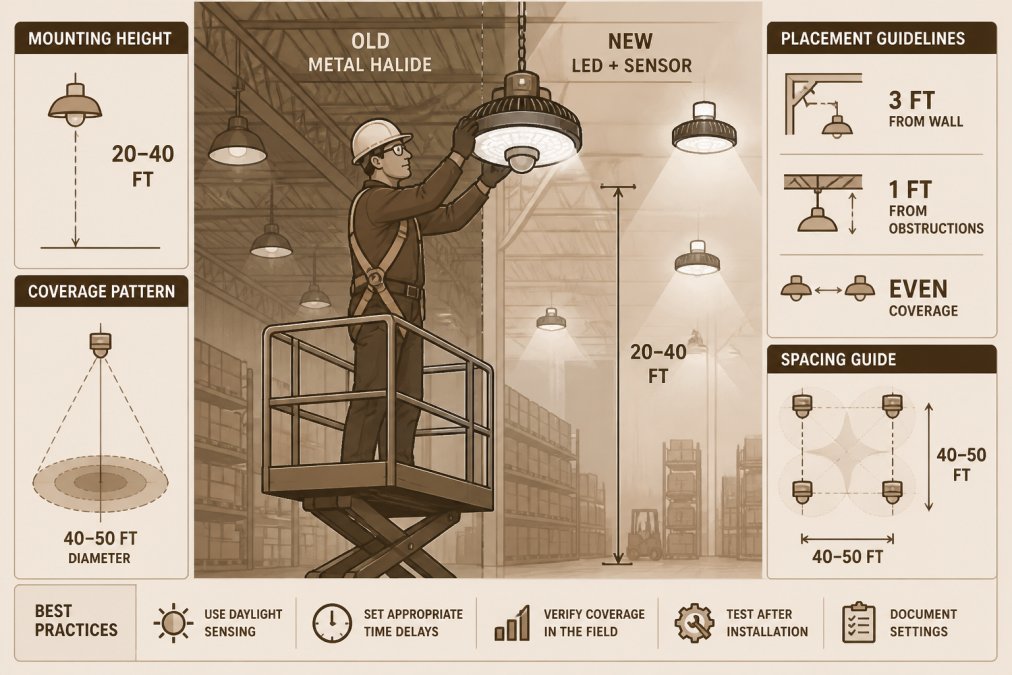
Mount sensors in high-traffic zones at 6-10 feet height. This captures motion across the entire space without being blocked by equipment or inventory.
-
Avoid mounting directly above workstations. Overhead placement misses lateral motion and creates blind spots. Position sensors to cover the space they’re meant to monitor, not the equipment in it.
-
Account for fixture-integrated versus standalone sensors. Fixture-integrated sensors live inside LED fixtures and monitor only the immediate area. Standalone sensors cover larger zones and work better for open spaces. Warehouses typically need both: fixture sensors for localized control and standalone sensors for zone-level coordination.
-
Test coverage before final commissioning. Walk the space during low-light conditions and verify that movement triggers the lights. Check that the off-delay (time before lights turn off after motion stops) matches your workflow. A 5-minute off-delay works for quick passes; a 15-minute delay suits areas where workers pause frequently.
-
Set sensitivity thresholds appropriately. Too sensitive triggers on minor air movement; too insensitive misses slow motion. Industrial spaces often benefit from slightly higher sensitivity than offices because motion patterns are less predictable.
-
Plan for maintenance access. Sensors need occasional cleaning and recalibration. Mount them where technicians can reach them safely without needing lifts or scaffolding for every maintenance visit.
Integration with Building Automation Systems
Connecting your smart controls for industrial lighting to a broader building automation system (BAS) multiplies the value. Instead of lighting operating in isolation, it coordinates with HVAC, security, energy management, and maintenance systems.
A BAS integration allows:
- Load shedding during peak demand periods. When energy demand spikes, the system can dim non-critical lighting to reduce strain on the electrical system and lower demand charges.
- Occupancy-driven HVAC adjustments. If occupancy sensors show a zone is empty, the BAS can reduce heating or cooling to that area simultaneously.
- Preventative maintenance scheduling. The system logs fixture operating hours and LED lumen maintenance data, alerting maintenance teams when fixtures are approaching end-of-life before failure occurs.
- Energy code compliance reporting. Many jurisdictions now require energy tracking and reporting. A BAS automatically collects the data needed for compliance documentation.
Integrating systems without planning the data flow creates maintenance headaches. A lighting system that can’t report its status to the BAS leaves facility managers flying blind. Verify integration capability during the assessment phase, not after installation.
Retrofitting Legacy Industrial Facilities
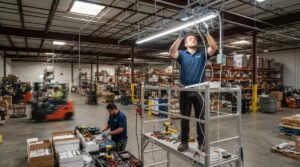
Legacy industrial buildings present unique challenges: high ceilings (often 30+ feet), aging electrical infrastructure, and equipment that can’t tolerate downtime. Retrofitting requires a different approach than new construction.
ROI Calculation and Payback Timelines
ROI isn’t just about energy savings. It includes reduced maintenance labor, avoided downtime from fixture failures, and improved productivity from better lighting conditions.
The basic calculation:
- Annual energy savings (kWh reduction × utility rate)
- Annual maintenance savings (fewer bulb replacements, reduced service calls)
- Minus annual system maintenance and monitoring costs
- Divided by total project cost = payback period
Variables that shift the timeline:
Get a Free Property Assessment →
- Baseline energy costs (higher rates = faster payback)
- Operating hours (24/7 facilities see faster returns than part-time operations)
- Rebate availability (utility rebates can reduce effective project cost by 25-40%)
- Maintenance labor costs (facilities with dedicated maintenance staff see larger maintenance savings)
- Retrofit scope (full facility retrofits achieve better per-fixture costs than partial upgrades)
Don’t calculate ROI on energy savings alone. Include maintenance labor, avoided downtime costs, and improved safety. The true payback is often 2-3 years faster than energy-only projections suggest.
Cybersecurity for Connected Lighting Systems
A connected lighting system is an entry point to your facility’s network. If compromised, an attacker could dim lights during a break-in, disable security lighting, or pivot into other building systems. This isn’t theoretical, industrial facilities have experienced exactly this.
Essential security measures:
-
Isolate the lighting network. The smart controls system should operate on a separate network segment from critical operations. A compromised lighting system shouldn’t provide access to production equipment or administrative systems.
-
Require authentication for remote access. Dashboard logins should demand strong passwords and multi-factor authentication. API connections to third-party systems should use encrypted tokens, not shared credentials.
-
Encrypt wireless communications. Mesh networks must use WPA3 encryption (or equivalent) to prevent eavesdropping or spoofing. Older systems using unencrypted protocols create vulnerabilities.
-
Plan for firmware updates. Sensors and controllers need regular security patches. A system vendor that doesn’t commit to updates for 5+ years is a liability. Verify the update process, can it be done remotely or does it require physical access to every device?
-
Monitor for anomalies. The BAS or lighting dashboard should log all changes: who adjusted what, when, and from where. Unusual patterns (lights dimming at 3 AM, repeated failed login attempts) signal potential compromise.
-
Disable unnecessary features. If you don’t need remote access, don’t enable it. If sensors don’t need to communicate with the cloud, configure them for local-only operation. Reducing the attack surface is the simplest security measure.
U.S. Department of Energy guidance on industrial lighting efficiency
ASHRAE standards for lighting control and energy management
NFPA electrical code requirements for industrial facilities
Frequently Asked Questions
What are the primary benefits of smart controls for industrial lighting?
Smart controls for industrial lighting reduce energy consumption by 30-50% through automated scheduling, occupancy sensors, and daylight harvesting. They lower maintenance costs by tracking fixture health and enabling predictive maintenance. Facilities also gain real-time visibility into power consumption, improve workplace safety through consistent illumination, and extend LED fixture lifespan. Integration with building automation systems centralizes facility management and simplifies compliance with energy codes.
How do occupancy sensors improve energy efficiency in warehouses?
Occupancy sensors detect movement and automatically adjust lighting levels or turn fixtures off when spaces are unoccupied. In warehouses with variable activity patterns, loading docks, storage aisles, break areas, this prevents lights running at full capacity during idle periods. Combined with daylight harvesting in naturally lit zones, occupancy sensors can reduce lighting energy use by 20-40% without affecting safety or productivity. Fixture-integrated sensors eliminate installation complexity in high-bay environments.
What are the common risks associated with industrial lighting control systems?
Key risks include cybersecurity vulnerabilities in cloud-connected systems, compatibility issues when retrofitting legacy infrastructure, and commissioning errors that reduce efficiency gains. Network disruptions can affect remote access and automated scheduling. Poorly designed zoning may create dark spots or over-lit areas, impacting worker safety and productivity. Vendor lock-in with proprietary dimming protocols (0-10V, DALI) can complicate future upgrades. Addressing these requires careful system design, regular security audits, and professional installation and commissioning.
How long does it typically take to see ROI from smart industrial lighting upgrades?
Most facilities see positive ROI within 3-5 years through energy savings alone. Payback accelerates with utility rebates. A warehouse reducing energy consumption and maintenance costs may achieve payback in 2-3 years. ROI depends on baseline consumption, local utility rates, operating hours, facility size, and rebate availability. Turnkey providers who manage rebate coordination significantly reduce project costs, improving payback timelines.
Can smart lighting controls work with older building electrical systems?
Yes, but retrofitting legacy infrastructure requires careful assessment. Modern LED drivers and wireless mesh networking reduce wiring complexity compared to hardwired 0-10V or DALI systems. Existing high-bay fixtures can often be retrofitted with fixture-integrated sensors and compatible drivers. However, older electrical panels may need upgrades to handle new loads or communication protocols. A comprehensive property assessment identifies compatibility issues and retrofit costs before installation begins, ensuring no surprises during the project.
What cybersecurity measures protect connected lighting systems?
Secure smart lighting systems use encrypted communication protocols, regular firmware updates, and role-based access controls for remote management. Edge applications that process data locally reduce reliance on cloud connectivity and limit exposure. Network segmentation isolates lighting controls from critical facility systems. Choose vendors who conduct security audits, provide transparent update schedules, and support multi-factor authentication. For facilities handling sensitive operations, on-premise control options offer additional protection versus fully cloud-dependent systems.
How does daylight harvesting work in industrial facilities?
Daylight harvesting uses ambient light sensors to measure natural light levels and automatically reduce or dim artificial lighting proportionally. In warehouse zones near windows or skylights, this can cut lighting energy use by 20-30% on sunny days. The system maintains consistent illumination levels (lumen maintenance) regardless of time of day or weather. Fixture-integrated sensors simplify installation in high-ceiling environments where external sensors are difficult to maintain. This is especially effective in facilities with regular daytime operations and significant window exposure.
What makes wireless mesh networking better than wired control systems for industrial lighting?
Wireless mesh networking reduces installation time and cost by eliminating extensive wiring through high-bay spaces. It scales easily, adding new fixtures or zones requires no rewiring. Mesh networks self-heal when nodes fail, ensuring reliability in facilities running 24/7. However, wired systems like DALI offer deterministic performance and are immune to radio interference. Many modern installations use hybrid approaches: wireless for occupancy sensors and scheduling, wired for critical load-shedding functions. The choice depends on facility layout, uptime requirements, and existing infrastructure.