Table of Contents
- Why Facility Managers Switch From Pearl Street Systems
- Comparison Table: Pearl Street Systems vs. Leading Alternatives
- NexVolt Energy Group: Turnkey LED Upgrades With Full Rebate Support
- Commercial LED Lighting Contractors: What to Expect From Full-Service Partners
- Utility Rebate Coordination Services: Removing the Administrative Burden
- Warehouse Lighting Upgrade Cost: Breaking Down Investment and ROI
- How to Choose the Right Alternative for Your Facility
- Frequently Asked Questions
Last Updated: September 23, 2026
Why Facility Managers Switch From Pearl Street Systems
Facility managers often discover that Pearl Street Systems feels transactional rather than collaborative, the real friction point is administrative overhead.
Pearl Street Systems alternatives exist because facility managers tire of juggling rebate paperwork, coordinating multiple vendors, and managing projects without accountability, time spent on compliance and coordination is time lost to operations.
Facility managers shift to alternatives when they realize turnkey solutions handle rebates and installation as one service, specialized contractors deliver better industrial results, and upfront assessment matters more than vendor brand.
NexVolt Energy Group manages the entire process from property assessment through rebate verification and professional installation, eliminating the integration work facility managers typically handle themselves.
Comparison Table: Pearl Street Systems vs. Leading Alternatives
| Factor | Pearl Street Systems | Full-Service LED Contractor | Equipment Supplier | Engineering Firm |
|---|---|---|---|---|
| Turnkey Project Management | Limited | Full service | Partial | No |
| Rebate Coordination | Self-service | Full assistance | Not included | Not included |
| Industrial Lighting Expertise | General | Specialized | Specialized | Engineering-focused |
| Installation Services | Partner network | In-house | No | No |
| Smart Controls Integration | Basic | Advanced | Available | Advanced |
| BMS Integration Support | Limited | Full | Minimal | Full |
| Best For | Mid-market facilities | Warehouses & industrial | Contractors & designers | Large infrastructure projects |
Building Management System Integration: The Hidden Complexity
The most critical difference between Pearl Street Systems alternatives is integration compatibility with your existing building management system (BMS), where facility managers encounter the largest hidden costs.
Most commercial facilities operate a building management system (Johnson Controls, Honeywell, Siemens, Automated Logic, or proprietary) controlling HVAC, electrical distribution, security, and lighting. New lighting controls must integrate with your existing BMS or operate independently without conflicts.
Integration complexity depends on your BMS architecture:
BACnet Protocol Integration: BACnet-based systems allow direct integration, enabling your BMS to monitor energy consumption and occupancy from a single interface. Many contractors claim compatibility but lack expertise to configure it properly, resulting in partial integration or failed data exchange.
Modbus/TCP Integration: Legacy Modbus systems require protocol translation devices or custom middleware, adding cost and creating failure points if not properly configured.
Standalone System with Manual Coordination: Non-integrated systems require separate monitoring interfaces, fragmenting operations and complicating troubleshooting across two systems.
Proprietary System Lock-in: Proprietary protocols prevent integration with standard BMS platforms, creating vendor lock-in for future upgrades and repairs.
Full-service LED contractors understand integration requirements and design systems compatible with existing infrastructure. Equipment suppliers typically cannot, making integration capability a primary evaluation criterion.
Ask alternatives specifically: “How does your control system integrate with [your BMS brand]? What protocol? Who configures integration? What if it fails during commissioning?” Specific answers indicate true understanding; generic “compatibility” claims signal future problems.
NexVolt Energy Group: Turnkey LED Upgrades With Full Rebate Support
NexVolt Energy Group handles Pearl Street Systems alternatives by combining comprehensive facility assessment, utility rebate coordination, and professional installation with smart controls integration.
The turnkey model eliminates administrative burden: one team manages the entire workflow from assessment through rebate verification, removing the need to coordinate between suppliers, electricians, and integrators.
For warehouse and industrial facilities, this approach delivers measurable advantages. High-bay retrofits require specialized knowledge about fixture mounting, thermal management, and electrical integration, expertise NexVolt brings directly rather than through subcontractors.
Rebate coordination matters significantly: utility programs vary by region and facility type. NexVolt manages technical documentation, compliance, and timelines, eliminating rejection risk from incomplete data or missing specifications.
Commercial LED Lighting Contractors: What to Expect From Full-Service Partners
A full-service commercial LED lighting contractor handles the entire installation process, not just the equipment supply. This distinction separates true alternatives to Pearl Street Systems from basic suppliers.
When you work with a full-service contractor, the assessment phase determines everything that follows. The contractor evaluates your facility’s current lighting performance, electrical capacity, mounting infrastructure, and operational requirements. They then design a system that meets your specific needs rather than offering a standardized package.
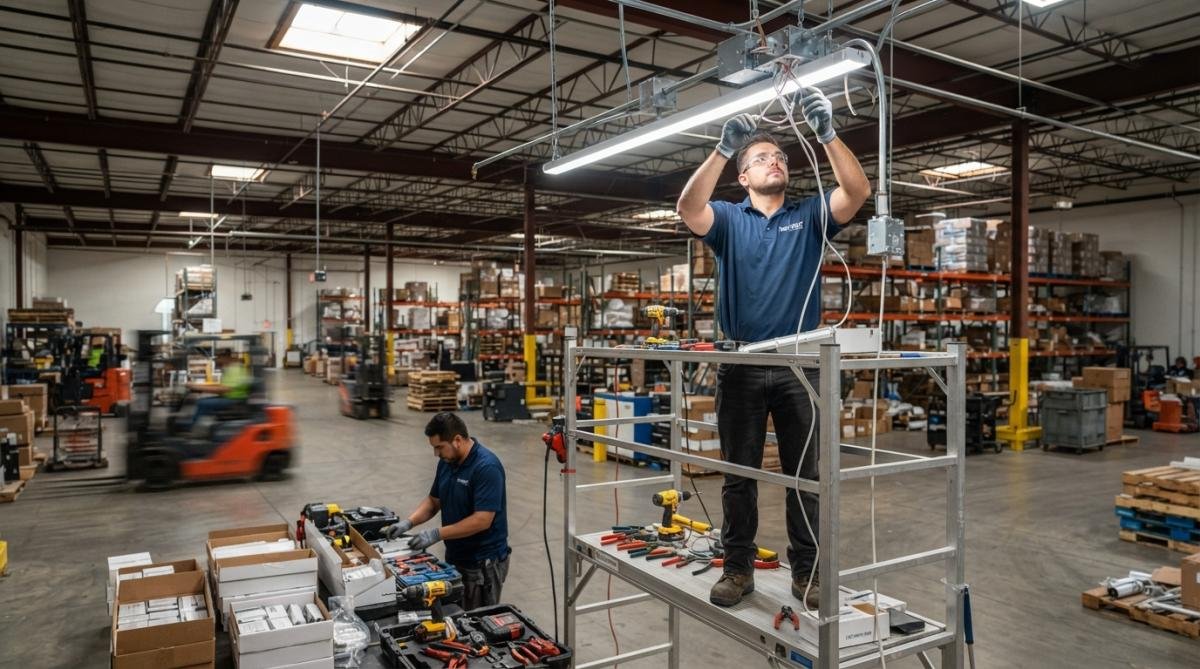
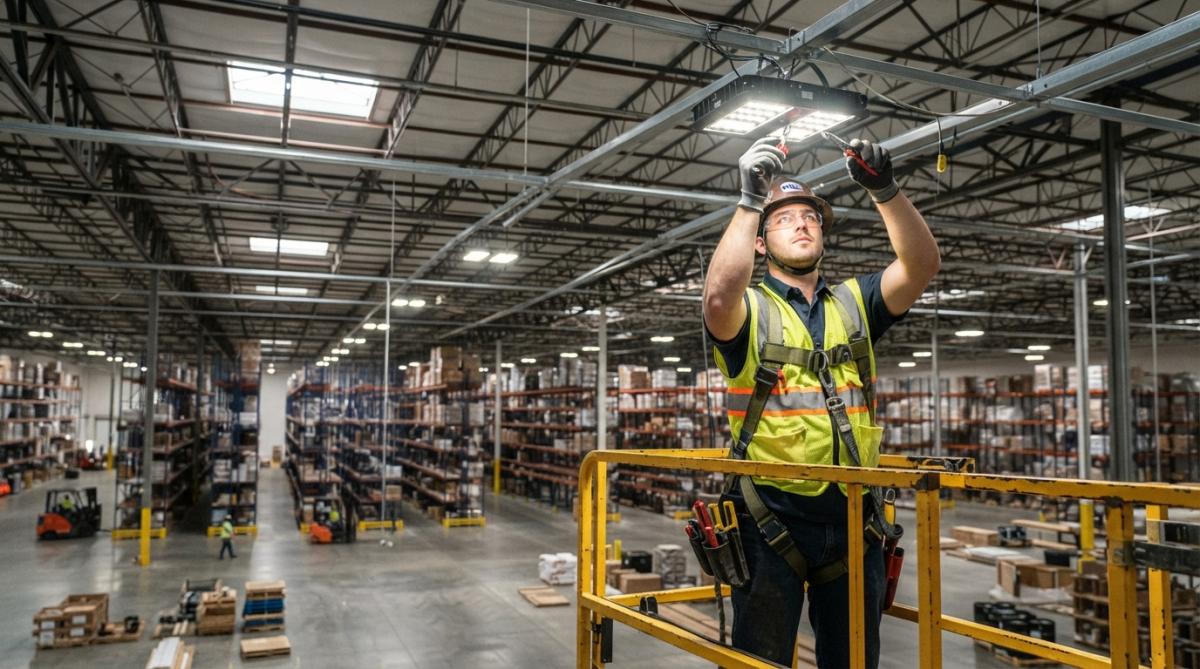
Installation in industrial settings requires safety certifications, equipment for high-work access, and coordination with your operational schedule. A facility running 24/7 cannot simply shut down for installation. Professional contractors build installation plans that work around your production schedule, often working night shifts or coordinated downtime windows.
Post-installation support matters more than most facility managers realize. Smart controls require configuration and testing. Occupancy sensors need calibration. Integration with your existing building management systems requires technical troubleshooting. Full-service partners provide this support as part of the engagement rather than handing off the project once installation completes.
The difference between a supplier and a contractor becomes clear when something needs adjustment. A contractor understands your facility and can modify settings, troubleshoot integration issues, and optimize performance over the first months of operation. A supplier hands you a box of equipment and a manual.
Get a Free Property Assessment →
Utility Rebate Coordination Services: Removing the Administrative Burden
Utility rebate coordination services exist because the rebate application process creates a barrier that prevents many facility managers from upgrading their lighting systems. The barrier isn’t just administrative, it’s technical and regionally fragmented.
Most utilities offer significant rebates for commercial LED retrofits, but applications require detailed technical documentation that varies by program. Most utilities offer significant rebates for commercial LED retrofits, but applications require detailed technical documentation that varies by program. A facility in one region might submit photometric analysis and equipment cut sheets; another region requires energy modeling software output, baseline consumption verification, and post-installation commissioning reports.
Common documentation requirements include:
Photometric Analysis: Detailed lighting performance data showing illumination levels (measured in foot-candles) across the facility before and after retrofit. Utilities require this to verify that LED upgrades maintain or improve lighting quality while reducing energy consumption.
Equipment Specifications: Manufacturer datasheets for every fixture type, ballast, control module, and sensor. Utilities cross-reference these against their approved equipment lists.
Energy Consumption Baseline: Documented current energy usage for the lighting system, typically derived from utility bills, sub-metered data, or engineering calculations. Utilities use this baseline to calculate projected savings and rebate eligibility.
Installation Documentation: Photographs of completed work, equipment serial numbers, installation dates, and labor certifications. Some utilities require licensed electrician sign-off on installations. Others require third-party commissioning verification.
Compliance Verification: Proof that the installation meets local electrical codes, utility interconnection standards, and any local energy code amendments. This is where regional variation becomes critical, energy codes vary significantly by state and municipality.
Regional variation creates complexity that facility managers often underestimate. A rebate application that works in one state fails in another because the control configuration doesn’t match local code requirements.
The timeline compounds the burden. Most utilities require 30 to 60 days to review applications. If documentation is incomplete, the utility requests additional information, adding another 30 to 60 days. If the contractor used equipment not on the approved list, the entire project may need redesign. Facility managers managing this process themselves often face three to six month delays before rebate approval.
Rebate coordination services handle this workflow by maintaining current knowledge of regional utility requirements, pre-approved equipment lists, and documentation standards. They work with your contractor to gather required documentation in the format each utility expects. They submit applications with complete, compliant documentation the first time. They manage utility communications, respond to information requests within utility timelines, and track rebate approval through payment.
The financial impact is substantial. Missing a rebate due to incomplete documentation or equipment non-compliance represents significant lost incentives. Coordination services can help prevent application rejection or accelerate approval.
Warehouse Lighting Upgrade Cost: Breaking Down Investment and ROI
Understanding the investment structure for warehouse lighting upgrades removes the uncertainty that prevents many facility managers from moving forward.
A warehouse lighting upgrade involves several cost components: equipment costs for LED fixtures and controls, labor costs for installation at height, electrical infrastructure modifications if needed, and project management overhead. The total investment depends on your facility’s size, current condition, and desired performance level.
The ROI calculation matters more than the upfront cost. Warehouses typically run lighting systems 12 to 16 hours daily. Switching from older high-intensity discharge or metal halide fixtures to LED reduces energy consumption by 50 to 70 percent. Lower energy costs compound over time. A facility spending $8,000 monthly on lighting might reduce that to $3,000 to $4,000 after LED conversion.
Beyond energy savings, LED upgrades reduce maintenance costs.
How to Choose the Right Alternative for Your Facility
Selecting a Pearl Street Systems alternative requires evaluating several factors specific to your facility’s needs and constraints.
Frequently Asked Questions
What makes Pearl Street Systems alternatives different in terms of rebate handling?
Pearl Street Systems alternatives like NexVolt Energy Group handle utility rebate coordination as part of the turnkey service, managing applications, documentation, and verification on your behalf. Rather than leaving you to navigate rebate programs independently, full-service providers submit paperwork, track approvals, and ensure funds reach your account. This eliminates the administrative burden that often derails rebate projects and reduces the risk of application rejection due to incomplete documentation.
Can commercial LED lighting contractors handle high-bay installations above 30 feet?
Yes. Specialized commercial LED lighting contractors have equipment, safety certifications, and trained crews for high-bay installations at 30+ feet. They use aerial lifts, rope access, or scaffolding depending on facility layout and safety requirements. Before committing, verify that your chosen contractor holds appropriate safety certifications for work at height and carries insurance that covers high-bay projects. Request references from similar warehouse installations to confirm their experience.
How is warehouse lighting upgrade cost structured if my facility has electrical issues?
Warehouse lighting upgrade cost depends on your facility’s current electrical infrastructure. A professional assessment identifies necessary upgrades before installation begins. Reputable contractors clarify upfront whether remedial electrical work is included in the project quote or billed separately. Some offer fixed-price turnkey packages that cover pre-installation corrections; others quote electrical fixes as add-ons. Request a detailed scope of work and written estimate that separates LED installation from any electrical remediation to avoid surprises.
What ROI timeline should I expect from a commercial LED lighting upgrade?
ROI timelines vary based on facility size, current fixture age, operating hours, and local energy rates. ROI timelines vary based on facility size, current fixture age, operating hours, and local energy rates. A professional energy audit provides facility-specific projections. When utility rebates are applied, payback periods often shorten. Demand a written ROI analysis from your contractor that includes energy savings, maintenance cost reductions, and rebate amounts.