Table of Contents
- 1. Energy Efficiency and Cost Savings
- 2. LED vs HID Warehouse Lighting Comparison
- 3. Improving Warehouse Safety with Lighting
- 4. Smart Lighting Controls for Warehouses
- 5. LED Lighting Utility Rebates
- 6. Pros and Cons of LED Warehouse Lighting
- 7. Conclusion
- Frequently Asked Questions
Last Updated: September 19, 2026
1. Energy Efficiency and Cost Savings
The benefits of LED warehouse lighting start with the electricity bill. LED fixtures convert most of the power they draw into light rather than heat, so a facility gets more usable illumination from every watt. That single difference is why so many operators treat an LED upgrade as a cost-reduction project first and a lighting project second.
LED warehouse lighting is a high-efficiency illumination system that uses light-emitting diodes to deliver high lumen output at low wattage, typically paired with occupancy sensors and dimming controls to cut usage further. The practical effect is a lower connected load, fewer run-hours, and a smaller monthly utility charge.
For a facility manager, the math is straightforward. High-bay fixtures run every operating hour, and in a 24/7 distribution center those hours add up fast. Reducing wattage per fixture while maintaining foot-candle levels at the floor is the core of the savings. A common approach is to compare current fixture wattage against an LED replacement of equal or better output, then multiply the difference by operating hours.
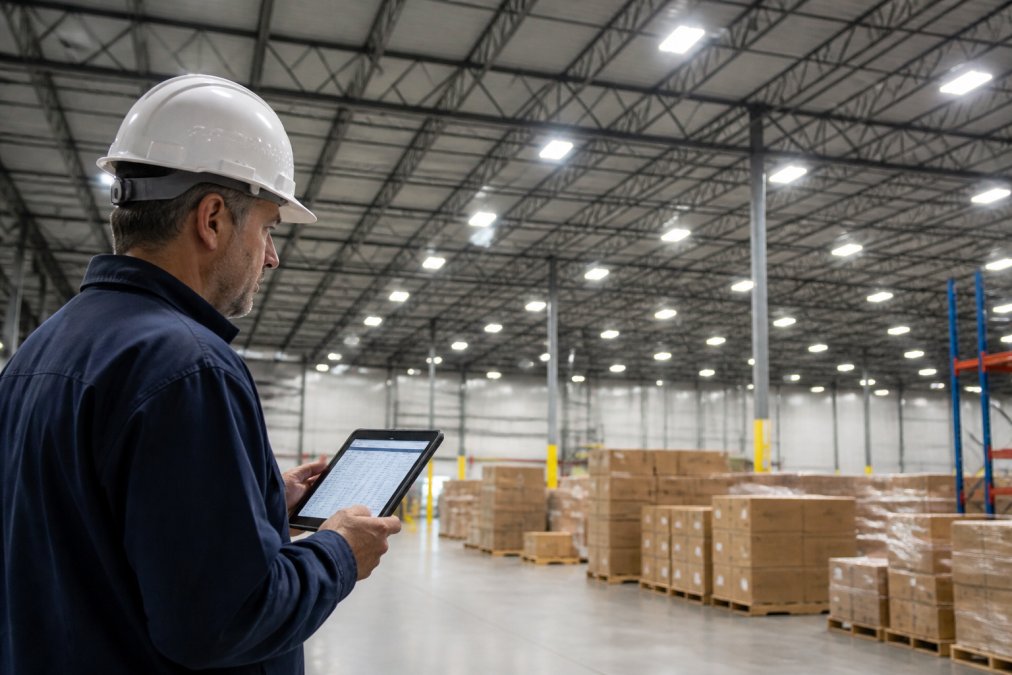
At NexVolt Energy Group, we treat the assessment as the foundation of every project. A comprehensive property assessment maps existing fixtures, mounting heights, and operating schedules before any numbers are quoted, because the savings estimate is only as good as the input data.
Measure run-hours, not just wattage. Two facilities with identical fixtures can have very different bills if one runs 4,000 hours a year and the other runs 8,000. Get the schedule right before you model savings.
2. LED vs HID Warehouse Lighting Comparison
The LED versus HID warehouse lighting comparison usually comes down to four factors: wattage per fixture, maintenance frequency, light quality, and control capability. HID systems, including metal halide and high-pressure sodium, produce light by heating gas, which wastes energy as heat and degrades output over time. LED systems produce light directly and hold their output far longer.
| Factor | HID (Metal Halide / HPS) | LED High Bay |
|---|---|---|
| Warm-up time | Several minutes to full output | Instant, flicker-free |
| Dimming | Limited or none | Full dimming and sensors |
| Light quality | Color shifts with age | Stable color temperature |
| Maintenance | Frequent lamp and ballast changes | Long service intervals |
That table hides the real story, though. The biggest operational difference is not the wattage number on the box; it is how often someone has to rent a lift and send a technician 30 feet up to change a lamp. High-bay maintenance is expensive because of access, not parts.
A common mistake is comparing fixtures on purchase price alone. The right comparison is total cost across the fixture’s life: energy, replacement lamps, labor, and lift rental. When you run that comparison, the LED retrofit usually wins on payback period even before rebates enter the picture.
3. Improving Warehouse Safety with Lighting
Improving warehouse safety with lighting is largely about uniformity and glare control, not raw brightness. A floor that is bright in one aisle and dim in the next creates the exact conditions where forklift operators misjudge distances and pedestrians get missed.
Three lighting factors drive safety outcomes:
- Uniformity: Even foot-candle levels across aisles reduce dark zones where hazards hide.
- Glare reduction: Shielded fixtures and correct beam angles keep light out of operators’ eyes.
- Color rendering index: A higher CRI makes labels, wiring colors, and safety markings easier to read.
Color temperature matters here too. Cooler light in the 4000K to 5000K range is common in industrial settings because it supports alertness, while warmer light can suit inspection areas where color accuracy is critical. The right choice depends on the task, not on a default setting.
Skipping a photometric analysis is the fastest way to buy the wrong fixtures. Without it, you can end up with bright spots, dark aisles, and glare complaints that no amount of dimming will fix.
4. Smart Lighting Controls for Warehouses
Smart lighting controls for warehouses turn a static fixture into an adjustable system. Occupancy sensors, daylight harvesting, and dimming controls let a facility match light output to actual activity instead of running every fixture at full power around the clock.
The savings come from three behaviors:
- Occupancy sensing: Fixtures dim or switch off in unoccupied aisles and return to full output when motion is detected.
- Scheduling: Zones follow shift patterns, so lighting tracks the operating schedule automatically.
- Daylight harvesting: Fixtures near skylights or windows reduce output when natural light is sufficient.
Integration with building management systems takes this further. When lighting ties into a central platform, facility teams can monitor energy use, set zone schedules, and pull reports without walking the floor. That data feeds directly into the ROI calculation, because you can see actual run-hours instead of estimating them.
The thing nobody tells you about controls is that commissioning matters more than the hardware. A sensor aimed at the wrong zone or a schedule set to the wrong shift will erase the savings you paid for. Budget time for setup and verification, not just installation.
5. LED Lighting Utility Rebates
LED lighting utility rebates are incentive payments from utilities and program administrators that offset part of the cost of an efficiency upgrade. They exist because reducing demand helps utilities avoid building new capacity, and they can meaningfully shorten the payback period on a qualifying project.
Get a Free Property Assessment →
Rebate programs vary widely by utility and by the efficiency measures installed. Common structures include per-fixture rebates, per-watt-saved rebates, and custom incentives for larger projects. Because the terms change, the only reliable move is to confirm current eligibility and amounts directly with the utility or the program administrator before you commit to a scope of work. Database of State Incentives for Renewables & Efficiency catalogs many of these programs and is a useful starting point.
The paperwork is where most projects stall. Documentation requirements typically include fixture specifications, quantities, installation dates, and sometimes post-installation verification. Missing a single form can delay or void a payment.
Rebate coordination is a project-management job, not a filing task. Someone has to track deadlines, gather specs, and follow up with the utility. Assign that owner before installation starts, not after.
NexVolt Energy Group handles utility rebate coordination as part of its turnkey approach, managing the documentation from assessment through verification so facility teams are not left chasing forms after the work is done.
6. Pros and Cons of LED Warehouse Lighting
The pros and cons of LED warehouse lighting are worth weighing honestly, because the technology is not automatically the right answer for every building.
Pros:
- Lower energy consumption and reduced operational costs
- Longer lifespan with fewer maintenance cycles and less lift access
- Better light quality, uniformity, and glare control
- Instant, flicker-free output with full dimming and sensor compatibility
- Smaller carbon footprint and support for sustainability reporting
Cons:
- Higher upfront fixture cost than replacing an old lamp
- Retrofit design work and photometric analysis add project time
- Older buildings may need electrical repairs before installation can proceed
- Controls require commissioning and occasional adjustment
That last point on electrical readiness is a real one. If an assessment uncovers wiring or panel issues, that work has to be scoped and priced separately, and it is better to know that before installation day than during it.
Facilities running long shifts or 24/7 operations, where accumulated run-hours make the payback period shortest and the maintenance savings largest.
7. Conclusion
The case for upgrading is strong, but the outcome depends on execution. Facilities that skip the assessment, guess at run-hours, or treat rebate paperwork as an afterthought tend to see weaker returns than the technology actually delivers.
NexVolt Energy Group manages that entire path: comprehensive property assessments, utility rebate coordination, and professional installation of LED high bay fixtures, occupancy sensors, and smart controls. The result is lower energy consumption, reduced maintenance costs, and improved workplace visibility and safety, all backed by a longer fixture lifespan and enhanced facility performance.
Get a free property assessment from NexVolt Energy Group and see what your facility’s lighting is actually costing you.
Frequently Asked Questions
What are the primary advantages of switching to LED warehouse lighting?
Switching to LED warehouse lighting cuts energy use by 50-70% compared to HID fixtures, reduces maintenance cycles because LEDs last 50,000-100,000 hours, and improves light quality with better color rendering and uniformity. LEDs also produce less heat, lowering cooling loads. Many facilities see a payback period of two to four years, especially when utility rebates offset upfront costs.
What is the typical return on investment for LED warehouse lighting upgrades?
ROI depends on your current fixture type, operating hours, and local utility rates. A facility running 24/7 with older HID high bays often sees a payback period of two to four years. After payback, the energy and maintenance savings continue for the remaining fixture lifespan. Utility rebates through programs like those coordinated by NexVolt Energy Group can shorten that timeline further by reducing upfront costs.
Do LED warehouse lights require less maintenance than traditional HID fixtures?
Yes. HID fixtures need lamp replacements every 15,000-25,000 hours, plus ballast repairs. LED fixtures rated at 50,000-100,000 hours often run for years without maintenance. For high-ceiling warehouses where lifts or scaffolding are needed to reach fixtures, that difference in maintenance cycles translates to significant labor savings and less disruption to operations.
How do occupancy sensors and smart controls enhance LED lighting benefits?
Occupancy sensors and dimming controls let you run lights only when and where they are needed. In low-traffic aisles or during shift changes, sensors dim or shut off fixtures automatically. Smart lighting controls for warehouses can add 20-40% energy savings on top of LED efficiency gains. They also support scheduling, daylight harvesting, and integration with building management systems for centralized monitoring.