Table of Contents
- What LED Retrofit for High Bay Warehouse Means
- Benefits of LED Retrofitting and Energy Savings ROI
- Best LED Color Temperature for Warehouses
- High Bay LED Retrofit Kit Installation Guide
- Warehouse Lighting Energy Rebate Programs
- HID vs. LED Comparison for Industrial Lighting
- Maintenance, Longevity, and Regulatory Compliance
- Frequently Asked Questions
Last Updated: September 25, 2026
What LED Retrofit for High Bay Warehouse Means
An LED retrofit for high bay warehouse is the process of replacing older high-intensity discharge (HID) lighting fixtures, typically metal halide or HPS (high-pressure sodium) lamps, with modern LED alternatives in industrial spaces with ceilings 20 feet or higher. This conversion modernizes warehouse illumination while reducing energy consumption and maintenance overhead.
The distinction matters because high bay environments present unique challenges. Fixtures hang 30+ feet overhead, making installation labor-intensive and safety-critical. The lighting must deliver sufficient lumens per watt to illuminate large floor areas evenly, maintain consistent color temperature for worker safety and productivity, and withstand the thermal and electrical demands of 24/7 industrial operations.
NexVolt Energy Group specializes in turnkey LED retrofit projects for warehouses and distribution centers, managing everything from initial property assessments through utility rebate coordination to professional installation. The retrofit process typically involves three core decisions: choosing the right color temperature (measured in Kelvin), selecting between direct-fit or ballast bypass installation methods, and planning the logistics of working at significant heights without disrupting facility operations.
Unlike generic lighting upgrades, a warehouse LED retrofit requires understanding industrial-grade specifications: foot-candles (the actual light intensity on the floor), beam angles for proper light distribution, DLC qualification for rebate eligibility, and compliance with workplace safety standards. Getting these details right determines whether your facility sees genuine energy savings or ends up with inadequate lighting that forces workers into inefficient workarounds.
Benefits of LED Retrofitting and Energy Savings ROI
LED technology delivers measurable operational advantages beyond simple energy reduction. The core benefit is efficiency: LEDs convert a much higher percentage of electrical input into usable light rather than waste heat, which translates directly to lower utility bills and reduced cooling loads in climate-controlled warehouses.
The ROI calculation depends on several factors working in your favor. First, LED fixtures last significantly longer than HID equivalents, typically 50,000 hours or more versus 15,000-20,000 hours for metal halide. This extended lifespan dramatically cuts maintenance costs because you’re replacing fixtures less frequently, and you’re not paying labor to access 30+ foot ceilings for routine bulb changes.
Second, many states offer utility rebate programs specifically for LED industrial lighting upgrades. These rebates can offset a substantial portion of your upfront investment, sometimes reducing your net cost to near-zero depending on facility size and local incentive structures. NexVolt Energy Group handles the rebate application and verification process, removing the administrative burden from your team.
Third, improved lighting quality enhances worker productivity and safety. Modern LED fixtures deliver better color rendering (how accurately colors appear) and eliminate the flicker and warm-up delay common in older HPS systems. Workers can see more clearly, reducing errors and safety incidents in high-traffic warehouse environments.
The timeline to break even varies. Many facilities see positive ROI within 3-5 years based purely on energy savings, with the payback accelerated significantly when utility rebates are applied. After the break-even point, every year of operation represents pure savings.
Best LED Color Temperature for Warehouses
Color temperature, measured in Kelvin (K), determines the visual character of your warehouse lighting and has real implications for worker performance and safety.
4000K (Neutral White) is the most common choice for warehouse applications. It delivers a balanced, daylight-like quality that feels neither too warm nor too cool. Workers experience less eye strain during extended shifts, and the neutral tone makes it easier to distinguish colors and details, critical when handling inventory, reading labels, or performing quality inspections. This temperature sits comfortably between the warm 3000K (which can feel dingy in industrial spaces) and the cool 5000K+ (which can feel sterile and fatiguing over long periods).
5000K (Cool White) works well for high-security areas, outdoor loading docks, or facilities where maximum visual clarity is essential. The cooler tone enhances alertness and is sometimes preferred in spaces where safety-critical tasks dominate. However, extended exposure to 5000K+ can increase eye fatigue in workers spending 8+ hour shifts under the lighting, so it’s best reserved for specific zones rather than entire warehouses.
3000K (Warm White) is rarely used in warehouses because it reduces color discrimination and can make the space feel dim even when foot-candles are adequate. It’s better suited to office areas or break rooms within a facility rather than the warehouse floor itself.
The practical choice for most warehouses is 4000K. It balances worker comfort, visibility, and energy efficiency without requiring workers to adapt to an unusual light quality. If your facility has mixed-use areas (office, warehouse floor, loading dock), you can specify different color temperatures for different zones, with 4000K dominating the primary work areas.
High Bay LED Retrofit Kit Installation Guide
A successful LED retrofit for high bay warehouse installation requires careful planning around three critical variables: the installation method you choose, the logistics of working at extreme heights, and the coordination with your facility’s operational schedule.
DirectFit vs. Ballast Bypass Installation
The two primary installation approaches differ in complexity, cost, and long-term performance.
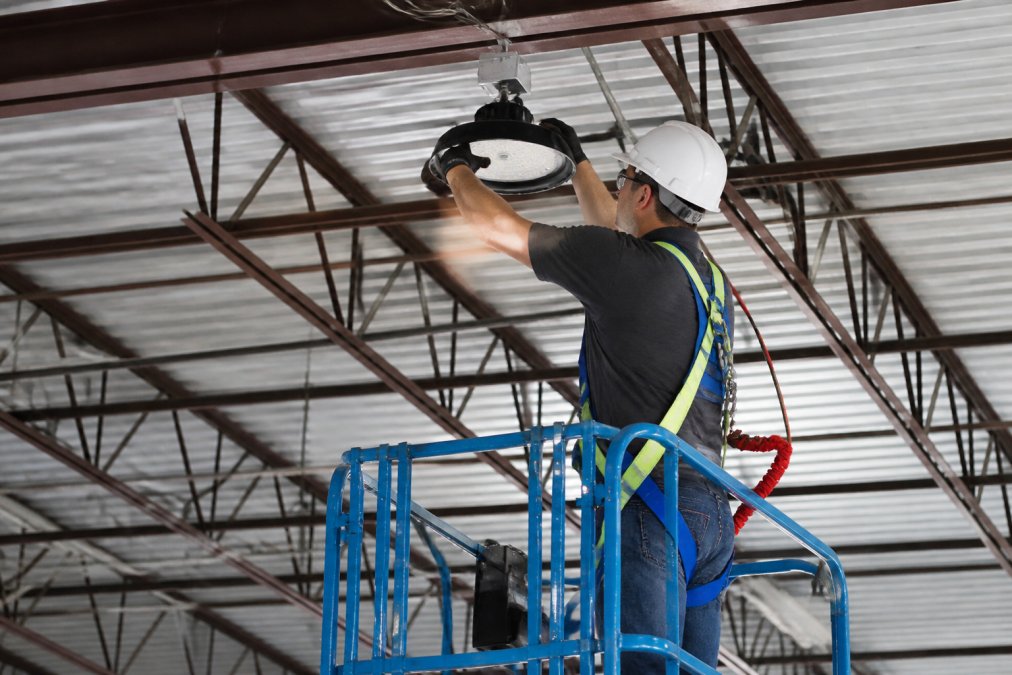
DirectFit (Plug-and-Play) LED retrofit kits are designed to fit into existing HID fixtures without modification. You remove the old bulb and ballast, install the LED bulb directly into the socket, and the fixture is operational. This method is faster and requires minimal electrical work, making it attractive for facilities that want to minimize installation labor and downtime.
Get a Free Property Assessment →
The trade-off is that DirectFit LEDs operate within the constraints of the original HID ballast, which can limit the LED’s full performance potential. The ballast may not optimize the LED’s electrical input, potentially reducing efficiency gains. Additionally, not all DirectFit kits are compatible with all ballast types, so compatibility verification is essential before ordering.
Ballast Bypass installation removes the original HID ballast entirely and wires the LED fixture directly to the electrical supply. This approach unlocks the LED’s full efficiency because the fixture operates without the ballast’s constraints. The LED driver (the component that regulates power to the LED) is integrated into the fixture itself, optimizing performance.
Ballast bypass requires more electrical work and carries higher labor costs because the installation involves disconnecting the original ballast and rewiring the fixture. However, the efficiency gains and superior long-term performance often justify the additional upfront labor. Facilities planning to operate the retrofit for 10+ years typically see better ROI with ballast bypass.
The choice between the two depends on your facility’s tolerance for installation disruption, your budget for labor, and how long you plan to operate the retrofit. DirectFit suits short-term or budget-constrained projects; ballast bypass suits long-term, high-use facilities.
Handling 30+ Foot Installation Heights
Installing fixtures 30+ feet overhead introduces safety and logistical complexity that can’t be overlooked.
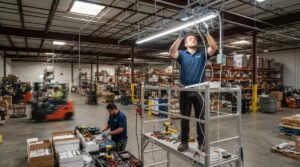
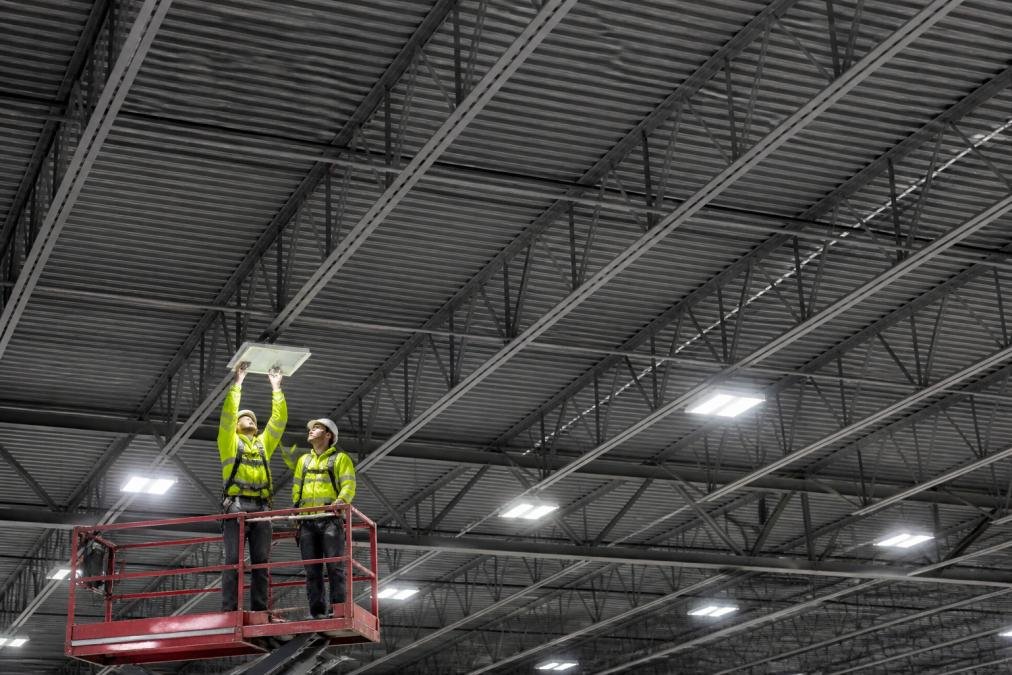
The standard approach uses elevated work platforms (scissor lifts or boom lifts) to position installers safely at fixture height. This requires a clear floor area, a stable surface, and coordination with your facility’s operations to prevent collisions with inventory or equipment movement. Many facilities schedule LED retrofit installations during lower-traffic periods or after-hours to minimize disruption.
Safety compliance is non-negotiable. All personnel must wear appropriate fall protection, and the work platform must be properly maintained and inspected.
Warehouse Lighting Energy Rebate Programs
Utility rebate programs for LED industrial lighting vary by state and utility provider, but most programs share a common structure: they reimburse a portion of your LED retrofit costs based on the energy savings your facility achieves.
HID vs. LED Comparison for Industrial Lighting
Understanding how LED fixtures perform relative to the HID technology they replace clarifies why the retrofit is worth the investment.
| Factor | HID (Metal Halide/HPS) | LED |
|---|---|---|
| Lifespan | 15,000-20,000 hours | 50,000+ hours |
| Lumens per Watt | 70-100 | 100-150+ |
| Warm-up Time | 5-10 minutes | Instant-on |
| Color Rendering | Moderate (70-90 CRI) | Excellent (90+ CRI) |
| Flicker | Noticeable | Flicker-free |
| Maintenance | Frequent bulb changes | Minimal |
| Operating Cost (annual) | Higher (energy + labor) | Lower |
Maintenance, Longevity, and Regulatory Compliance
A complete LED retrofit for high bay warehouse evaluation must account for maintenance requirements, fixture durability, and regulatory standards that govern industrial lighting.
Frequently Asked Questions
What are the benefits of retrofitting high bay lights to LED?
LED retrofit for high bay warehouse fixtures reduces energy consumption by 40-60% compared to metal halide and HPS systems, lowers maintenance costs through longer fixture lifespan (50,000+ hours), improves light quality and color rendering for better visibility and workplace safety, and qualifies for utility rebates that offset upfront investment. Many facilities see full ROI within 3-5 years.
What is the best LED color temperature for warehouse high bay lighting?
For warehouse operations, 4000K to 5000K color temperature is optimal. 4000K provides neutral white light suitable for general inventory and picking tasks, while 5000K delivers cooler, brighter illumination for detailed work and safety-critical areas. The choice depends on task requirements, retail and distribution centers typically prefer 4000K for ambiance and productivity balance.
Are LED high bay retrofits eligible for utility rebate programs?
Yes. Most commercial LED high bay retrofits qualify for substantial utility rebates through state and local energy efficiency programs. Rebates typically cover 20-40% of project costs for DLC-qualified fixtures. NexVolt Energy Group manages the entire rebate coordination process, handling applications, documentation, and verification so you avoid paperwork burden and ensure timely rebate delivery.
How disruptive is LED retrofit installation to 24/7 warehouse operations?
Professional installation minimizes downtime by scheduling work during off-peak hours, using phased approaches for large facilities, and coordinating around your operational schedule. Most warehouses experience zero production loss when installers work nights or weekends. NexVolt Energy Group plans installations to fit your facility’s operating rhythm, ensuring no unplanned shutdowns.
What’s the difference between direct-fit and ballast bypass LED retrofit installation?
Direct-fit (plug-and-play) retrofits install directly into existing fixtures without rewiring, reducing labor costs and installation time. Ballast bypass retrofits remove the old ballast and rewire for direct power, offering better thermal management and longer fixture lifespan. Bypass is preferred for high-performance applications and newer facilities; direct-fit suits budget-conscious projects with compatible existing fixtures.
How much energy can a warehouse save by switching to LED high bay lighting?
Warehouses typically reduce lighting energy consumption by 40-60% after LED retrofit, depending on fixture type replaced and operational hours. A 50,000 sq ft warehouse running 16 hours daily could save $15,000-$30,000 annually in energy costs alone. Combined with maintenance savings and utility rebates, most facilities achieve payback within 3-5 years and enjoy 15+ years of reduced operating costs.