Table of Contents
- Why Energy Efficiency Upgrades Matter for Schools
- Conducting a School Building Energy Audit
- Energy-Saving Lighting for Schools and LED Retrofits
- School HVAC Energy Efficiency: Heating and Cooling Upgrades
- Building Envelope and Indoor Air Quality Improvements
- Securing School Energy Efficiency Grants and Rebates
- Prioritizing Projects and Measuring Results
- Conclusion
- Frequently Asked Questions
Last Updated: October 15, 2026
Why Energy Efficiency Upgrades Matter for Schools
Energy efficiency upgrades for schools address a critical challenge: aging facilities that drain budgets while compromising learning environments. Districts spend millions annually on utilities, yet many buildings run outdated HVAC systems, inefficient lighting, and poor insulation.
Facility managers juggle tight budgets, aging infrastructure, and pressure to create safe, healthy spaces. A mid-winter boiler failure or flickering lights disrupt education and drive emergency repair costs.
What makes energy efficiency upgrades different from typical maintenance: they pay for themselves.
The path forward starts with understanding what upgrades deliver the most impact, how to fund them, and how to measure results.
Conducting a School Building Energy Audit
An energy audit is the foundation of any upgrade strategy. It identifies where your school wastes energy, quantifies potential savings, and prioritizes projects by impact and cost, but not all audits are equal.
The three audit tiers, and which one your district needs:
- Walk-through (ASHRAE Level 1). A visual survey of major systems with a rough, low-cost/no-cost recommendation list. Fast and inexpensive, but it won’t produce the engineering-grade savings estimates that utility rebates and grants typically require.
- Energy survey and analysis (ASHRAE Level 2). The workhorse for school districts. It combines a detailed walk-through with utility bill analysis, end-use breakdown, and cost estimates for each measure. Most utility custom-incentive programs and DOE-funded projects expect this documentation.
- Detailed analysis of capital-intensive modifications (ASHRAE Level 3). Adds modeling, dynamic energy simulation, and rigorous financial analysis for large capital projects such as a full HVAC plant replacement or deep envelope retrofit.
What a Level 2 audit includes:
- Visual inspection of HVAC systems, boilers, furnaces, chillers, and ductwork
- Lighting assessment across classrooms, hallways, gymnasiums, cafeterias, and outdoor areas
- Building envelope evaluation: insulation, windows, doors, air leaks, roof condition
- Energy consumption analysis using at least 12 months of utility bills and meter data
- Identification of equipment nearing end-of-life
- Indoor air quality and ventilation review against ASHRAE Standard 62.1 ventilation rates
- A measure-by-measure table with estimated installed cost, annual energy savings, and simple payback
Benchmark every building in the district, not just the one you plan to upgrade. The score comparison often reveals that the oldest building is not the worst performer, a newer building with a stuck economizer or an over-scheduled HVAC system can waste more energy per square foot.
How to read the audit report. Don’t accept a single blended savings number. Insist on a table separating each measure by installed cost, annual dollar savings, simple payback, and expected useful life. Replacing gymnasium fluorescent lighting might save roughly 40% of that space’s electricity use with a 3-5 year payback, while sealing envelope air leaks cuts heating costs about 15% with a longer payback.
Many facility managers skip this step and jump straight to visible problems like burned-out lights. That’s a mistake.
EPA ENERGY STAR Portfolio Manager benchmarking tool for K-12 schools
Energy-Saving Lighting for Schools and LED Retrofits
LED lighting retrofits transform school facilities. They reduce electricity consumption, improve visibility in classrooms and hallways, and cut maintenance costs because LEDs last 25,000 to 50,000 hours versus 10,000 for fluorescent bulbs.
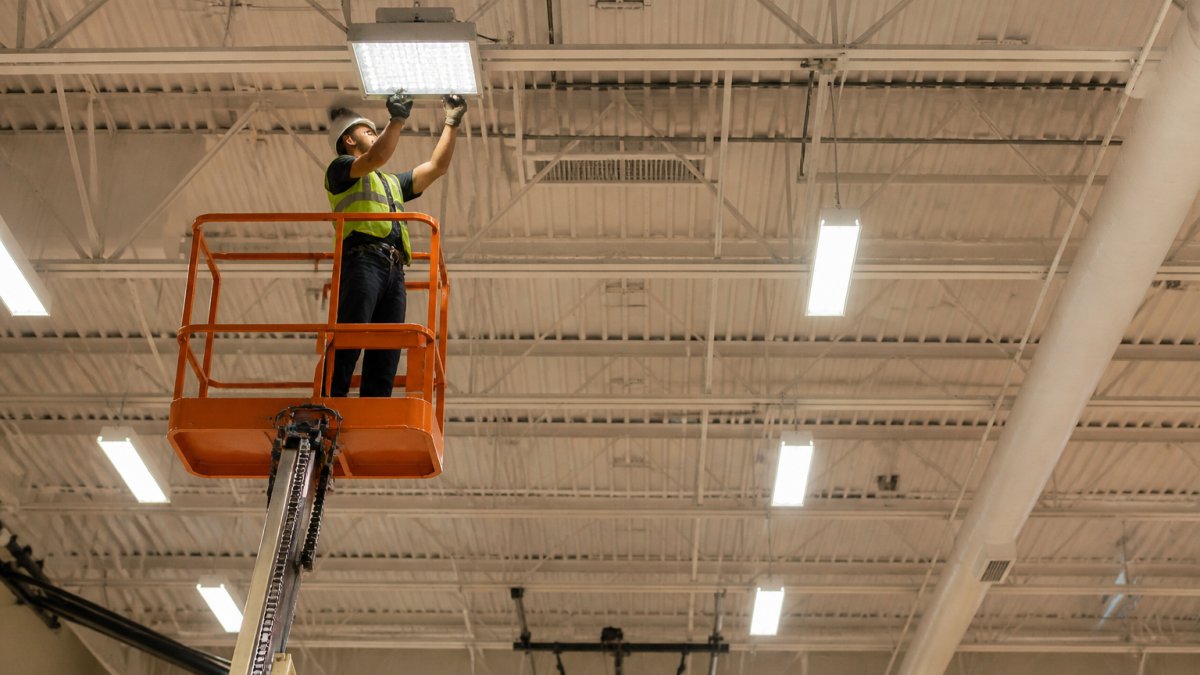
Why LED retrofits matter for schools:
- Fluorescent lighting consumes 30-40% more energy than LED equivalents
- LED fixtures produce better light quality, reducing eye strain during instruction
- Longer lifespan means fewer maintenance calls and replacements
- Occupancy sensors and lighting controls eliminate waste in unused spaces
- Dimming capabilities allow teachers to adjust light levels for presentations and activities
A typical school has 500-1,000 light fixtures across classrooms, hallways, gymnasiums, cafeterias, and administrative spaces. Replacing all fluorescent fixtures with LEDs cuts lighting energy use 50-70%.
Lighting retrofits also improve indoor air quality. Fluorescent ballasts emit heat, forcing HVAC systems to work harder. LEDs generate minimal heat, reducing cooling load and extending HVAC lifespan.
Smart lighting controls amplify these benefits.
School HVAC Energy Efficiency: Heating and Cooling Upgrades
HVAC systems account for 40-50% of school energy consumption. Upgrading heating and cooling equipment cuts operating costs and improves classroom thermal comfort.
Old boilers and furnaces operate at 60-75% efficiency; modern high-efficiency systems reach 90-98%. For a school spending $40,000 annually on heating, upgrading the boiler saves $8,000-$16,000 per year.
School HVAC energy efficiency improvements include:
- Replacing boilers and furnaces with high-efficiency models
- Upgrading to variable-frequency drives (VFDs) on pump and fan motors
- Installing programmable thermostats that adjust temperatures during unoccupied hours
- Sealing ductwork leaks that allow conditioned air to escape
- Cleaning and maintaining coils, filters, and heat exchangers
- Replacing older AC units with SEER-rated systems (Seasonal Energy Efficiency Ratio)
HVAC upgrade payback typically ranges from 5-10 years, depending on equipment age and local energy costs. A 20-year-old boiler replaced with a modern system delivers savings for 15+ years after payback.
Building controls enhance efficiency further. A school can program different temperature setpoints for occupied and unoccupied periods. Gyms and cafeterias need different heating/cooling profiles than classrooms.
Building Envelope and Indoor Air Quality Improvements
The building envelope, walls, roof, windows, doors, and foundation, controls how much energy escapes or enters. Poor insulation and air leaks force HVAC systems to work harder, driving up operating costs and creating uncomfortable spaces.
Building envelope upgrades for schools:
- Adding attic and wall insulation to reduce heat transfer
- Sealing air leaks around windows, doors, and penetrations
- Replacing single-pane windows with energy-efficient double or triple-pane models
- Installing weatherstripping on doors and hatches
- Upgrading roof reflectance to reduce cooling load (cool roofs reflect sunlight)
- Repairing or replacing damaged siding and caulking
These improvements also enhance indoor air quality. Proper insulation prevents condensation and mold growth, and sealed envelopes reduce outdoor air pollution infiltration. Combined with upgraded ventilation, envelope work creates healthier learning environments where students concentrate better and attendance improves.
Get a Free Property Assessment →
A school in a cold climate might lose 30% of heating energy through poor insulation and air leaks. Sealing and insulating reduces that loss to 10%, cutting heating costs by two-thirds.
Securing School Energy Efficiency Grants and Rebates
Funding is the barrier most facility managers face. Energy efficiency upgrades require upfront capital, yet school budgets are stretched thin. Grants and rebates change the equation by covering 30-80% of project costs.
Federal and state funding sources for schools:
- U.S. Department of Energy (DOE) grants for K-12 school energy upgrades
- State energy office rebate programs (vary by state)
- Utility company rebates for LED retrofits, HVAC upgrades, and controls
- USDA Rural Energy for America Program (REAP) for eligible school districts
- Environmental Protection Agency (EPA) recognition programs with incentives
- Property Assessed Clean Energy (PACE) financing for energy improvements
Many schools qualify for multiple funding sources simultaneously.
The application process is complex. Utilities require detailed specifications. Grant programs demand energy audit reports, project plans, and contractor certifications. Many facility managers lack time to navigate this paperwork.
This is where NexVolt Energy Group helps. We manage rebate coordination and grant applications on behalf of our clients, handling documentation, compliance verification, and fund disbursement.
Prioritizing Projects and Measuring Results
Not every upgrade delivers the same return, and the order matters as much as the picks. A sequenced plan lets a district fund later phases with savings from earlier ones instead of asking voters for the entire capital budget at once.
A practical five-phase sequence:
- Benchmark and audit. Establish the ENERGY STAR Portfolio Manager baseline and complete a Level 2 audit (see the audit section above). No spending decisions before this.
- Low-cost operational fixes first. Correct schedules, setpoints, and simultaneous heating/cooling; repair economizers; replace filters on schedule. These cost little, cut energy use meaningfully, and make the baseline cleaner for the capital projects that follow.
- Quick-payback capital measures. LED retrofits and lighting controls usually pay back in 3-5 years and generate immediate cash flow. Do these before the long-payback work.
- Major equipment and envelope. HVAC plant replacement, controls/building automation, and envelope work carry 7-12 year paybacks but the largest absolute savings and the biggest comfort and indoor-air-quality gains.
- Renewables and resilience. On-site solar and battery storage come last, sized to the load you have already reduced, never size renewables against an un-optimized building.
How to prioritize when the budget only covers one project:
- Calculate simple payback. Divide installed cost by annual energy savings. A $50,000 HVAC upgrade saving $5,000 per year has a 10-year simple payback.
- Then compare lifecycle cost, not just first cost. A cheaper unit with a 10-year life and higher maintenance can cost more over 20 years than a premium unit with a 20-year life. Ask for total cost of ownership over the equipment’s expected life, including maintenance, filter/parts, and projected energy price escalation.
- Weigh equipment age. Systems near end-of-life must be replaced regardless; specify high-efficiency models at that moment rather than replacing twice.
- Match climate to measures. Cold climates get the most from insulation, air sealing, and heating efficiency. Hot climates prioritize cooling efficiency, controls, and reflective roofing.
- Factor facility constraints and student impact. A 24/7 building may prioritize non-disruptive measures; a building with air-quality complaints prioritizes ventilation and envelope work.
Verify results, don’t assume them. Savings are a prediction until measured, so build verification in from day one:
- Commission the systems. Retro-commissioning confirms that new controls, VFDs, and sensors actually operate as designed. A common pattern is a new building automation system installed and then left on factory default schedules, erasing much of the expected savings.
- Track against the baseline. Compare post-upgrade kWh and therms to the Portfolio Manager baseline, normalized for weather and occupancy. Most comprehensive school retrofits land in the 20-35% total energy reduction range, but the only number that matters is your building’s.
- Use measurement and verification (M&V). For larger projects, follow the IPMVP framework (International Performance Measurement and Verification Protocol) so savings claims are defensible to a school board, a utility, or a performance contractor.
- Report monthly. Track utility bills and consumption, and review at 12 months. Documented savings justify the next phase and protect the program when leadership changes.
The sequencing rule: benchmark, then fix operations, then buy quick-payback measures, then replace major equipment, then add renewables, and commission and measure every phase before funding the next one.
U.S. Department of Energy guidance on energy audits and measurement and verification
Conclusion
Energy efficiency upgrades for schools are investments in both financial health and student wellbeing.
The path forward starts with a comprehensive energy audit that identifies priorities and quantifies savings potential. Securing grants and rebates reduces upfront costs dramatically. Proper project sequencing maximizes impact with available budget.
NexVolt Energy Group turns this plan into reality. We coordinate utility rebates and grant applications, manage professional installation of LED lighting and controls, and verify results through post-upgrade measurement.
Get a Free Property Assessment from NexVolt Energy Group. We’ll evaluate your school’s current energy use, identify upgrade opportunities, and estimate potential savings, no obligation.
| Upgrade Type | Typical Energy Savings | Payback Period | Best For |
|---|---|---|---|
| LED Lighting Retrofit | 50-70% lighting costs | 3-5 years | All schools |
| HVAC System Upgrade | 20-30% heating/cooling costs | 5-10 years | Aging equipment |
| Building Envelope | 15-25% heating/cooling costs | 7-12 years | Poor insulation |
| Smart Controls | 10-15% overall energy | 2-4 years | Any facility |
U.S. Department of Energy K-12 school energy efficiency guidance
EPA’s ENERGY STAR program for schools and school districts
American School & University facilities management best practices
Frequently Asked Questions
What are the most cost-effective energy efficiency upgrades for schools?
LED lighting retrofits and HVAC system tune-ups deliver the fastest payback periods, typically 3 to 5 years. Building envelope improvements such as insulation and air sealing take longer but reduce heating and cooling loads permanently. Schools should prioritize based on current energy use, building age, and climate. A professional energy audit reveals which upgrades will cut your facility’s electricity use and operating costs most significantly.
How can schools fund energy efficiency improvements without upfront costs?
Federal and state grants, utility rebates, and on-bill financing programs allow schools to fund upgrades with little or no money down. Working with an energy consultant who coordinates grants and rebates removes the paperwork burden and ensures your school captures all available incentives.
What should a school energy audit include?
A thorough school building energy audit assesses electricity use, heating and cooling systems, lighting efficiency, building envelope condition, and equipment age. The audit produces a prioritized list with payback periods and lifecycle cost comparisons. This roadmap helps facility managers and school boards make data-driven decisions and apply for targeted grants.
How do schools measure energy savings after upgrades are installed?
Track utility bills before and after the project to calculate real energy reduction. Compare consumption during the same season in consecutive years to account for weather variations. Advanced building controls and sensors provide real-time energy monitoring. Many schools also benchmark against peer facilities using ENERGY STAR Portfolio Manager. Documenting actual savings validates the project’s ROI and supports applications for future funding.