Table of Contents
- Warehouse Lighting Safety Standards: Why Compliance Matters
- OSHA Warehouse Lighting Requirements and General Duty Obligations
- Warehouse Lighting Levels in Foot-Candles by Work Area
- Warehouse Emergency Lighting Requirements and Testing
- Warehouse Lighting Inspection Checklist and Compliance Verification
- Uniform Light Coverage and Glare Prevention
- LED Lighting Upgrades for Compliance and Efficiency
- Frequently Asked Questions
Last Updated: October 17, 2026
Warehouse Lighting Safety Standards: Why Compliance Matters
Warehouse lighting safety is foundational to facility operations. At NexVolt Energy Group, we help facility managers diagnose lighting deficiencies and build compliant, efficient systems.
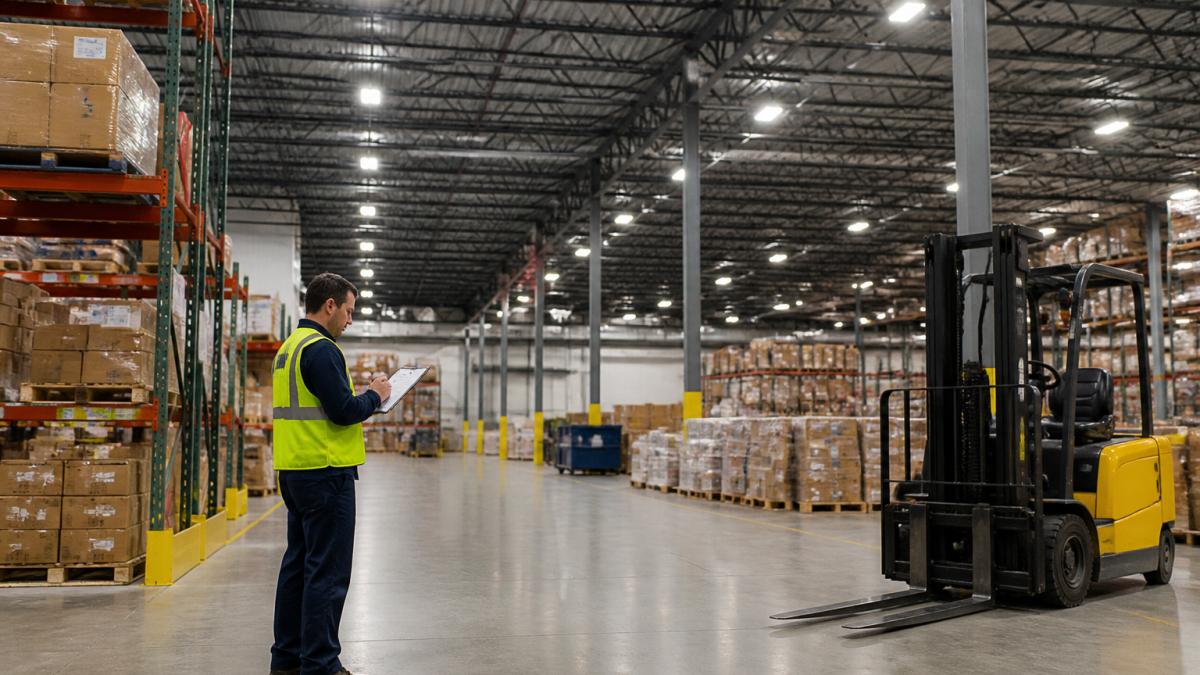
OSHA enforces illumination standards through the general duty clause, which requires employers to maintain safe working conditions. Inadequate warehouse lighting exposes your operation to citations, worker injuries, and liability.
This guide covers the illumination standards that apply to warehouse operations, how to measure compliance, and practical upgrade steps, including the regulatory framework, area-by-area lighting levels, emergency lighting requirements, and inspection procedures.
OSHA Warehouse Lighting Requirements and General Duty Obligations
29 CFR 1926.56 and General Illumination Standards
OSHA’s primary illumination standard is 29 CFR 1926.56, which specifies minimum foot-candle requirements for different work areas. Foot-candles measure light intensity falling on a surface.
The general duty clause under Section 5(a)(1) of the Occupational Safety and Health Act requires employers to provide a workplace “free from recognized hazards.” Poor warehouse lighting qualifies.
Foot-candles are measured with a light meter pointed at the work surface.
Powered Industrial Truck Operations Under OSHA 1910.178
Powered industrial trucks, forklifts, pallet jacks, and similar equipment have dedicated illumination requirements under OSHA 1910.178.
Forward-facing headlights on material handling equipment must be functional, but they cannot substitute for facility lighting. Facility ambient lighting must be adequate first; equipment lights are supplementary.
Areas where powered industrial trucks operate, such as aisles, ramps, and loading zones, require higher illumination levels than general warehouse space, detailed in the next section.
Warehouse Lighting Levels in Foot-Candles by Work Area
General Warehouse Aisles and Walkways
General warehouse aisles and walkways require a minimum of 10 foot-candles (approximately 110 lux) under 29 CFR 1926.56.
Many facilities operate at or slightly above this minimum, leaving little margin for aging fixtures or uneven distribution. Uniform coverage matters as much as the average level: dark spots create trip hazards and blind spots where debris accumulates unnoticed.
Walkways leading to exits or emergency equipment require the same 10 foot-candles minimum but should be prioritized for upgrade because they support safe evacuation.
Loading Docks, Loading Bays, and Material Handling Zones
Loading docks and loading bays are high-activity zones where workers and equipment move simultaneously.
Material handling zones where products are sorted, stacked, or inspected also fall into the 30 foot-candle category, including packing stations, quality control areas, and assembly zones.
Loading dock lighting often degrades first because fixtures are exposed to weather, vibration, and physical damage. Monthly or quarterly inspections catch failures before they create safety gaps.
Exit Areas and Emergency Pathways
Exit areas and emergency pathways must maintain a minimum of 10 foot-candles (approximately 110 lux) under the normal lighting system. Emergency lighting that activates during power loss has different requirements: exit signs must be illuminated by the normal system or a dedicated emergency power source, and the pathway leading to the exit must also be clearly visible during an emergency.
Emergency pathways are often overlooked during routine inspections because they’re not used daily. A facility might have adequate normal lighting but inadequate emergency lighting, creating serious liability if an evacuation occurs during a power outage.
Warehouse Emergency Lighting Requirements and Testing
Exit Lighting and Illuminated Pathways
Exit signs must be illuminated at all times.
Many facilities rely on battery-backed LED exit signs, which activate automatically during power loss.
Fixture spacing depends on the illumination level provided: a fixture rated for 10 foot-candles at distance might be spaced 30 feet apart, while a brighter fixture could cover 50 feet. Document layout and spacing in your emergency lighting design.
Annual Testing and Documentation
Emergency lighting systems must be tested annually under most state codes and NFPA 110.
Annual testing should be conducted by a licensed electrician or qualified technician: cut power to the normal lighting system and verify that emergency fixtures activate and illuminate exit routes to at least 10 foot-candles.
Many facilities skip this testing or perform it informally. During an OSHA inspection or fire code audit, failure to document annual testing can result in citations even if the emergency lighting is functional.
Get a Free Property Assessment →
Warehouse Lighting Inspection Checklist and Compliance Verification
Measuring and Documenting Illumination Levels
Measuring illumination requires a light meter (illuminance meter), which is available from industrial suppliers or rental services. The meter reads foot-candles or lux at the work surface. To measure warehouse lighting levels accurately, follow these steps:
- Select a light meter with appropriate range (0-500 foot-candles is typical for warehouse work)
- Identify the work surfaces where illumination must be verified (aisles, loading dock, packing stations)
- Take readings at multiple points across each area to check for uniform coverage
- Record the date, location, fixture type, and reading for each measurement
- Compare readings to the required foot-candle level for that area
- Document any areas that fall below the standard
Take readings during normal operating hours under representative conditions. If your warehouse uses natural light from skylights or windows, measure on a cloudy day to see the worst case. Shadows from tall racks or equipment can create dark spots that appear only under certain conditions.
Fixture Condition, Mounting, and Hazard Assessment
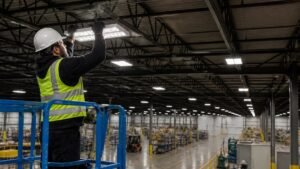
Beyond illumination levels, inspect the physical condition and mounting of all fixtures. Look for:
- Exposed live parts: Any fixture with exposed wiring, terminals, or components that could contact skin or conductive material creates an electrical hazard. Damaged fixtures must be repaired or replaced immediately.
- Secure mounting: Fixtures should be firmly attached to ceiling, wall, or pole. Loose fixtures can fall, creating a serious hazard.
- Lens or cover damage: Cracked or missing diffusers reduce light output and can allow dust and debris to accumulate inside the fixture, further reducing efficiency.
- Corrosion or moisture: Fixtures in damp areas (near dock doors, in humid climates) can corrode or develop moisture inside. Corrosion weakens mounting and can cause electrical failure.
- Adequate clearance: Fixtures should have clearance from storage, equipment, and materials. Blocked fixtures reduce light output and create fire hazards if the fixture generates heat.
Document fixture condition and any defects in your inspection record. Defects should be addressed on a priority basis: electrical hazards first, then mounting issues, then performance issues.
| Inspection Item | Frequency | Action if Non-Compliant |
|---|---|---|
| Illumination level (foot-candles) | Annually | Upgrade fixtures or clean existing fixtures |
| Fixture mounting security | Annually | Tighten or replace mounting hardware |
| Exposed live parts or damage | Quarterly | Repair or replace fixture immediately |
| Emergency lighting activation | Annually | Service batteries or replace fixture |
| Exit sign illumination | Annually | Replace bulbs or battery backup system |
Uniform Light Coverage and Glare Prevention
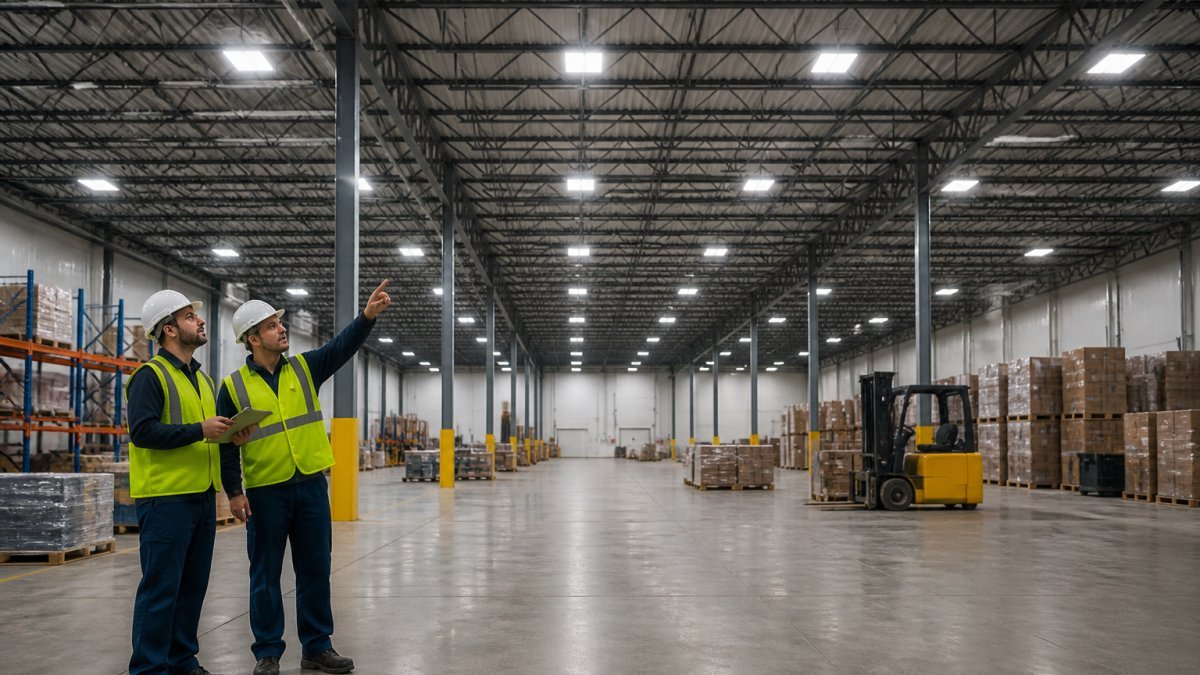
Uniform light distribution across a warehouse is as important as meeting minimum foot-candle levels.
Glare occurs when bright light sources are visible directly or reflect off surfaces into workers’ eyes. In a warehouse, glare from ceiling fixtures can be distracting and fatiguing.
High-bay warehouses with 25-foot or higher ceilings often use fixtures mounted on the ceiling pointing downward. Lower-mounting fixtures (12-20 feet) can be aimed at a slight angle to reduce direct glare.
When upgrading warehouse lighting, prioritize uniform coverage over raw brightness.
After upgrading to LED fixtures, take illumination readings at the same locations annually. Fixture degradation is slower with LEDs than older technologies, but it still occurs. Tracking readings over time helps you plan the next upgrade cycle.
LED Lighting Upgrades for Compliance and Efficiency
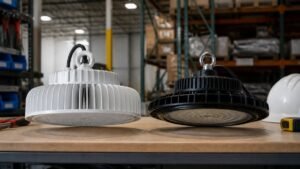
LED fixtures deliver compliance-level illumination while reducing energy consumption and maintenance costs.
Beyond energy savings, LED fixtures last 50,000-100,000 hours, roughly 10-15 years of continuous operation. Older fixtures require replacement every 3-5 years.
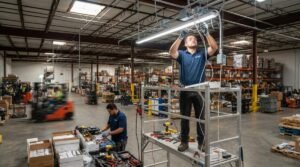
When planning an LED upgrade, work with a professional assessment to determine the right fixture type and quantity for your space.
Utility rebate programs often offset the upfront cost of LED upgrades.
LED upgrades improve warehouse lighting safety, reduce energy costs, and lower maintenance overhead. The combination of compliance-level illumination, long fixture life, and utility rebates makes LED conversion the standard approach for modern warehouses.
Warehouse lighting safety standards exist to protect workers and ensure productive operations.
If your facility has aging fixtures, uneven lighting, or unclear compliance status, a professional assessment is the first step. We manage the entire process, from initial evaluation through rebate coordination to final installation, so you can focus on running your facility. Get a Free Property Assessment today and understand exactly where your warehouse stands.
Frequently Asked Questions
What are the OSHA requirements for warehouse lighting?
OSHA requires adequate illumination in all workplaces under the General Duty Clause and 29 CFR 1926.56. For warehouses, minimum illumination standards depend on the task and area: general warehouse aisles require 10 foot-candles, and other work areas require appropriate illumination based on task complexity. Powered industrial trucks must have forward-facing headlights and adequate general illumination. Compliance is verified through foot-candle measurements taken at floor level in work areas.
What is the recommended lighting level for a warehouse in foot-candles?
Recommended foot-candle levels vary by warehouse area and task. General warehouse aisles and walkways typically need 10 foot-candles minimum. Loading bays and loading docks require appropriate foot-candle levels for safe material handling. Precision work areas, inspection zones, or offices may require higher foot-candle levels. Emergency pathways and exits require a minimum of 5 foot-candles. These levels ensure visibility for safe navigation and material handling while complying with OSHA standards and industrial safety best practices.
What are the OSHA requirements for warehouse emergency lighting?
OSHA requires emergency lighting systems that maintain adequate illumination at floor level along all emergency exit routes and pathways. Emergency lighting must activate automatically during power loss and remain functional for at least 90 minutes. Exit signs must be illuminated and clearly visible. All emergency lighting fixtures, batteries, and backup systems must be tested annually and documented. Licensed electricians should perform testing to verify compliance and ensure system reliability during actual emergencies.
How often should warehouse emergency lighting be tested?
Emergency lighting systems must be tested at least annually and documented in writing. Full-duration tests (running the system for 90 minutes on battery backup) should occur at least once per year. Monthly or quarterly visual inspections of fixtures, batteries, and connections help catch degradation early. Testing records must be maintained on site and available for OSHA inspection. Many facilities conduct testing after-hours to avoid disruption. Documentation should include test date, time, duration, any failures, and corrective actions taken.
What should a warehouse lighting safety inspection include?
A complete warehouse lighting inspection should measure foot-candle levels in all work areas using a calibrated light meter, document fixture condition and mounting security, check for exposed live parts or electrical hazards, verify emergency lighting functionality and battery status, assess glare and uniform coverage, and inspect high-bay fixtures for alignment and damage. The inspection should also verify that powered industrial trucks have functional forward-facing headlights and that all fixtures meet OSHA standards. Written records should be kept for compliance documentation and future reference.
How do you measure light levels in a warehouse?
Light levels are measured using a calibrated foot-candle meter (light meter) held at floor level or work surface height in the area being tested. Take measurements at multiple points across each work zone to verify uniform coverage. Measurements should be taken during normal operating conditions and recorded with date, time, location, and meter model. Compare results against OSHA standards for that area type. If levels fall below required minimums, document the deficiency and plan corrective action. Annual documentation of measurements creates a compliance record for regulatory inspections.
Do warehouse lighting requirements vary by work area?
Yes, warehouse lighting requirements vary significantly by work area and task. General warehouse aisles and walkways require 10 foot-candles minimum. Loading docks and material handling zones require appropriate foot-candle levels for safe visibility during receiving and shipping. Office areas, inspection zones, and quality control stations may require higher foot-candle levels. Emergency pathways and exits require 5 foot-candles minimum. Hazardous environments have additional requirements. Powered industrial truck operation areas must have both forward-facing headlights and adequate general illumination. Tailoring lighting to specific work areas ensures compliance and operational efficiency.
What type of lighting is best for a warehouse?
LED high-bay fixtures are the current best choice for warehouses. They provide uniform illumination, reduce energy consumption by 50-70% compared to older metal halide or high-pressure sodium fixtures, require less frequent maintenance, and have a longer lifespan (50,000+ hours). LED fixtures can integrate occupancy sensors and smart controls for additional energy savings. They generate less heat, improving warehouse climate control. When selecting LED fixtures, verify they meet OSHA illumination standards for your warehouse zones, offer appropriate color temperature (4000-5000K for industrial spaces), and include proper shielding to minimize glare and prevent exposed live parts.