Last Updated: October 29, 2026
Quick Summary
Improve safety in dim warehouse aisles by measuring current light levels with a meter, setting zone targets, and upgrading fixtures where readings fall short. Pair the lighting work with reflective floor markings, convex mirrors at blind intersections, physical separation, and posted speed limits, then re-measure to confirm progress.
- Measure floor-level and task-height light with a meter and log readings for each aisle.
- Fix critical dark spots first, especially on pedestrian routes and forklift intersections.
- Use 4000K to 5000K neutral white light for most warehouse aisles.
- Install convex mirrors and reflective markings at blind intersections and rack-end corners.
- Keep egress lighting on at all times, even when motion sensors are controlling other lights.
Table of Contents
- Why Dim Warehouse Aisles Create Safety Risks
- Understanding OSHA Warehouse Lighting Standards
- Assessing Your Aisle Lighting With a Light Meter
- Choosing the Best LED Color Temperature for Warehouses
- Aisle Hazard Controls Beyond Lighting
- Running a Warehouse Safety Audit Checklist
- Scheduling Your Free Property Assessment
- Frequently Asked Questions
Why Dim Warehouse Aisles Create Safety Risks
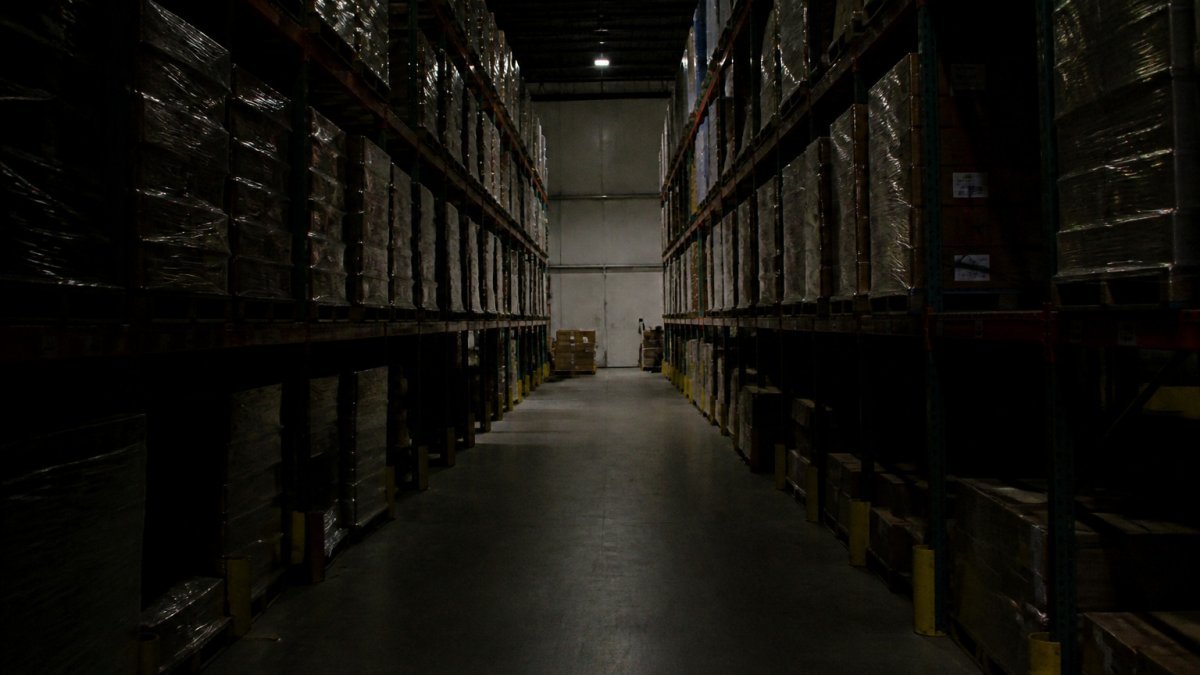
Dim warehouse aisles are one of the most overlooked hazards on the floor. When workers can’t see pallets, forklifts, or floor obstacles clearly, accidents happen fast.
Poor light makes it hard to judge distance and spot trip hazards. Shadows hide spills and damaged racking. Forklift operators lose reaction time when they can’t read the aisle ahead.
Here’s what dim aisles usually cause:
- Trips and falls on uneven or unseen floor surfaces
- Forklift collisions with pedestrians or racking
- Missed hazard signs and floor markings
- Eye strain that leads to fatigue over a long shift
The good news is that most of these risks can be reduced with practical changes. Start by understanding the rules that apply to your space.
Understanding OSHA Warehouse Lighting Standards
OSHA sets minimum lighting requirements for workplaces in the United States. The rules are found in OSHA general lighting requirements in 29 CFR 1910.22. For the full regulatory detail behind these requirements, see the complete warehouse lighting standards guide.
Lighting isn’t just about compliance. Good visibility lets workers spot hazards before they become incidents.
Check your local requirements and insurance guidance too. Your safety consultant can confirm which rules apply to your operation.
Assessing Your Aisle Lighting With a Light Meter
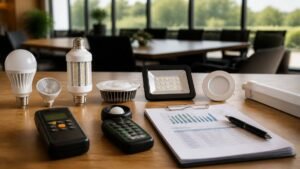
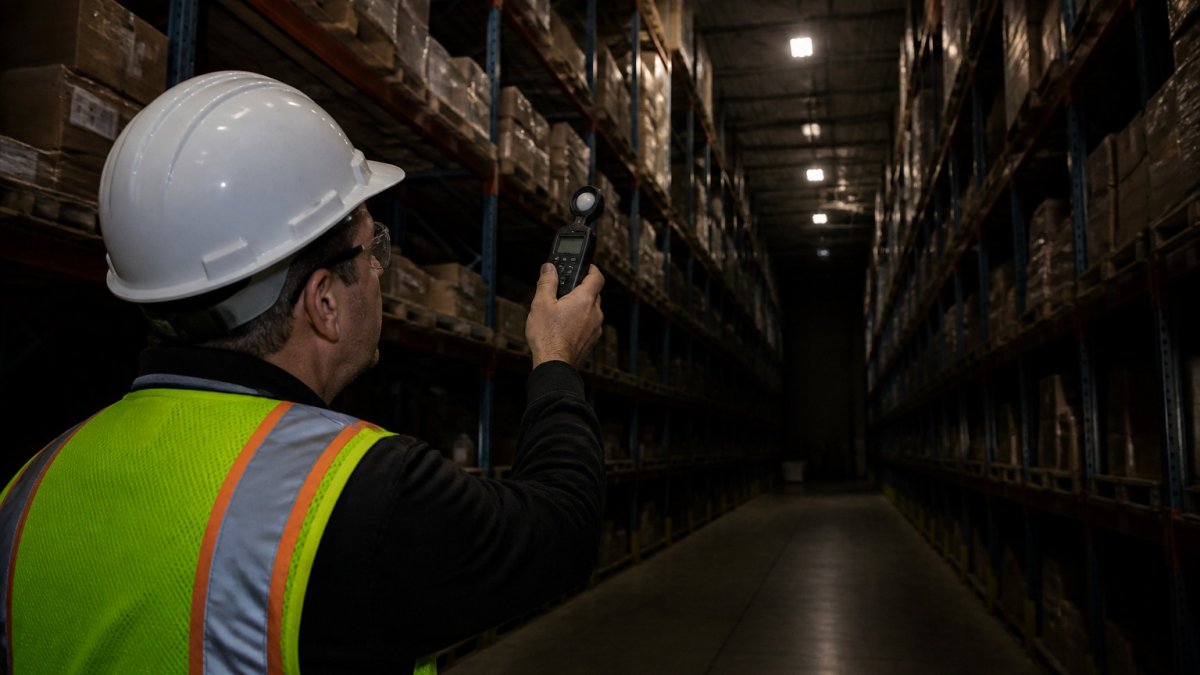
A light meter turns “it looks dim” into a number you can act on. Walk each aisle with a handheld meter and take readings at floor level (about 30 inches, the height of a pallet deck) and at task height (about 36 to 48 inches for picking and inspection).
How to build a measurement grid:
- Divide each aisle into thirds and take a reading at the start, middle, and end.
- Add readings at rack ends, corners, dock doors, and anywhere shadows fall across the walkway.
- Measure at floor level and at task height at each point, the gap between the two often reveals a fixture that lights the rack face but leaves the floor dark.
- Note the time of day and whether skylights or dock doors are contributing daylight, since those numbers will change after dark.
- Repeat the same grid after any fixture change so you can prove the improvement.
What to look for beyond the number:
- Glare: A bright fixture in your line of sight can wash out the aisle ahead. Stand where a forklift operator sits and look down the aisle; if you see the fixture instead of the floor, you have glare.
- Shadows: Rack uprights, stacked pallets, and mezzanine edges cast shadows that hide spills and damaged racking. Note any shadow that crosses a walkway.
- Uniformity: A bright patch at the aisle entrance with a dark middle is a common failure. Compare the brightest and darkest readings in the same aisle; a large spread means workers’ eyes have to constantly readjust.
- Flicker and color shift: Failing fixtures often flicker or shift color before they go dark. Log them for replacement even if the meter reading still looks acceptable.
Recommended Illumination Levels by Area
Use your readings to compare each zone against a target. Once your measurements show where fixtures need upgrading, you can explore JCP&L lighting rebate options for New Jersey commercial facilities to help fund the work. These are planning targets, not a substitute for the applicable workplace standard, confirm the requirement for your operation with your safety consultant and OSHA general lighting requirements in 29 CFR 1910.22.
Set a target for each zone before you buy fixtures:
- Emergency egress paths: enough to keep exits and signage visible at all times
Areas that fall well below target are your first priority. Areas that meet the target but show glare, shadows, or a wide bright-to-dark spread are second priority, they need better placement or shielding, not necessarily more fixtures.
Photograph each measurement point with the meter reading visible in the frame. The photo log makes it easy to show management, insurers, and contractors exactly where the problems are.
Turning Readings Into a Fix List
Rank your findings in three tiers: critical (below target and on a pedestrian route or forklift intersection), high (below target in a picking or staging area), and monitor (meets target but shows glare or shadows). Fix critical spots first, then high spots, then re-measure the monitor list after the first round of changes. This tiered approach lets you show measurable progress without replacing every fixture at once.
Choosing the Best LED Color Temperature for Warehouses
Color temperature affects how clearly workers see colors, edges, and contrast. Most warehouses do well with a neutral white light in the range of 4000K to 5000K. Cooler light can help with visibility, but very cool light may cause glare for some workers.
Pick a color temperature that matches your tasks. Aisles with lots of foot traffic usually benefit from clear, bright white light. Areas with fine detail work may need a slightly warmer tone.
Get a Free Property Assessment →
Quick guidance on color temperature:
- 4000K: balanced light for general aisles
- 5000K: crisp visibility for picking and inspection
- Avoid mixing very different tones in the same aisle
The article gives a quick reference for matching color temperature to the task.
| Color temperature | Best for | Note |
|---|---|---|
| 4000K | General aisles | Balanced light |
| 5000K | Picking and inspection | Crisp visibility |
| Warmer tone | Fine detail work | Slightly warmer than 4000K |
| 4000K to 5000K | Most warehouses | Neutral white range |
Aisle Hazard Controls Beyond Lighting
Lighting is only one part of the picture. Traffic separation and physical barriers protect workers even on well-lit floors, and the controls work best when they are planned together with the lighting upgrade rather than bolted on afterward. Clear walkways and floor markings also cut down on confusion.
A coordinated aisle-control plan covers:
- Reflective floor markings: Use reflective markings for pedestrian lanes, forklift lanes, and stop lines at intersections where visibility matters.
- Illuminated and reflective signs: Post aisle speed limits, pedestrian warnings, and rack-height clearance signs where drivers and walkers actually look, at eye level on rack ends and at intersections.
- Mirrors at blind intersections: Convex mirrors at aisle crossings and rack-end corners let forklift operators and pedestrians see each other before they meet. Mount them at a height that works for both seated operators and standing workers.
- Physical separation: Use guardrails or bollards where vehicles get close to walkways, and protect rack ends with end-of-aisle barriers. Barriers do double duty: they stop impacts and they define the pedestrian route so workers do not drift into vehicle lanes.
- Forklift speed and visibility controls: Set and post aisle speed limits, require horns or lights at intersections, and make sure operators can see over and around loads. A load that blocks forward visibility should be driven in reverse or with a spotter.
- Housekeeping and obstruction removal: Keep walkways clear of stock, pallets, and debris. An obstructed aisle forces pedestrians into vehicle lanes and hides floor markings.
Motion Sensors and Occupancy Controls
Motion sensors help keep lights on where people are working. They also reduce wasted energy in empty aisles. Pair them with emergency lighting so exits stay visible during outages.
Set sensor timeouts long enough that lights don’t drop out during slow tasks, a short timeout can leave a worker in the dark mid-task. Test sensors across the full aisle length before you call the job complete, and check that the sensor pattern covers rack ends and intersections, not just the center of the aisle.
Do not let occupancy controls dim or shut off emergency egress lighting. Exit signs and egress paths must stay illuminated regardless of sensor state.
A Prioritized Retrofit Plan
A full aisle retrofit can be staged so you get safety gains early without replacing every fixture at once:
- Fix critical dark spots first. Add or reposition fixtures at pedestrian routes, forklift intersections, and dock doors. This is usually the lowest-cost step with the biggest safety return.
- Add reflective markings and mirrors at intersections. These are inexpensive, quick to install, and work with whatever light you already have.
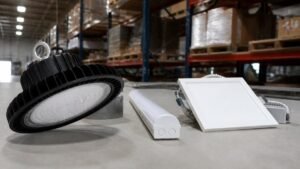
- Upgrade fixtures in high-traffic aisles. Replace failing or inefficient fixtures with aisle-specific high-bay or linear fixtures, and add occupancy controls where aisles are intermittently used.
- Re-measure and monitor. Re-run your light-meter grid after each stage and track near misses, aisle incidents, lighting failures, and inspection completion. Patterns in these records point to the aisles that need the next round of attention.
Budgeting considerations: occupancy controls and motion sensors can reduce energy use in intermittently occupied aisles. Utility programs may also help fund upgrades. Confirm the current program terms before you budget, since rebate levels and eligibility change.
The strongest aisle-safety result comes from combining measurable lighting targets, reflective markings, mirrors, physical separation, and speed controls, then verifying performance with re-measurement and incident tracking. Lighting alone fixes visibility; the coordinated plan fixes the aisle.
Running a Warehouse Safety Audit Checklist
A regular audit turns one-time fixes into lasting habits. For a step-by-step walkthrough, see how to conduct a commercial lighting audit. Use a checklist that covers lighting, floor condition, signage, and traffic flow. Review it monthly and after any layout change.
Include these items in your warehouse safety audit checklist:
- Lighting levels meet your target in every aisle
- Burned-out or flickering fixtures are logged and replaced
- Floor markings and warning signs are visible
- Walkways stay clear of stock and debris
- Forklift and pedestrian lanes are separated
- Racks and barriers show no damage
- Near misses are reported and reviewed
Track near misses and corrective actions. Patterns in these records often point straight to the aisles that need attention first.
Scheduling Your Free Property Assessment
Measuring and planning takes time, and a professional review can speed things up. NexVolt Energy Group offers a free property assessment for New Jersey facilities.
To request your assessment, contact NexVolt Energy Group about a New Jersey commercial LED lighting assessment. Our team can discuss your facility layout and lighting goals.
Frequently Asked Questions
What are the OSHA requirements for warehouse aisle lighting?
OSHA does not set a single numeric lighting level for warehouse aisles in its general industry rules. Its walking-working surfaces and general lighting expectations require that work areas and passageways be lit well enough for workers to see hazards safely. Many facilities use recognized engineering references, such as IES recommendations, as a benchmark for aisle illumination, then document their measurements in the safety audit. A light meter reading at floor level, taken at several points along each aisle, gives you evidence to support your compliance position.
What is the recommended foot-candle level for warehouse aisles?
Illumination targets depend on the activity, the racking height, and the traffic in each aisle. General warehouse aisles are commonly planned in a range that supports safe forklift and pedestrian movement, while areas with fine detail work or label reading need higher levels. Measure at floor level with a calibrated light meter, check the minimum and average readings, and compare them against your chosen engineering benchmark. Record each reading so you can track improvement after an LED upgrade.
How can LED upgrades improve warehouse safety?
LED fixtures can provide more uniform light across high-bay aisles and reduce flicker and glare when properly specified. Paired with occupancy sensors, they can brighten aisles when workers or forklifts enter and dim when the space is empty. Better visibility helps workers spot pallets, spills, and pedestrians sooner. Get a Free Property Assessment from NexVolt Energy Group to see which fixtures and controls fit your racking layout.
How do motion sensors improve energy efficiency in dim aisles?
Motion sensors and occupancy controls switch or dim lights only when an aisle is in use, which cuts runtime in rarely visited storage lanes. The right setup keeps a minimum safe light level in idle aisles so workers entering from a dark area can still see. Sensor placement, time delays, and dimming ranges should be set during commissioning, not left at factory defaults. Pricing for controls depends on fixture count, mounting height, and integration requirements, so request a quote for your specific facility.