Last Updated: October 30, 2026
Quick Summary
A commercial lighting rebate is a cash incentive from your electric utility that lowers what you pay for qualifying efficient fixtures at purchase. The federal Section 179D deduction instead reduces taxable income. Many New Jersey projects can use both, but the rebate typically reduces the basis the deduction is calculated on.
- A utility rebate reduces project cost; the Section 179D deduction reduces taxable income.
- Pre-approval is often required, so confirm it before ordering or installing fixtures.
- Rebate programs may require installed fixtures to match approved specifications exactly.
- Section 179D is calculated per square foot of building, not per fixture.
- Keep pre-approval letters, invoices, spec sheets and installation records for both incentives.
Table of Contents
- Rebate or Tax Deduction: The Short Answer
- How a Utility Rebate Works for Commercial Lighting
- How the Section 179D Lighting Deduction Works
- Side-by-Side: Rebate Versus Tax Deduction
- Applying for a Commercial LED Lighting Rebate
- Documentation You Need for Rebates and Deductions
- Booking Your Free Property Assessment
- Frequently Asked Questions
Rebate or Tax Deduction: The Short Answer
Commercial lighting upgrades in New Jersey can qualify for a commercial lighting rebate from the utility, a federal tax deduction, or both. A utility rebate lowers your project cost at the point of purchase. The Section 179D deduction reduces your taxable income.
Most owners ask the wrong question first. The real question is how each incentive interacts with your project cost, your tax position and your timing. Get those three things right and the choice usually becomes clear.
How a Utility Rebate Works for Commercial Lighting
A utility rebate is a cash incentive paid by your electric utility for installing qualifying efficient equipment. You can explore the New Jersey utility lighting rebate programs available to commercial facilities. A commercial lighting rebate is usually paid per fixture or per kilowatt-hour saved, and it reduces what you pay for the project. U.S. Department of Energy guidance on utility energy efficiency programs
Commercial Lighting Utility Rebate Eligibility Requirements
Eligibility is set by the utility serving your address and the program you enroll in. Requirements typically cover the type of account, the fixtures being replaced, and whether equipment is installed by a qualifying contractor. Pre-approval is often required before you buy, so check the program rules first.
Watch out: many rebates are lost because the purchase order or installation starts before pre-approval is confirmed.
How the Section 179D Lighting Deduction Works
Section 179D is a federal tax deduction for energy-efficient improvements to commercial buildings, including interior lighting. The New Jersey Board of Public Utilities lists it among federal incentives for commercial property owners. New Jersey Board of Public Utilities federal incentives page
The deduction reduces taxable income rather than project cost. Its value to you depends on your tax rate and how the deduction is claimed, so review it with your tax advisor. The incentive information available does not give a fixed deduction amount, so treat any figure you see with caution.
Current 179D Status and Transition Rules
Rules for this deduction can change over time, so confirm the current status with the IRS and a qualified tax professional before you plan around it. IRS guidance on energy-efficient commercial building deduction
Side-by-Side: Rebate Versus Tax Deduction
The query behind this article is a comparison, so here is the comparison in one place. The two incentives are not substitutes, they hit different lines on your financial statements at different times, and most qualifying projects can use both. For a fuller comparison, read the Commercial LED Lighting Rebate Guide for NJ.
| Factor | Utility Rebate | Section 179D Deduction |
|---|---|---|
| Who provides it | Your electric utility | Federal government, via your tax return |
| What it reduces | Project cost (cash in) | Taxable income (tax liability down) |
| When you see the benefit | After pre-approval, installation, and verification | On the tax return for the year the property is placed in service |
| Form of benefit | Cash payment or bill credit | Deduction against income |
| Typical basis | Per fixture, per kWh saved, or percent of project cost | Per square foot of building, tiered by performance |
| Main eligibility test | Utility program rules, account type, equipment listing, contractor requirements | Qualifying building improvement, baseline performance, construction start date |
| Caps and limits | Program caps, often a percent of project cost | Statutory dollar caps per square foot, tiered |
| Who benefits most | Any owner or tenant paying the project cost | Owners with taxable income and basis to use the deduction |
| Paperwork | Pre-approval letter, invoices, spec sheets, verification | Contractor certification, spec sheets, tax preparer documentation |
| Risk if missed | Rebate is lost; project cost is higher | Deduction is missed or reduced; tax bill is higher |
A Worked Example
Now suppose the same project qualifies for a 179D partial deduction. The deduction is calculated per square foot of the building, not per fixture, so the building square footage drives the number. If the applicable partial-deduction rate is, for illustration, $0.60 per square foot, the deduction would be $24,000 on a 40,000-square-foot building. At a 24% marginal tax rate, the cash value of that deduction is roughly $5,760, not $24,000. The rebate and the deduction are not the same size in cash terms, and the deduction’s value moves with your tax rate.
These figures are illustrative only. Rebate amounts, per-square-foot deduction rates, and tax rates vary by program, building, and taxpayer. Confirm the actual numbers with your utility and your tax advisor before you rely on them.
How the Two Interact on Your Tax Return
A rebate that reduces the cost of the project generally reduces the tax basis of the property, which in turn can reduce the depreciation you claim and the deduction you can support. In practice, the rebate lowers the amount you have invested in the asset, and the tax calculation starts from that lower number. The deduction and the rebate are not simply additive, the rebate can shrink the base the deduction is measured against.
Get a Free Property Assessment →
A common pattern is to apply the rebate first, document the net project cost, and then have your tax advisor calculate the deduction on the reduced basis. IRS guidance on energy-efficient commercial building deduction
Which One Should You Pursue First?
For most owners, the rebate is the first move because it is cash, it is available at the point of project approval, and it does not depend on your tax position. The deduction is the second move because it is claimed after the project is placed in service and its value depends on your taxable income. If your project qualifies for both, pursue both, but sequence the paperwork so the rebate approval is in hand before you finalize the tax basis your advisor will use.
The rebate is cash against project cost; the deduction is a reduction in taxable income. They can both apply, but the rebate generally reduces the basis the deduction is calculated on, so the combined benefit is less than the sum of the two headline numbers.
Applying for a Commercial LED Lighting Rebate
Start before you order fixtures. Confirm which utility serves the property, find the program that matches your project, and request pre-approval. If PSE&G serves your property, you can review the PSE&G lighting rebate options for New Jersey commercial facilities. If JCP&L serves your property, you can review the JCP&L lighting rebate options for New Jersey commercial facilities. Keep dated quotes, product specification sheets and proof of installation.

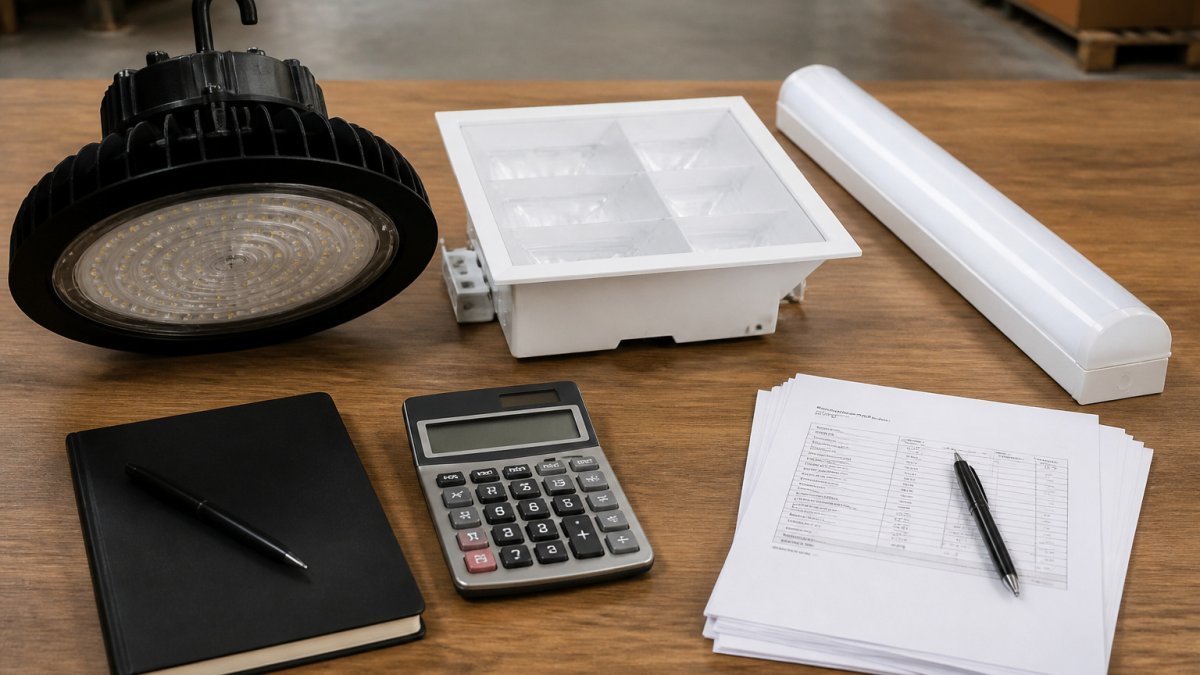
A sensible sequence is to assess the existing fixtures, match them to a listed program, get pre-approval, install, then submit verification. A facilities manager and an electrician reviewing paperwork beside a high-bay LED fixture in a warehouse aisle is a common setup for this stage.
Watch out: rebate programs often require the installed fixtures to match the approved specifications exactly, so substitutions can void an approval.
Documentation You Need for Rebates and Deductions
Good records make both incentives easier to claim. Keep the following organized from the start:
- Utility account number and service address
- Pre-approval letter or confirmation number
- Itemized equipment quotes and final invoices
- Fixture specification sheets showing wattage and efficiency
- Before-and-after fixture counts or photos
- Installation dates and contractor information
- Records of operating hours and any controls installed
These documents support the rebate application and the tax filing alike. Store them in one place so you can produce them quickly if the utility or the IRS asks.
Booking Your Free Property Assessment
A property assessment shows which fixtures qualify, which utility programs apply, and how the rebate and deduction would compare for your facility. NexVolt Energy Group manages the process from assessment through installation and rebate coordination.
Get a Free Property Assessment to review your lighting needs and incentive options. You can submit your facility details for a New Jersey commercial LED lighting assessment to get started.
Frequently Asked Questions
What is the difference between a commercial lighting rebate and a tax deduction?
A utility rebate is a cash payment from your electric utility, usually paid per fixture or per kWh saved, and it reduces your project cost directly. A Section 179D deduction is a federal tax benefit that reduces taxable income based on qualifying energy-efficiency improvements to a commercial building. The rebate lowers what you pay upfront, while the deduction lowers your tax bill. Because they target different costs, many businesses evaluate both, though the tax treatment of any rebate you receive affects how much deduction you can claim. Confirm the treatment with your tax advisor before filing.
Can a business combine a utility lighting rebate with a federal tax deduction?
In many cases yes, but the rebate generally reduces the cost basis of the equipment, which lowers the amount eligible for the deduction. Businesses should calculate the net cost after the rebate and then determine the deduction on the remaining basis. Program rules and current federal guidance should be reviewed before claiming both, since eligibility and transition rules have changed. A tax professional can confirm the exact figures for your project.
What documentation is needed for a commercial lighting rebate or tax deduction?
Rebate applications typically require invoices, equipment specification sheets showing fixture wattage and type, installation dates, and proof of the existing equipment being replaced. Keeping project photos, contractor contracts, and before-and-after lighting audits makes both claims easier to substantiate. Retain these records according to IRS and utility program retention requirements.
How does NexVolt Energy Group help with rebate paperwork?
NexVolt Energy Group manages the rebate process from property assessment through utility verification, which includes coordinating documentation requirements. Pricing depends on project size, fixture count, and site conditions, so the most accurate figures come from a site-specific quote. Visit NexVolt Energy Group’s website to request a free property assessment.