
Table of Contents
- What Lighting Control Systems Deliver: The Real Benefits
- Smart Lighting Controls vs Traditional Lighting: What Changes
- Occupancy Sensors for Warehouse Lighting: Practical Impact
- The Real Drawbacks: Risks and Operational Challenges
- Lighting Control System Installation Considerations
- Lighting Control System Maintenance: Long-Term Reliability
- Is a Lighting Control System Right for Your Facility?
- Frequently Asked Questions
Last Updated: October 20, 2026
What Lighting Control Systems Deliver: The Real Benefits
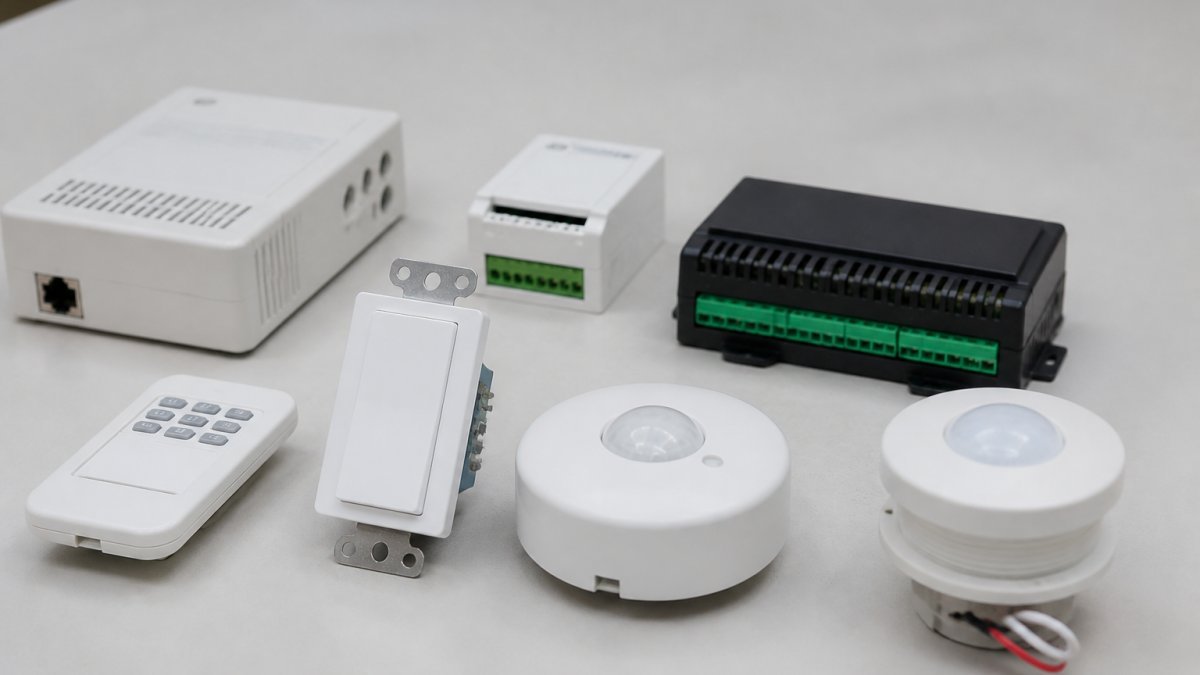
A lighting control system automatically adjusts light levels, timing, and brightness based on occupancy, daylight, and scheduling. The real value isn’t just lower energy bills, it’s the operational flexibility and reduced maintenance burden that compounds over years.
Energy Efficiency and Lower Operating Costs
The most obvious benefit is reduced electricity consumption: occupancy sensors turn lights off in empty spaces, daylight sensors dim fixtures when natural light suffices, and scheduled lighting aligns with facility hours.
But consistency matters more than headline savings. A 24/7 facility can’t rely on people remembering to switch lights off; automated systems enforce efficiency every shift.
Key efficiency mechanisms:
- Occupancy sensors eliminate lights left on in empty rooms
- Daylight harvesting reduces reliance on artificial light during business hours
- Time-based controls align lighting to actual occupancy patterns
Extended Equipment Life and Reduced Maintenance
Traditional lighting runs continuously at full power. LED fixtures with smart controls operate at lower average power and cycle less frequently, extending lamp and luminaire lifecycles.
The practical impact: fewer maintenance visits, less downtime, lower replacement costs. A warehouse with fixtures 30 feet high doesn’t want crews up there every few months.
Maintenance advantages:
- Reduced cycling extends lamp lifespan
- Lower operating temperatures protect electronic components
- Fewer replacements mean less labor and material cost
Safety, Security, and Occupant Comfort
Proper lighting design improves safety: emergency pathways stay illuminated, staircases and loading areas maintain consistent visibility, and security lighting deters unauthorized access.
Occupant comfort matters too. Responsive controls maintain appropriate light levels for the task at hand, so spaces feel less harsh than under constant maximum brightness.
Safety and comfort factors:
- Emergency lighting operates reliably during power events
- Security areas stay properly illuminated
- Responsive controls prevent eye strain from over-bright or dim conditions
Smart Lighting Controls vs Traditional Lighting: What Changes
The fundamental difference is responsiveness. Traditional lighting runs on a fixed schedule or manual switches. Smart lighting responds to real-time conditions.
Traditional systems use:
- Manual on/off switches
- Fixed schedules (if any automation at all)
- Full-brightness operation regardless of occupancy or daylight
Smart lighting controls use:
- Occupancy and motion sensors
- Daylight harvesting
- Responsive dimming
The gap widens in large facilities: a warehouse with hundreds of fixtures benefits enormously, while a small office sees modest savings.
Occupancy Sensors for Warehouse Lighting: Practical Impact
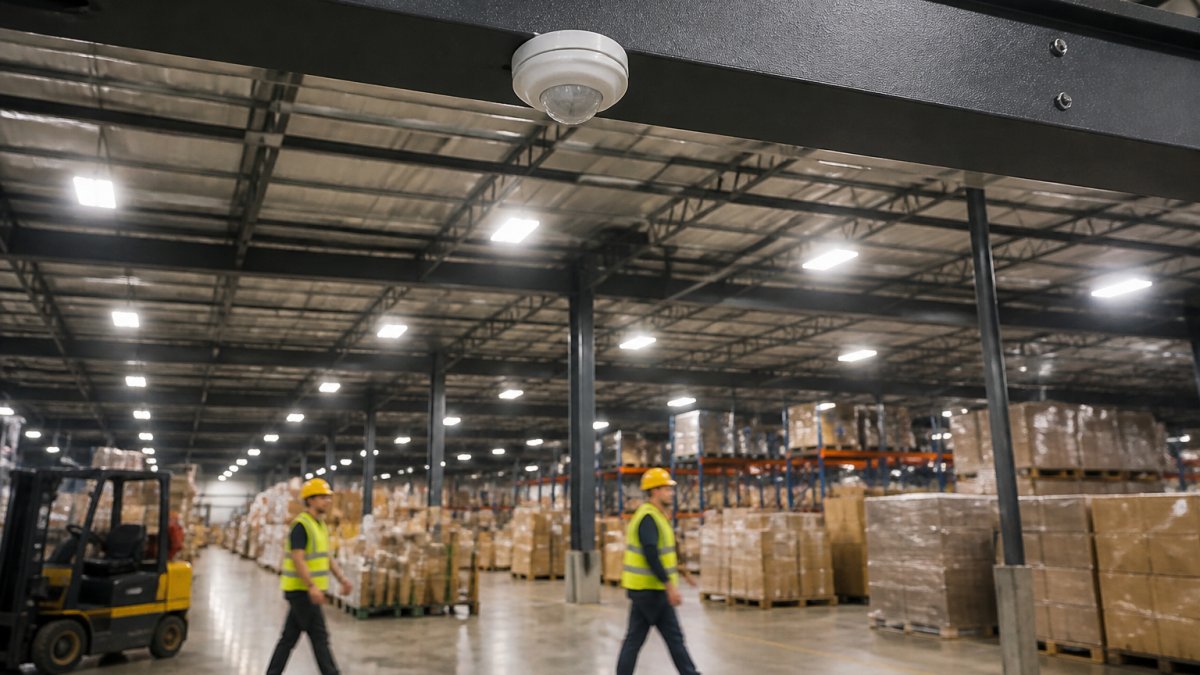
Occupancy sensors are the workhorse of warehouse lighting control. They detect movement and trigger lights on; when motion stops for a set period (typically 5-15 minutes), lights fade or shut off. For high-ceiling facilities, this solves a real problem: nobody manually controls lights 30+ feet overhead, and sensors deliver dramatic energy savings in spaces with variable occupancy, receiving areas, staging zones, break rooms.
How occupancy sensors work in practice:
- Motion detection triggers lights to full brightness
- Adjustable timeout periods match facility workflows
- Multiple sensors in large spaces prevent dark spots
Warehouse operators report that occupancy sensors eliminate the “lights on in empty zones” problem entirely.
The Real Drawbacks: Risks and Operational Challenges
Every technology has limitations. Most smart lighting failures are quiet: a sensor that stops detecting, a schedule that drifts, a network dependency nobody planned for. Below are the failure modes facility managers actually encounter.
Upfront and Hidden Costs
Installation of a lighting control system isn’t free. Sensor hardware, wiring, control panels, and professional installation add real expense, and utility rebates only offset some of it. Beyond hardware, hidden costs include system commissioning and testing, staff training, integration with existing building systems, and ongoing monitoring and adjustments. Facilities with older electrical infrastructure may need upgrades first; in pre-1980 buildings, the electrical remediation line often exceeds the controls hardware line.
Cost categories to budget for:
- Hardware: sensors, fixtures, control panels, wiring
- Installation: labor for mounting, electrical work, integration
- Commissioning: testing, calibration, system verification
Budget a contingency line of roughly 10-20% of the controls hardware cost. The most common overrun is not the controls themselves but the electrical work needed to support them.
Sensor Errors and Control Failures
The failure modes that erode trust are usually sensor-level, not system-level:
- False-off events. Passive infrared (PIR) sensors detect motion, not presence. A worker sitting still at a desk, reading in a storage aisle, or standing at a fixed workstation can be missed, and the lights drop out. Ultrasonic or dual-technology sensors reduce this, at higher cost and with more false-on triggers from air movement.
- False-on events. Air handling units, curtains moving near diffusers, and HVAC airflow can trigger ultrasonic sensors, keeping lights on in empty rooms and erasing the savings the system was sold on.
- Timeout mismatch. A 5-minute timeout saves energy but frustrates occupants in long-duration tasks; a 30-minute timeout is comfortable but cuts savings. There is no universal setting, and commissioning has to match the actual workflow.
Cybersecurity, Network Dependence, and Vendor Lock-In
Smart lighting systems connect to networks, and connected systems can be hacked.
Network dependence creates another risk. If your facility’s network goes down, some smart controls degrade gracefully (lights stay on). Others fail completely.
Vendor lock-in is real. Once you’ve installed one manufacturer’s sensors and control panels, switching to a competitor means replacing hardware. Proprietary software and closed ecosystems make migration expensive.
Get a Free Property Assessment →
Cybersecurity and operational risks:
- Network breaches can expose facility data
- System failures during outages may leave areas dark
- Manual overrides may be limited or unavailable
Ask three questions before signing: What happens to the lights when the network is down? Can a qualified third party service the system? Which open protocols does it support? The answers separate a long-lived asset from a five-year liability.
User Acceptance and Manual Override Challenges
Not everyone likes automated lighting. Some occupants feel they’ve lost control, and motion sensors that miss stationary workers create dark zones and dissatisfaction.
Manual overrides sound good in theory but are often hidden or hard to access.
User experience challenges:
- Occupants feel loss of control in automated spaces
- Motion sensors may not detect stationary activity
- Dim transitions can feel jarring or uncomfortable
Accessibility matters here too. Controls and overrides should be reachable and operable, and automatic dimming should not push light levels below what tasks and egress require.
Lighting Control System Installation Considerations
Professional installation matters. Sensor placement, wiring quality, and system configuration determine whether the system performs as intended.
Key installation factors:
- Sensor placement must cover all occupied zones without blind spots
- Wiring runs should be protected and properly sized
- Control panels need appropriate electrical supply and grounding
NexVolt Energy Group handles the full installation process, assessment, design, installation, and commissioning, verifying the system works as specified before handoff. Poor installation is a common reason smart lighting systems underperform. High-ceiling installations require specialized equipment and trained technicians, and not all contractors can safely install sensors and fixtures 30+ feet overhead.
Lighting Control System Maintenance: Long-Term Reliability
Smart lighting systems require ongoing attention. Sensors accumulate dust and lose sensitivity. Wiring connections loosen. Software needs updates. Neglected systems degrade over time.
Maintenance tasks:
- Clean sensors quarterly to maintain motion detection accuracy
- Inspect wiring and connections annually
- Test system performance against baseline measurements
A maintenance plan extends system life and prevents performance drift. Many facilities skip this step and wonder why their system stops working as expected after three years.
The good news: maintenance is straightforward and relatively inexpensive. Preventive maintenance costs far less than emergency repairs or full system replacement.
Is a Lighting Control System Right for Your Facility?
Most competitors answer this with a list of benefits. The more useful answer is a payback calculation you can run on your own building before you talk to a vendor, using the same logic a controls contractor uses during a walkthrough.
Run the Payback Math First
Payback is annual savings divided into net installed cost. The inputs that matter:
- Connected lighting load (kW). Fixture count times wattage, divided by 1,000.
- Annual operating hours. How many hours the lights currently run, not how many they should run.
- Occupancy factor. The share of those hours the space is actually occupied. A warehouse running 6,000 hours a year at 40% occupancy has a large addressable slice.
- Blended electricity rate ($/kWh). Use your actual utility bill, including demand charges if they apply.
- Controls savings fraction. Occupancy sensing, daylight harvesting, and scheduling typically stack to a meaningful share of lighting energy, but the fraction depends heavily on how wasteful the baseline is. A building that already runs manual switches well has less to gain.
A worked example with round numbers: 200 high-bay fixtures at 150 W each is 30 kW. At 6,000 hours a year that is 180,000 kWh. At $0.12/kWh the annual lighting bill is about $21,600. If controls cut lighting energy by 30%, savings are roughly $6,500 a year. Against a net installed cost in the low-to-mid five figures after rebates, payback lands in the several-year range, which is why the 3-5 year window is a reasonable planning assumption rather than a promise.
Use your own numbers, not a vendor’s. The single biggest error in payback estimates is using design operating hours instead of metered or logged hours.
Where the Money Actually Comes From
Savings are not evenly distributed across a facility. The fastest payback zones are:
- Warehouses and distribution centers with high-bay fixtures, variable occupancy, and long operating hours.
- Parking structures where occupancy is intermittent and fixtures run all night.
- Stairwells, restrooms, and storage rooms where lights are routinely left on.
Zones that pay back slowly or not at all: continuously occupied open offices with good manual habits, small spaces with few fixtures, and any area where the baseline is already efficient.
The Decision Checklist
Smart lighting controls make sense when:
- Your facility has variable occupancy (not fully occupied 24/7)
- High-ceiling or hard-to-reach fixtures make manual control impractical
- Energy costs are a significant operational expense
They make less sense when:
- Your facility is small with minimal occupancy variation
- All spaces are occupied continuously
- Upfront budget is extremely constrained
- Your facility lacks network infrastructure
What to Ask Before You Sign
- What is the net installed cost after utility rebates, in writing?
- What are the modeled annual kWh and dollar savings, and what assumptions produced them?
- What happens to lighting during a network outage, and where are the manual overrides?
- Which open protocols does the system support, and can a third party service it?
The decision depends on your specific situation. NexVolt Energy Group offers free property assessments to help facility managers understand whether smart lighting controls align with their goals and constraints. We evaluate your current lighting, occupancy patterns, electrical infrastructure, and operational priorities, then recommend solutions that actually fit your facility.
Frequently Asked Questions
What are the main benefits of a lighting control system?
Lighting control systems reduce energy consumption by 20-40% through occupancy sensors, scheduling, and dimming. They extend lamp and luminaire lifecycles by reducing runtime and stress, lower maintenance costs, improve workplace safety through responsive controls and emergency lighting integration, and enhance occupant comfort by adjusting light levels to match natural daylight and task requirements. Commercial buildings also benefit from better code compliance and design intent verification.
What are the risks and disadvantages of smart lighting controls?
Key risks include upfront installation and commissioning costs that may take 3-7 years to recoup through energy savings, network dependence and cybersecurity exposure if systems are connected to building networks, vendor lock-in that limits future flexibility, user acceptance issues when occupants cannot override automated controls, and potential failure modes if sensors malfunction or connectivity drops. Older buildings may require electrical upgrades before installation, adding unexpected costs.
How do occupancy sensors for warehouse lighting improve facility performance?
Occupancy sensors automatically turn lights on and off based on movement detection, eliminating wasted energy in unoccupied zones. In warehouses with high ceilings and large open areas, this reduces electricity costs significantly while improving safety by ensuring pathways and staircases remain lit when occupied. Combined with daylight sensors, they maintain consistent light levels throughout the day, reducing eye strain and improving worker productivity without requiring manual intervention.
What should facility managers consider before installing lighting controls?
Evaluate upfront costs against long-term energy and maintenance savings, verify that your electrical infrastructure can support the system without costly upgrades, assess cybersecurity requirements if the system connects to your building network, ensure compatibility with existing fixtures and building codes, plan for installation disruption and 24/7 facility operations, confirm that occupants have manual override access for comfort and accessibility, and verify that your vendor provides ongoing commissioning support and system documentation for future maintenance.