Table of Contents
- Step 1: Conduct a Warehouse Energy Efficiency Audit
- Step 2: Upgrade to Commercial LED Lighting Retrofit Benefits
- Step 3: Install Motion Sensors and Smart Controls
- Step 4: Optimize HVAC and Climate Control Systems
- Step 5: Improve Insulation and Seal Thermal Leaks
- Step 6: Access Utility Rebate Programs for Warehouses
- Step 7: Monitor Energy Consumption and Maintain Equipment
- Frequently Asked Questions
Last Updated: September 21, 2026
Step 1: Conduct a Warehouse Energy Efficiency Audit
An energy audit is your starting point for understanding how to lower warehouse electricity costs. It identifies where energy waste happens, quantifies the waste in dollars, and prioritizes improvements by return on investment. Without an audit, you’re making upgrades based on assumptions rather than data.

What a Professional Audit Measures
A comprehensive audit examines your entire facility and produces a detailed report with specific findings:
- Lighting inventory: Fixture type, wattage, age, operating hours, and condition. Auditors calculate annual lighting energy consumption and identify which areas consume the most.
- HVAC systems: Equipment age, efficiency rating (SEER/AFUE), thermostat settings, ductwork condition, and insulation levels. They measure actual operating temperatures and compare them to setpoints.
- Building envelope: Insulation R-values in walls, roof, and foundation. Thermal imaging identifies air leaks, cold spots, and heat loss patterns invisible to the naked eye.
- Operational patterns: When equipment runs, which areas are occupied during different shifts, and whether systems operate during unoccupied periods.
- Utility bill analysis: 12-month consumption history, demand charge patterns, peak usage windows, and seasonal variation.
- Equipment condition: Age and efficiency of motors, compressors, pumps, and material handling equipment.
Conducting Your Own Preliminary Audit
Start by collecting 12 months of utility bills. Create a spreadsheet with monthly energy consumption (kWh) and demand charges (kW). Plot these on a graph. Look for patterns:
- Do consumption and demand spike during specific months? (Summer cooling or winter heating peaks)
- Do demand charges spike on certain days or times? (Peak demand windows often occur 2 PM-8 PM on weekdays)
- Has consumption trended upward over the year? (Indicates equipment degradation or increased operational hours)
Walk through your warehouse with a detailed checklist:
- Lighting: Are lights on in unoccupied areas? How many fixtures are on during night shifts? Are high-bay fixtures (30+ feet overhead) original or recently upgraded? Do any fixtures flicker or dim (sign of ballast failure)?
- HVAC: Do thermostats show actual setpoints? Do systems run continuously or cycle based on need? Are there obvious air leaks around ducts, windows, or doors? Is ductwork insulated or exposed in unconditioned spaces?
- Insulation: Is insulation visible in walls, roof, or attic? Are there gaps around penetrations (pipes, electrical conduit, roof vents)? Does the roof show signs of deterioration or missing insulation?
- Doors and seals: Do dock doors seal completely when closed? Are dock levelers functioning? Do overhead doors close fully or leave gaps?
- Equipment: How old are major systems (HVAC, lighting, compressors)? Are there obvious signs of wear, rust, or leaks?
Take photos of problem areas. These details guide your next steps and provide baseline documentation for measuring improvement.
Prioritizing Findings by ROI
Not all improvements deliver equal returns. Prioritize by payback period:
- Quick wins (6-12 month payback): Motion sensors in intermittently used spaces, thermostat adjustments, sealing obvious air leaks, filter replacement, and equipment maintenance. These cost little and save immediately.
- Medium-term projects (2-4 year payback): LED retrofits, dock seals, HVAC optimization, and smart controls. These require capital investment but deliver substantial annual savings.
- Long-term investments (5+ year payback): Roof insulation, envelope improvements, and equipment replacement. These are necessary for older facilities but require larger budgets.
Calculate simple payback for each improvement: Annual savings ÷ Upgrade cost = Payback period in years. Improvements with 3-year payback or better are typically worth pursuing immediately. Those with 5+ year payback may require utility rebates or tax credits to justify the investment.
Professional Audit vs. DIY Assessment
A professional energy auditor uses thermal imaging cameras, power meters, and specialized software to measure what you cannot see. They identify hidden losses (air leaks, thermal bridging, equipment inefficiency) and provide a prioritized list with cost estimates and ROI projections.
If your facility is large (50,000+ sq ft) or your utility bills are high ($10,000+ monthly), a professional audit typically pays for itself within months through identified savings. Many utility companies offer free or subsidized audits as part of their commercial efficiency programs. Check with your local utility to see if this service is available.
For smaller facilities or as a preliminary step, a thorough DIY audit using the checklist above, combined with 12 months of utility bill analysis, provides enough data to prioritize your first improvements.
Step 2: Upgrade to Commercial LED Lighting Retrofit Benefits
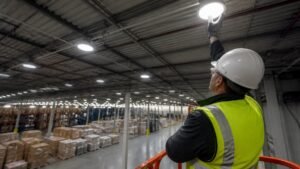
LED lighting retrofits deliver the fastest payback of any warehouse upgrade. Replacing old fluorescent or metal halide fixtures with LEDs cuts lighting costs by 50-70%.
Commercial LED lighting retrofit benefits extend beyond lower electricity bills. LEDs produce better light quality, which improves workplace safety and employee productivity. They also last 25,000-50,000 hours compared to 10,000-20,000 hours for traditional fixtures. That means fewer maintenance calls and less downtime.
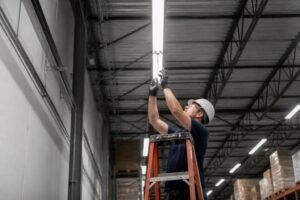
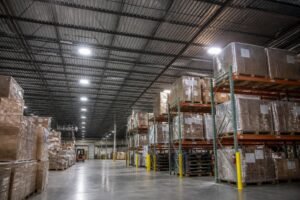
High-bay warehouses benefit most from LED upgrades. Fixtures mounted 30+ feet overhead are expensive to maintain. LED’s longer lifespan cuts maintenance costs significantly. Your team spends less time on ladders and more time on core operations.
Consider these LED advantages for your facility:
- 50-70% reduction in lighting energy consumption
- Better light quality and color rendering
- Longer fixture lifespan means fewer replacements
- Reduced heat output lowers cooling costs
- Dimming and control compatibility for further savings
- Improved visibility for safety and accuracy
The upfront cost of LED retrofit varies based on your facility size and fixture count. However, many warehouses qualify for utility rebates that offset or eliminate upfront expenses. NexVolt Energy Group handles rebate coordination so you don’t navigate paperwork alone.
Step 3: Install Motion Sensors and Smart Controls
Motion sensors and smart controls transform how your facility uses energy. Instead of lights running all night in empty spaces, sensors turn them on only when needed.
Get a Free Property Assessment →
Occupancy sensors work in warehouses where activity patterns change. Loading areas, offices, and break rooms see irregular use. Motion sensors detect presence and dim or shut off lights when spaces empty. This alone cuts lighting energy use by 20-30% in many facilities.
Smart controls add another layer of efficiency. Daylight harvesting systems dim artificial lights when natural light is sufficient. Time-based controls adjust lighting schedules based on actual operational hours. Some systems integrate with your HVAC, so climate control matches occupancy patterns too.
Installation considerations for motion sensors:
- Mounting height affects detection range (8-15 feet typical for warehouses)
- Sensor placement matters, avoid blind spots and direct sunlight on sensors
- Adjustment periods let you fine-tune sensitivity and delay times
- Multiple sensors work together in large spaces for accurate coverage
Smart controls also provide data. You see exactly when and where energy is consumed. This visibility helps identify further optimization opportunities. Many facility managers discover that equipment runs during off-hours when no one is using the space.
Step 4: Optimize HVAC and Climate Control Systems
HVAC systems often consume 40-50% of warehouse energy. Optimization here delivers significant savings without replacing equipment.
Start with your thermostat settings. Raising cooling setpoints by just 2-3 degrees in summer reduces energy use substantially. During winter, lowering heating setpoints by similar amounts saves without compromising worker comfort. Many warehouses maintain tighter climate control than necessary for operations.
Preventative maintenance keeps HVAC running efficiently. Dirty filters restrict airflow and force systems to work harder. Clean filters monthly during peak seasons.
Thermal management improvements include:
- Sealing air leaks around ducts and connections
- Insulating exposed ductwork in unconditioned spaces
- Installing programmable thermostats that adjust automatically
- Zoning systems so you condition only occupied areas
- High-volume, low-speed (HVLS) fans to circulate air and reduce reliance on heating and cooling
Step 5: Improve Insulation and Seal Thermal Leaks
Thermal barriers prevent conditioned air from escaping. Poor insulation forces your HVAC system to work constantly to maintain temperature.
Priority areas for sealing and insulation:
- Dock doors and loading bays (major sources of air leaks)
- Roof penetrations and skylights
- Wall gaps around utility entries
- Foundation cracks and floor perimeter
- Window and door frames
- Overhead doors that don’t seal completely
Step 6: Access Utility Rebate Programs for Warehouses
Utility rebate programs for warehouses offset the cost of energy upgrades. Many facility managers don’t realize these programs exist or how substantial the rebates can be.
Finding available programs requires research:
- Contact your local utility company directly
- Ask about commercial rebate programs
- Check if your state offers additional energy efficiency incentives
- Look for federal tax credits for certain upgrades
- Inquire about time-limited programs with higher incentive levels
Common rebate-eligible upgrades:
- LED lighting retrofits and fixtures
- Motion sensors and occupancy controls
- HVAC optimization and equipment upgrades
- Insulation and weatherization
- Energy management systems
- High-efficiency motors and drives
Step 7: Monitor Energy Consumption and Maintain Equipment
Monitoring transforms energy management from a one-time project into an ongoing process. Real data reveals what’s working and where problems develop.
Establish a maintenance schedule:
- Monthly: Check filters, inspect for obvious problems
- Quarterly: Review energy reports and compare to baseline
- Annually: Professional HVAC inspection and cleaning
- As needed: Repair or replace failing equipment
Frequently Asked Questions
What runs up a warehouse electric bill the most?
Lighting and HVAC systems account for the largest share of warehouse electricity costs. In facilities running 24/7, inefficient high-bay fixtures consume significant energy, especially older metal halide or fluorescent systems. Climate control, refrigeration (if applicable), and equipment operation add substantially to the bill. A warehouse energy efficiency audit identifies which systems consume the most power so you can prioritize upgrades for the fastest return on investment.
How much can LED lighting retrofits reduce warehouse electricity expenses?
Commercial LED lighting retrofit benefits typically deliver 50-70% energy savings on lighting costs alone, depending on your current fixtures and operating hours. Since lighting often represents 30-40% of total warehouse electricity consumption, a retrofit can reduce overall facility energy costs by 15-25%. Additional savings come from reduced maintenance, LED fixtures last 25,000-50,000 hours versus 10,000 hours for traditional bulbs, cutting replacement labor and material expenses.
How do utility rebate programs for warehouses work, and will you handle the paperwork?
Utility rebate programs for warehouses offer direct incentives for energy-efficient upgrades like LED retrofits and smart controls. Rebates typically cover 20-40% of project costs. NexVolt Energy Group manages the entire rebate coordination process, from eligibility verification through documentation and submission, removing the administrative burden from your team. This turnkey approach ensures you capture available incentives without navigating complex paperwork yourself.
Can you install LED lighting in high-bay warehouses over 30 feet tall?
Yes. NexVolt Energy Group specializes in high-bay warehouse installations, including fixtures 30+ feet overhead. Our team uses proper safety equipment, rigging, and specialized installation techniques to handle complex ceiling heights without requiring facility shutdown. We coordinate installation around your operating schedule to minimize operational disruption, whether your warehouse runs single-shift or 24/7 operations.