Table of Contents
- Why Industrial Energy Costs Are Rising in 2026
- Conduct an Industrial Energy Audit Checklist to Identify Savings
- LED Lighting Retrofits and Commercial LED Lighting Retrofit ROI
- Industrial Energy Efficiency Incentives and Tax Credits for 2026
- Energy Storage and On-Site Renewable Generation
- Negotiating Energy Supply Contracts and Managing Price Volatility
- Short-Term Cost Reduction Measures You Can Implement Now
- Frequently Asked Questions
Last Updated: September 27, 2026
Industrial facility managers face rising energy costs and intense pressure to cut expenses without sacrificing operations. Reducing industrial energy costs requires a practical, step-by-step approach that addresses both quick wins and long-term structural changes.
Why Industrial Energy Costs Are Rising in 2026
Energy prices remain volatile due to global supply chains and grid demand peaks. Many facilities now run extended hours or around-the-clock operations, increasing baseline electricity demand.
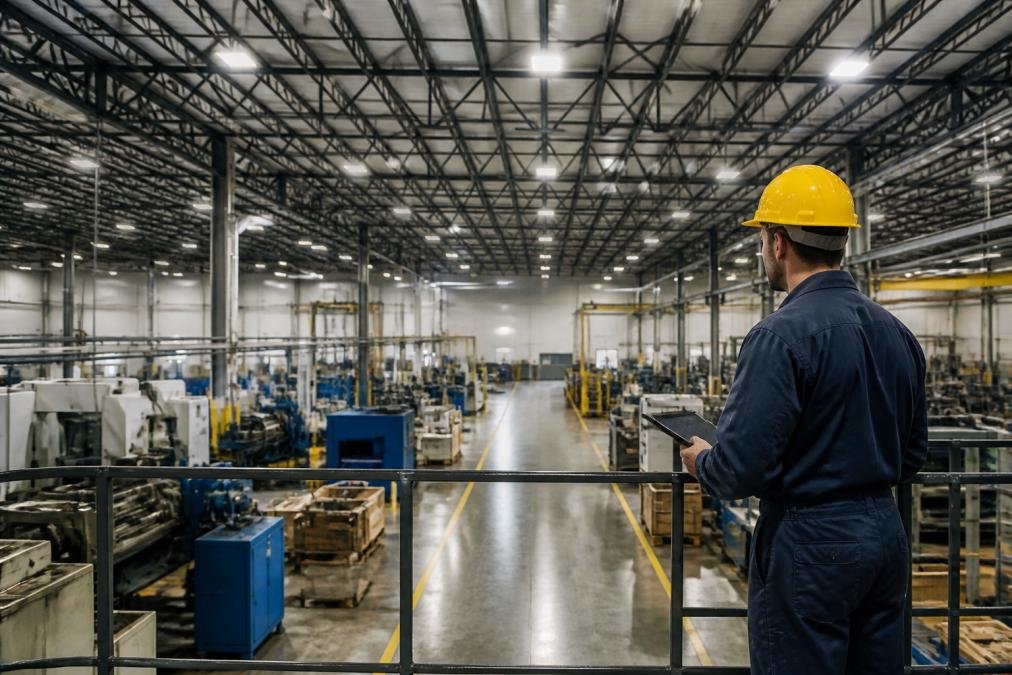
Most facilities operate with equipment installed 10-20 years ago. Older lighting, inefficient HVAC, and manual load management waste energy constantly because facility managers haven’t mapped where consumption is actually going.
Reducing industrial energy costs is achievable through new technology, utility incentive programs, and proven operational changes that deliver measurable savings within months.
Conduct an Industrial Energy Audit Checklist to Identify Savings
Start with data. An industrial energy audit checklist gives you a baseline by systematically documenting:
- Lighting systems: Type, age, wattage, hours of operation per zone
- HVAC equipment: Age, thermostat settings, maintenance schedule
- Motor-driven equipment: Compressors, pumps, fans, and their run times
- Compressed air systems: Leak points, pressure settings, usage patterns
- Process equipment: Ovens, boilers, chillers, and their efficiency ratings
- Building envelope: Insulation condition, air sealing, window quality
- Controls: Manual switches versus automated sensors and timers
Document actual usage patterns.
| Audit Category | What to Check | Why It Matters |
|---|---|---|
| Lighting | Fixture type, wattage, occupancy patterns | Lighting is often 20-40% of industrial energy use |
| HVAC | Equipment age, thermostat settings, duct condition | Heating and cooling drive major consumption spikes |
| Motors & Compressors | Run times, pressure settings, maintenance logs | Inefficient motors waste energy continuously |
| Building Envelope | Insulation, air leaks, door seals | Poor envelope control forces HVAC to work harder |
| Controls | Manual vs. automated, sensor placement | Manual operation often means equipment runs when not needed |
LED Lighting Retrofits and Commercial LED Lighting Retrofit ROI
Lighting is where most industrial facilities find their fastest wins. LEDs use 60-75% less energy than older technologies (Saving American Families and Businesses Money through Lighting Efficiency). A warehouse with 200 high-bay fixtures running 20 hours per day can cut lighting energy costs by tens of thousands annually. The commercial LED lighting retrofit ROI typically delivers payback in 2-4 years.
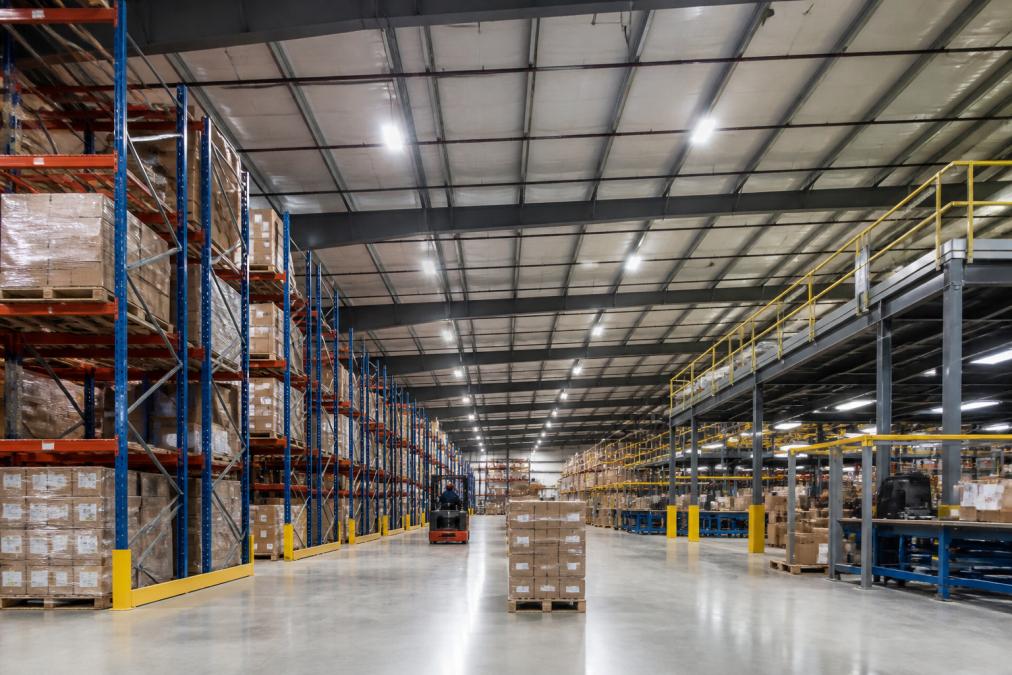
High-Bay and Warehouse Lighting Solutions
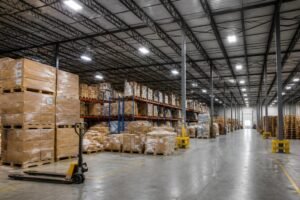
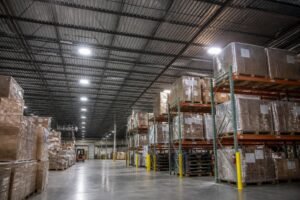
Modern LED high-bays deliver instant-on capability, better light distribution, longer lifespan (50,000+ hours vs. 15,000-20,000 for older tech), and lower maintenance costs. Energy savings alone justify the retrofit; reduced maintenance labor accelerates returns.
Smart Controls and Occupancy Sensors
Occupancy sensors and daylight harvesting paired with LEDs cut lighting energy by 30-50% in low-traffic areas. Smart controls also provide visibility into consumption patterns, often revealing operational inefficiencies like storage zones lit all night despite daytime-only access.
Industrial Energy Efficiency Incentives and Tax Credits for 2026
Utility companies and government programs offer incentives for energy efficiency upgrades. Missing deadlines or failing to pre-qualify can cost tens of thousands in lost rebates.
Federal Tax Credits and Deductions
Section 179D allows deductions up to $1.88/sq ft for building envelope, HVAC, and lighting retrofits reducing energy use by 50% vs. baseline code. The Investment Tax Credit (ITC) covers 30% of solar and storage costs, dollar-for-dollar against tax liability. Both require work completed and placed in service during the tax year claimed.
Utility Rebate Programs and Pre-Approval Requirements
Most utilities offer rebates covering 20-40% of project costs for LED retrofits, HVAC upgrades, and equipment replacements. Pre-approval before work begins is critical, submit specifications, quotes, and baseline data before installation. Completing work first disqualifies you from most programs. Application timelines range from 2-8 weeks; apply early as programs often fill during peak seasons.
Common rebate levels for industrial facilities:
- LED high-bay retrofit: $0.50-$1.50 per fixture (depending on wattage reduction)
- Occupancy sensors: $25-$75 per sensor
- HVAC commissioning: $500-$2,000 per system
- Variable frequency drives (VFDs) on motors: $100-$300 per motor
- Compressed air leak repair: Flat rebate of $500-$1,500 per facility
State and Local Incentive Programs
State and local programs offer direct grants for audits, low-interest financing, performance-based rebates, and accelerated depreciation. Eligibility varies by location, check your state energy office and local utility for facility-specific programs.
Managing the Incentive Application Process
Coordinate incentives by: (1) conducting your energy audit first, (2) identifying all applicable programs before designing your project, (3) submitting pre-approval requests 6-8 weeks before installation, (4) confirming tax credit eligibility with your advisor, (5) coordinating timing to complete work in the same tax year, and (6) documenting everything. Missing deadlines can reduce net project cost by 30-50%.
Get a Free Property Assessment →
Energy Storage and On-Site Renewable Generation
On-site solar and storage can offset grid consumption and reduce peak demand costs, but economics depend heavily on load profile, electricity rates, and incentives. A thorough analysis is essential before committing capital.
Solar Generation: Sizing and Economics
Solar systems generate 4-6 kWh per kW annually depending on location. Size systems based on daytime consumption (6 AM-6 PM). A facility consuming 500 kWh daily might install 75-100 kW to offset 40-60% of daytime use. Economics depend on rate structure, facilities with high daytime rates benefit most.
Energy Storage: When It Makes Economic Sense
Battery storage systems capture excess solar generation for use during evening hours or peak-rate periods. Storage is valuable only if your facility has a reason to use stored energy at a higher value than the cost of storing it.
Common storage use cases:
- Peak shaving: Your utility charges high demand charges based on your single highest 15-minute consumption window each month. A battery system that discharges during peak hours reduces that demand window, lowering demand charges by 10-30%. For facilities with demand charges exceeding $15/kW/month, peak shaving alone can justify storage.
- Time-of-use (TOU) arbitrage: Your utility charges different rates at different times. A battery charged during low-rate hours and discharged during high-rate hours captures the rate difference. If the rate difference is $0.10/kWh or more, storage economics improve significantly.
- Backup power: Storage provides resilience during grid outages. If your facility operates mission-critical equipment or faces revenue loss during outages, backup power has tangible value beyond energy cost savings.
- Demand-response participation: Some utilities pay facilities to discharge stored energy during grid stress events. Participating in these programs can generate $5,000-$20,000 annually for a 100 kWh system.
Payback Analysis: Solar Plus Storage
Combining solar and storage requires evaluating the combined system economics, not each component separately.
Example: 100 kW solar + 100 kWh battery system
- Solar cost (after 30% ITC): $140,000
- Battery cost (after 30% ITC): $10,500
- Total net cost: $150,500
- Annual energy savings (solar alone): $12,000-$18,000 (depending on rates)
- Annual demand charge reduction (storage): $2,000-$5,000
- Annual demand-response payments (if applicable): $0-$3,000
- Total annual benefit: $14,000-$26,000
- Payback period: 6-11 years
Battery Degradation and Replacement Costs
Lithium-ion batteries retain 80-90% capacity after 10 years and 70-80% after 15 years. A 100 kWh system degrading to 80% capacity loses 20 kWh of usable storage, factor this into long-term ROI. Replacement after 10-15 years costs $100-$150/kWh, or $10,000-$15,000 for a 100 kWh system.
Wind Generation for Industrial Facilities
Small-scale wind turbines require consistent wind speeds of 10-12 mph average. Most industrial facilities lack adequate resources unless in coastal, plains, or hilltop locations. A 20 kW turbine generates 40,000-60,000 kWh annually in good wind areas at $3.00-$5.00/watt ($60,000-$100,000 total). Payback is typically 10-20 years, making wind less attractive than solar for most applications.
Integrating Renewable Generation into Your Energy Strategy
On-site generation works best as part of a broader energy strategy including efficiency improvements and contract optimization. Start with an energy audit and rate analysis to determine consumption profile, peak demand windows, and rate structure. Model solar and storage scenarios to identify the configuration delivering acceptable returns for your facility.
Negotiating Energy Supply Contracts and Managing Price Volatility
Larger industrial facilities can negotiate directly with energy suppliers to lock in rates during favorable market conditions. Understanding your load profile is essential, peak demand charges often exceed per-unit energy rates. Fixed-rate contracts eliminate volatility; variable-rate contracts offer lower initial rates but expose you to market fluctuations. Demand-response programs pay you to reduce consumption during grid stress events, requiring flexibility to curtail non-critical loads.
Short-Term Cost Reduction Measures You Can Implement Now
Not every savings strategy requires capital investment. Several operational changes deliver immediate results.
Frequently Asked Questions
What federal tax incentives are available for industrial energy efficiency upgrades in 2026?
The Energy Efficiency and Conservation Block Grant Program and Section 179D tax deduction remain available for commercial buildings undertaking energy efficiency improvements, including LED lighting retrofits and HVAC upgrades. Additionally, the Investment Tax Credit (ITC) applies to solar and energy storage installations. Facility managers should consult with their tax advisor and utility provider to identify which federal, state, and local incentives apply to their specific industrial energy audit findings and retrofit scope.
What is the ROI timeline for a commercial LED lighting retrofit in an industrial facility?
Most industrial LED lighting retrofits achieve payback within 3 to 5 years through reduced energy consumption and lower maintenance costs. High-bay warehouses and distribution centers often see faster payback because they operate longer hours and use more electricity. When combined with utility rebates and tax incentives, payback can drop to 2 to 3 years. The exact ROI depends on your facility’s current lighting type, operating hours, local electricity rates, and available incentives, a professional energy audit provides precise numbers for your building.
How much can occupancy sensors reduce energy consumption in industrial facilities?
Occupancy sensors and smart lighting controls typically reduce energy use by 20% to 40% in spaces with variable occupancy patterns, such as warehouses, parking garages, and manufacturing areas. The savings depend on how frequently spaces are unoccupied and whether sensors are paired with LED fixtures. In 24/7 industrial operations, sensors on break rooms, offices, and auxiliary spaces deliver the most benefit. A detailed energy audit identifies which zones will benefit most from occupancy-based controls.
Why is electricity so expensive in 2026, and how can I prepare for price volatility?
Industrial electricity prices in 2026 reflect increased demand, grid modernization investments, and ongoing energy transition costs. Prices remain volatile due to fuel costs, weather patterns, and policy changes. Facility managers can prepare by conducting regular energy audits, locking in fixed-rate energy supply contracts where possible, investing in energy efficiency to lower overall consumption, and exploring on-site renewable generation or energy storage. These steps reduce exposure to price spikes and create more predictable operating costs.