Table of Contents
- Why Upgrade Warehouse Lighting Now
- What You’ll Need Before Starting Your Upgrade
- Best LED Color Temperature for Warehouses
- Warehouse Lighting Retrofit vs Replacement: Which Approach Fits Your Facility
- OSHA Warehouse Lighting Requirements and Safety Standards
- Securing Commercial Lighting Utility Rebates and Incentives
- Installation Steps and Common Mistakes to Avoid
- Conclusion
- Frequently Asked Questions
Last Updated: October 11, 2026
Why Upgrade Warehouse Lighting Now
Warehouse lighting is often one of the largest controllable expenses in a facility. Aging high-bay fixtures waste electricity and create maintenance headaches, while LED technology cuts both energy consumption and maintenance costs over the fixture lifespan.
There’s also a safety imperative: poor lighting increases accidents, reduces productivity, and hurts morale. Modern LEDs deliver superior light distribution and color rendering, so workers spot hazards and perform tasks accurately. When you upgrade warehouse lighting, you invest in worker safety as much as efficiency.
Timing matters because utility rebate programs have expanded significantly, letting many facilities complete LED upgrades with minimal or zero upfront capital. At NexVolt Energy Group, we handle rebate coordination, removing the administrative burden that often deters facility managers.
What You’ll Need Before Starting Your Upgrade
Before committing to an upgrade, assess your facility thoroughly. Document existing fixture types, wattage, mounting heights, and condition.
Review your utility bills for the past 12 months to establish an energy baseline. This data is essential for calculating ROI and verifying that rebate savings materialize after installation.
Identify your highest-demand areas.
Gather information about your electrical infrastructure. Older buildings may have outdated wiring or panel capacity limits requiring upgrades before LED installation; understanding these constraints upfront prevents costly surprises.
Document your operating schedule. If your warehouse runs 24/7, installation timing is critical; NexVolt Energy Group coordinates with your operations team to minimize disruption and schedule work during lower-traffic periods.
Best LED Color Temperature for Warehouses
The ideal color temperature for warehouses is 4000K-5000K, a neutral white that balances visibility with worker comfort. Lower temperatures (3000K) feel warm and yellowish, fine for offices, suboptimal for task-heavy work.
Color rendering index (CRI) matters equally. Measured 0-100, CRI indicates how accurately colors appear under a light source.
Combining 4000K-5000K with CRI 80+ keeps workers alert and reliable on detail-oriented tasks, and supports the security camera footage quality many facilities require for loss prevention.
Match color temperature to function: cold storage may benefit from slightly cooler temperatures, while general storage and administrative zones work well at 4500K. Aim for consistency across zones while matching light quality to each area’s tasks.
Warehouse Lighting Retrofit vs Replacement: Which Approach Fits Your Facility
A retrofit involves replacing the light source (lamps and ballasts) while keeping existing fixtures. A full replacement installs new fixtures entirely.
Retrofit upgrades work best when existing fixtures are structurally sound but outdated.
Full replacement becomes necessary when fixtures show corrosion, poor light distribution, or incompatibility with modern LED drivers. Newer fixtures often include integrated occupancy sensors and dimming controls retrofit kits can’t provide, enabling long-term savings beyond the basic LED conversion.
Consider fixture geometry and beam angle. Older fixtures often distribute light poorly, creating dark spots or glare, while new fixtures use optimized reflectors and lenses for more uniform illumination.
Controls-Readiness Checklist
Before you commit to either path, verify these five items. If two or more fail, full replacement is usually the better long-term decision:
- Driver compatibility, Can the fixture accept a 0-10V, DALI, or proprietary networked driver without voiding the fixture warranty?
- Sensor mounting, Is there a factory provision for high-bay occupancy sensors, or will sensors need to be field-mounted on separate brackets?
- Dimming range, Does the driver dim smoothly down to 10% or lower, or does it cut out below 30%? Low-end dimming performance determines whether daylight harvesting actually saves energy.
- Network protocol, Does the fixture support a wireless mesh (such as Zigbee or Bluetooth mesh) or does it require dedicated control wiring back to a panel?
- Warranty coverage, Does adding third-party controls void the fixture warranty? Some manufacturers require their own control ecosystem to maintain coverage.
Where Each Approach Wins
| Approach | Best For | Timeline | Upfront Disruption | Controls Capability |
|---|---|---|---|---|
| Retrofit | Sound existing fixtures, budget-conscious, single-shift operations | 2-4 weeks | Minimal | Limited, usually no networked dimming |
| Full Replacement | Aging or damaged fixtures, multi-shift operations, smart controls desired | 4-8 weeks | Moderate | Full, sensors, dimming, and network integration |
| Hybrid | Mixed facility conditions, phased approach, controls in high-value zones only | 6-12 weeks | Phased | Zone-dependent |
NexVolt Energy Group assesses both approaches during the property evaluation, analyzing your facility’s conditions and recommending the best long-term value. Sometimes a hybrid approach makes sense: retrofit some zones while replacing fixtures in others.
If you are not ready to commit to a full controls platform today, at minimum specify fixtures with 0-10V dimming leads and a standard sensor port. That single decision preserves your ability to add occupancy sensors and daylight harvesting later without replacing fixtures.
OSHA Warehouse Lighting Requirements and Safety Standards
Lighting requirements depend on the work performed and the standards that apply to the facility. The cited OSHA 1915.82 lighting standard applies to shipyard employment; it is not a universal 30-foot-candle requirement for ordinary warehouses. Have a qualified lighting professional assess the applicable requirements and task-specific lighting needs before selecting fixtures.
Foot-candles measure light intensity at a surface; one foot-candle equals one lumen per square foot.
A warehouse lighting design should also consider uniformity and glare control. Uneven lighting can create shadows and dark spots, while excessive glare can make visual tasks difficult.
Safety standards also address flicker-free operation. Flickering lights cause headaches and reduced alertness; high-quality LED drivers eliminate flicker, supporting worker health and productivity during extended shifts.
Get a Free Property Assessment →
Thermal management matters too. LEDs generate less heat than older systems, reducing fire risk where flammable materials are stored and preventing ceiling damage that shortens the lifespan of adjacent structures.
Securing Commercial Lighting Utility Rebates and Incentives
Most utility companies offer rebates for commercial LED lighting upgrades, offsetting a significant portion of project costs and sometimes covering the entire installation.
The application process involves documentation and verification: equipment specifications, before-and-after energy calculations, and proof of installation.
NexVolt Energy Group handles the entire rebate coordination process: preparing the application, submitting documentation, verifying qualification, tracking status, and ensuring timely payment.
Common eligibility requirements include ENERGY STAR certified fixtures, licensed contractors, and specific efficiency benchmarks, with exact criteria set by your utility provider.
Timing matters: some utilities cap annual rebate spending and process applications first-come, first-served. Starting early ensures your facility secures the incentive before funding depletes.
Installation Steps and Common Mistakes to Avoid
Professional installation of high-bay warehouse fixtures requires specialized equipment, training, and safety protocols, not a task for general contractors. It involves working at heights, managing electrical connections, and ensuring proper fixture alignment for optimal light distribution.
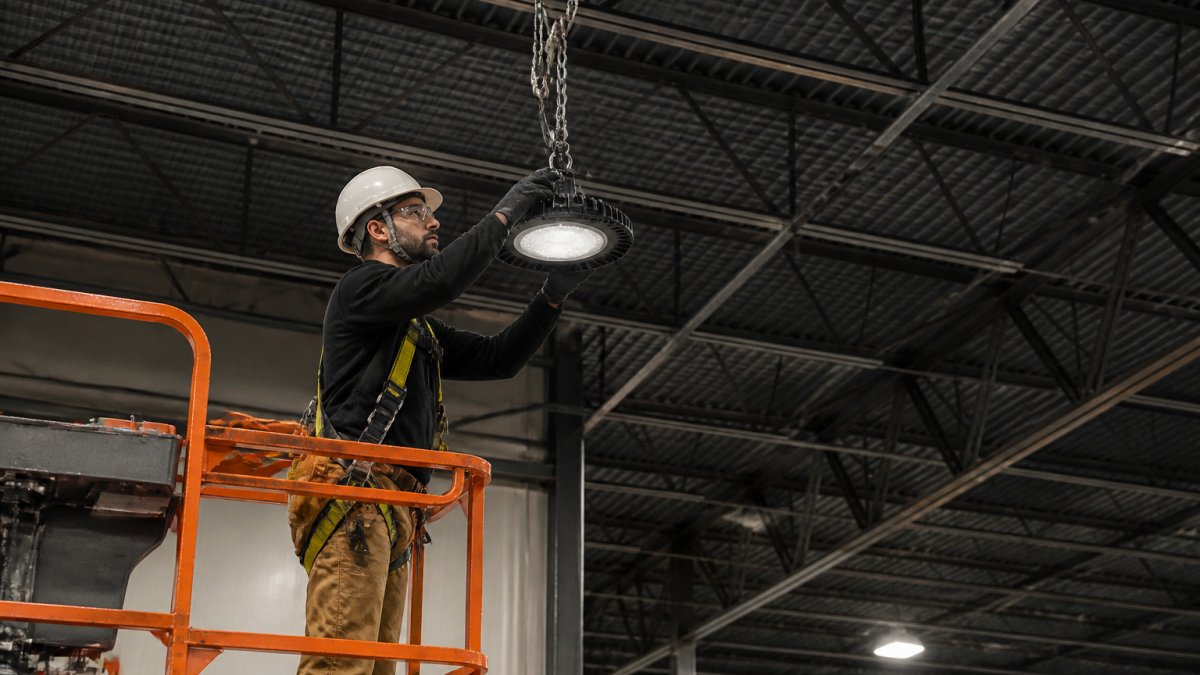
Installation begins with a detailed lighting design. Our team calculates fixture placement, quantity, and orientation to achieve required foot-candles facility-wide, preventing mistakes like insufficient coverage or wasted fixtures in low-traffic areas.
Design the Layout by Zone, Not by Square Footage
The single biggest mistake in warehouse lighting upgrades is treating the facility as one uniform space. A 200,000-square-foot building has at least four distinct lighting zones, and each has different requirements:
- High-density racking aisles, Vertical illuminance on the rack faces matters more than horizontal foot-candles on the floor. Aim for uniform vertical illumination so workers can read labels at every shelf level. Narrow beam angles (60-90 degrees) mounted directly over the aisle centerline reduce spillover into adjacent aisles and cut fixture counts.
- Loading docks and shipping, These areas need the highest illuminance because of task precision, vehicle movement, and the contrast between bright exterior daylight and interior space. Use wider beam angles and consider higher color temperature to match daylight during open-door periods.
- Packing and staging stations, Task-level lighting at the work surface matters more than ceiling-level uniformity. Consider lower-mounted linear fixtures or task lighting in addition to high bays.
- Open storage and bulk floor areas, Standard high-bay layout with symmetric distribution works here. This is where you can safely reduce fixture density if the space is low-traffic.
Mapping these zones before ordering fixtures prevents the most expensive retrofit error: buying a uniform fixture package that over-lights some areas and under-lights others.
Electrical Preparation and Smart Controls Integration
Electrical preparation comes next. Panel upgrades or new circuits must be completed before fixture installation; coordinating the two prevents scheduling conflicts and keeps the project on track.
If installing networked controls, plan the network architecture before the first fixture goes up. Wireless mesh systems (Zigbee, Bluetooth mesh, or proprietary equivalents) need a gateway with adequate facility-wide coverage; wired systems need low-voltage control wiring alongside power circuits.
Place occupancy sensors where they’ll actually save energy, aisles with intermittent traffic, restrooms, break areas, and staging zones. Sensors in continuously occupied areas deliver no savings and add cost. Daylight harvesting sensors belong near skylights or perimeter windows, where they dim fixtures in response to natural light.
Mounting, Alignment, and Commissioning
Fixture mounting and alignment require precision; improper angles reduce light distribution and create glare. Our installation teams use laser alignment tools to position fixtures at exact angles for uniform illumination across your warehouse floor.
Wiring demands attention to detail. LED drivers must be installed correctly to prevent flickering or premature failure, and all connections follow electrical code and are tested before the system goes live.
Commissioning is the step most facilities skip, and the one that determines whether controls actually deliver savings. Sensor sensitivity is tuned, dimming schedules programmed, and daylight harvesting setpoints calibrated. A system installed but not commissioned typically delivers a fraction of its projected savings.
Common Mistakes That Undermine the Upgrade
- Rushing the layout design. Facilities that skip the design phase often end up with dark spots, excessive glare, or insufficient coverage in critical areas. The initial design investment prevents costly corrections later.
- Choosing fixtures on price alone. A cheaper fixture with poor optics may require more units to achieve adequate coverage, negating any cost savings. Beam angle and light distribution characteristics matter more than unit cost.
- Overlooking occupancy sensor integration. Sensors reduce energy consumption by dimming or shutting off lights in unoccupied zones. This feature pays for itself through energy savings within the first few years of operation.
- Skipping commissioning. An uncommissioned controls system is a controls system that is not saving money.
- Ignoring legacy lamp disposal. Old HID and fluorescent lamps contain mercury and other regulated materials. Federal rules under the Resource Conservation and Recovery Act (RCRA) govern how these lamps must be handled at end of life, and many states add stricter requirements. Plan for proper recycling or hazardous waste disposal before removal begins, not after the pallets of old lamps are sitting in your loading dock.
Fluorescent and HID lamps are regulated waste in most jurisdictions. Do not send them to a standard dumpster. Budget for lamp recycling as a line item in the project, and get documentation from your disposal vendor in case of an audit.
Conclusion
Upgrading warehouse lighting reduces energy costs, improves safety, and extends fixture lifespan. LED technology, proper installation, and utility rebate coordination together make a compelling financial case for modernization. NexVolt Energy Group manages every stage of your upgrade, from property assessment through installation and rebate verification, specializing in warehouse and industrial lighting with occupancy sensors and smart controls that deliver measurable long-term value. Get a free property assessment from NexVolt Energy Group and discover how much your facility can save.
Frequently Asked Questions
What is the best LED color temperature for warehouses?
Most warehouses perform best with 4000K to 5000K color temperature. This range provides neutral white light that enhances visibility for picking and packing operations while reducing eye strain during long shifts. Higher kelvin values (5000K+) work well in distribution centers where task accuracy is critical. Lower values (4000K) suit warehouses with existing warm ambient lighting. Color rendering index (CRI) of 70 or higher ensures accurate color identification for inventory management.
How much can you save by upgrading warehouse lighting to LED?
LED upgrades typically reduce lighting energy consumption by 50-75% compared to traditional high-bay fixtures. Actual savings depend on your current fixture type, operating hours, and local electricity rates. Many facilities also see reduced maintenance costs since LEDs last 50,000+ hours versus 15,000-20,000 for metal halide. Combined energy and maintenance savings provide significant long-term value.
Should I choose a retrofit kit or replace the entire fixture?
Retrofit kits work best for facilities with modern, structurally sound fixtures where only the lamp and ballast need updating. Full replacement is preferable when existing fixtures are over 15 years old, damaged, or lack proper thermal management. Replacement allows you to optimize beam angle, lumen output, and mounting height for your specific layout. Retrofit costs less upfront; replacement provides better long-term performance, warranty coverage, and integration with smart controls like occupancy sensors and dimming.
What are the OSHA requirements for warehouse lighting levels?
Required illumination depends on the tasks, areas and standards applicable to your facility. A qualified lighting professional should assess loading docks, storage aisles and workstations separately, including uniformity and glare, rather than applying one universal light level throughout the building.