Table of Contents
- Why LED Lighting Safety Matters in Warehouses
- OSHA Warehouse Lighting Requirements and Standards
- How Lighting Affects Worker Safety and Visibility
- Best LED Color Temperature for Warehouses
- Warehouse Aisle Lighting: Placement and Coverage
- Warehouse Lighting Checklist: Step-by-Step Safety Audit
- LED Lighting Benefits for Accident Prevention
- Implementing Safe LED Lighting in Your Warehouse
- Frequently Asked Questions
Last Updated: October 12, 2026
Why LED Lighting Safety Matters in Warehouses
Warehouse safety depends on one thing most facility managers overlook: light. Poor lighting causes accidents, workers miss floor hazards, forklifts collide with obstacles, and injuries spike.
LED lighting safety for warehouse workers isn’t just about brighter bulbs. It’s about how light affects what workers see, how eyes adapt between zones, and how to eliminate the dark spots and shadows that create hazards.
OSHA Warehouse Lighting Requirements and Standards
OSHA doesn’t specify a single lighting standard for all warehouses, it requires adequate illumination for the tasks performed.
Industry guidance sets the benchmark: general warehouse areas need 20-50 foot-candles, fine detail work like reading labels requires 100-200 foot-candles, and forklift traffic areas need at least 30 foot-candles so operators can spot obstacles and workers.
The key OSHA requirement is that lighting must match the hazards present. If workers can’t see a pallet on the floor, a ladder against a rack, or a coworker in an aisle, the lighting is inadequate.
Measure your current lighting with a simple light meter (available for under $50). Take readings at floor level in different zones: aisles, work areas, storage shelves, and loading docks. Compare them to your task requirements. This 30-minute audit reveals gaps immediately.
How Lighting Affects Worker Safety and Visibility
Workers make better decisions and move more carefully when they can see clearly. Bright, even lighting lets them work at normal pace with confidence.
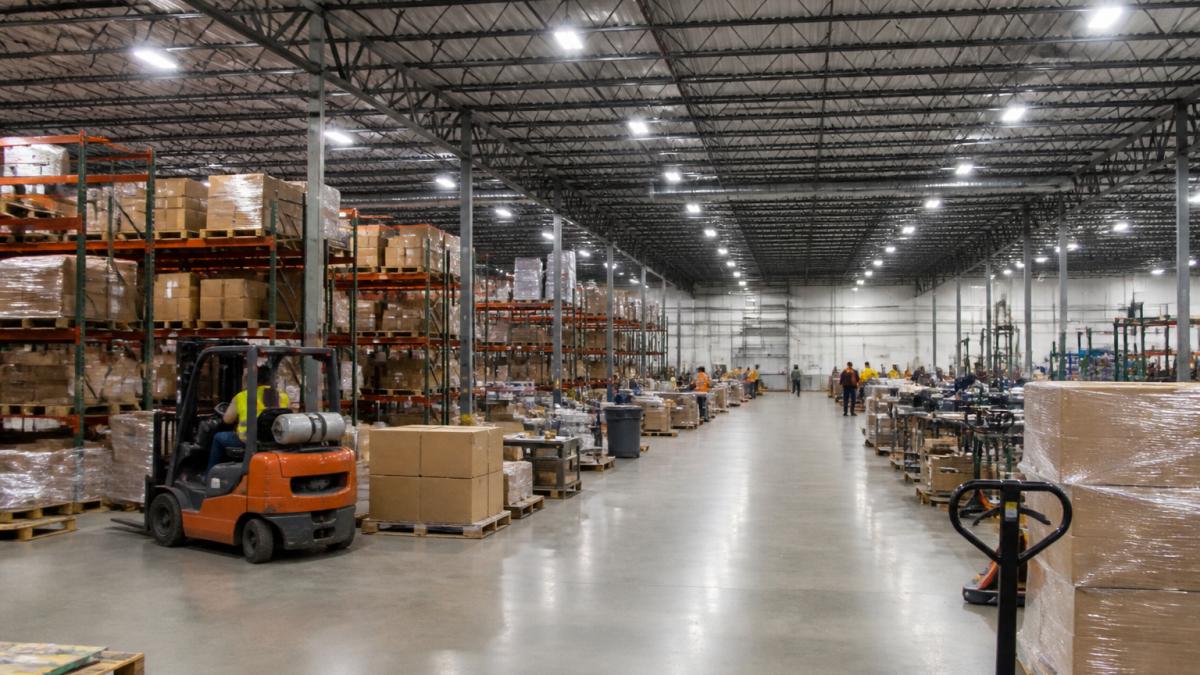
Visibility isn’t just about brightness, it’s about consistency. A warehouse with bright spots and dark corners is more dangerous than one with uniform moderate light, because eyes adjust to bright areas and then struggle in shadows.
LED lighting improves visibility in three ways:
- Even distribution: Modern LED fixtures spread light uniformly across the work area, eliminating dark pockets
- Reduced glare: Quality LEDs don’t create harsh reflections off metal shelving or wet floors that blind workers
- Better color rendering: LEDs show the true colors of objects, making it easier to spot damage, stains, or misplaced items
Illumination Levels and Safe Working Conditions
Foot-candles measure light intensity at a surface, one foot-candle equals one lumen per square foot. The level you choose depends on what workers do in each zone.
Here’s what different tasks require:
- General warehouse areas and aisles: 20-30 foot-candles minimum
- Packing and assembly stations: 50-100 foot-candles
- Inspection and quality control: 100-200 foot-candles
- Loading and unloading docks: 30-50 foot-candles
- Forklift routes and material handling: 30-50 foot-candles
- Emergency exit routes: 1-2 foot-candles minimum (enough to see the path)
The mistake most warehouses make is lighting everything the same. Tailoring light levels to tasks saves energy and keeps workers safe.
Overlighting wastes energy and creates glare. Underlighting causes accidents. The goal is the minimum light level that lets workers perform their task safely and accurately. Too bright is as problematic as too dim.
Reducing Shadows, Dark Spots, and Glare
Shadows are the enemy of warehouse safety. A single overhead fixture creates a shadow directly beneath it, and workers moving through alternating bright and dark zones can’t adapt fast enough, hazards go unnoticed.
LED lighting solves this with better placement and distribution.
Glare is equally dangerous. Light reflecting off polished concrete, wet floors, or metal shelving reduces visibility, workers squint, pupils contract, and they see less detail.
To eliminate shadows and glare:
- Position fixtures to overlap coverage areas
- Use diffusers or frosted lenses to soften direct light
- Avoid placing fixtures directly above reflective surfaces
- Choose matte finishes for shelving and equipment when possible
- Test the lighting with workers present, their feedback reveals problem zones
Best LED Color Temperature for Warehouses
Color temperature measures how “warm” or “cool” light appears, in Kelvin (K). Lower numbers (2700K) produce warm, yellowish light; higher numbers (5000K and above) produce cool, bluish light.
For warehouses, the science is clear: cooler light improves alertness and visibility. Workers focus better, their pupils stay more responsive, and colors appear more distinct.
Color Temperature and Worker Alertness
Research shows workers exposed to cooler light (4000-5000K) maintain better focus during long shifts.
For 24/7 operations this matters: night-shift workers already fight fatigue, and warm lighting makes it worse.
The trade-off: cool light can feel harsh if not implemented carefully. Pair cooler color temperature with proper brightness levels and diffusers to get alertness without discomfort.
Most warehouse operators settle on 4000K as the sweet spot.
Flicker-Free LED Lighting and Eye Strain Reduction
Flicker is invisible to the eye but detectable by the brain.
Quality LEDs flicker at rates imperceptible to the human nervous system, or don’t flicker at all.
In a warehouse, workers already face visual stress, scanning shelves, reading labels, tracking moving equipment.
Specify flicker-free LED fixtures with high-frequency drivers. The cost difference is minimal, and the safety and comfort improvement is measurable.
Flicker-free LEDs at 4000-5000K color temperature create the safest, most alert warehouse workforce. This combination is the standard for modern industrial facilities.
Warehouse Aisle Lighting: Placement and Coverage
Aisle lighting is where most warehouses get it wrong.
Proper aisle lighting requires thinking about sight lines: workers need to see down an aisle before entering it, spot obstacles at eye level and on the floor, and see the shelves they’re accessing.
Fixtures must light the aisle itself, not just the floor. Wall-mounted fixtures at mid-height (8-12 feet) combined with overhead fixtures create the needed visibility.
Task Lighting for Work Areas and Material Handling
Task lighting focuses bright light on specific work zones. A packing station, quality control area, or receiving dock needs more light than a general storage aisle.
The advantage is efficiency: instead of lighting the whole warehouse to 100 foot-candles, light general areas to 30 and task areas to 100-150.
Install task lighting at work stations, inspection areas, and packing lines. Position it to avoid shadows on the work surface.
Forklift Routes and Contrast for Safe Passage
Forklift operators face unique visibility challenges: they sit higher than pedestrians, their view is partly blocked by the load, and they move at speed.
Mark forklift routes with high-contrast paint (bright yellow or white) and keep lighting uniform along the entire route.
Get a Free Property Assessment →
Overhead fixtures that light the full aisle width work best; avoid side-mounted fixtures that cast shadows perpendicular to the forklift direction.
Warehouse Lighting Checklist: Step-by-Step Safety Audit
A lighting audit takes 2-4 hours and reveals exactly what needs to change. Do it quarterly or after any layout changes, and document findings as a baseline for improvement.
Follow this checklist:
- Measure foot-candles in each zone using a light meter at floor level
- Compare measurements to task requirements for each area
- Identify dark spots and shadow zones
- Check for glare on reflective surfaces
- Assess color temperature consistency across the warehouse
- Test for flicker using a smartphone camera (flicker appears as bands in video)
Zone-by-Zone Illumination Targets and Measurement
Divide your warehouse into zones by function, each has different lighting needs.
General storage areas: Measure at floor level in aisle centers.
Packing and assembly stations: Measure at work surface height.
Receiving and shipping docks: Measure at dock level and in the vehicle.
Forklift routes: Measure along the center line at floor level.
Emergency exit routes: Measure at floor level along the path.
Emergency Lighting and Backup Power Testing
Emergency lighting activates when main power fails and must light exit routes for safe evacuation.
LED fixtures with integrated battery backup are the modern standard. When power fails, the battery powers the LED for 90 minutes, enough time for safe evacuation.
Test emergency lighting monthly:
- Kill main power to a section of the warehouse
- Verify that emergency fixtures activate immediately
- Walk the exit routes and confirm visibility
- Check that all exit signs are illuminated
- Document test results
Battery-backed fixtures degrade over time. Replace batteries every 3-5 years even if tests pass.
LED Lighting Benefits for Accident Prevention
LED lighting reduces accidents through multiple mechanisms. Better visibility means workers spot hazards before they cause injury. Consistent light prevents eye fatigue that leads to mistakes. Reduced glare keeps workers alert and focused.
The result is measurable: warehouses that upgrade to modern LED lighting see fewer accidents, lower workers’ compensation claims, and fewer reported near-misses.
Improved Hazard Identification and Worker Focus
A well-lit warehouse is a transparent warehouse: workers see spilled materials immediately, spot damaged pallets before they collapse, and notice equipment problems before failure. This visibility prevents accidents before they happen.
Good lighting also improves worker focus. When workers can see clearly, they concentrate on their task instead of struggling to see. Concentration reduces errors and careless mistakes.
Energy Efficiency and Long-Term Maintenance Savings
LED lighting uses 50-75% less energy than older metal halide or fluorescent fixtures, a large warehouse might save tens of thousands of dollars annually on electricity.
Beyond energy, LEDs last 50,000+ hours versus 10,000-15,000 for metal halide, meaning fewer replacements, less maintenance labor, and less downtime.
The math is simple: lower energy plus lower maintenance equals fast payback on the upgrade.
Implementing Safe LED Lighting in Your Warehouse
A successful LED lighting upgrade requires planning: understand your current situation, design a solution that matches your needs, and install it correctly.
The process starts with a comprehensive property assessment: we measure current lighting, identify problem areas, and learn your operational needs, then design a system that meets safety standards, improves visibility, and minimizes energy use.
Assessment, Fixture Placement, and Commissioning
Assessment is the foundation. We measure foot-candles in every zone, document current fixtures, and identify hazards caused by poor lighting, then review your operations: shifts, tasks per area, and safety concerns.
Commissioning means testing before handoff: we verify each zone meets its target illumination, check for glare and shadows, test emergency lighting, and walk through with your operations team to confirm the lighting supports your workflows.
Request a detailed lighting design before installation begins. A good design shows fixture locations, illumination levels for each zone, and the reasoning behind placement choices. This transparency prevents surprises and ensures the final system meets your needs.
Occupancy Sensors and Smart Lighting Controls
Modern LED systems include occupancy sensors and smart controls.
In warehouses, occupancy sensors work best in low-traffic zones: restrooms, offices, storage areas.
Smart controls also enable scheduling, reduce lighting to 50% during low-activity periods and increase it before peak shifts, maximizing safety and efficiency.
The technology is proven and affordable: occupancy sensors and controls offer significant energy savings.
LED lighting safety for warehouse workers isn’t a luxury, it’s a foundation for safe operations.
Frequently Asked Questions
What are the OSHA requirements for warehouse lighting?
OSHA does not specify exact foot-candle levels for warehouses but requires adequate illumination to enable workers to perform tasks safely and identify hazards. General warehouse areas typically require 30 foot-candles, while detailed work areas need 50-100 foot-candles depending on task precision. Aisles, stairways, and exit routes must be illuminated to prevent trips and enable safe egress. A comprehensive warehouse lighting audit ensures compliance and identifies deficiencies in light distribution and fixture placement.
What is the best LED color temperature for warehouse lighting?
For warehouses, 4000-5000K (neutral white to daylight) is optimal. This range enhances worker alertness, improves color recognition for accurate material handling, and reduces eye strain during extended shifts. Lower color temperatures (2700K) can cause drowsiness in 24/7 operations, while higher temperatures (6500K+) may create visual discomfort. Flicker-free LED fixtures at 4000-5000K support focus, reduce accidents, and boost productivity in high-ceiling and task-intensive environments.
How can warehouses reduce glare and shadows from LED lighting?
Reduce glare by positioning LED fixtures to avoid direct sight lines and using diffusers or indirect mounting. Eliminate shadows through overlapping light distribution and strategic placement over work areas, aisles, and shelving. High-bay LED fixtures with asymmetrical beam angles direct light downward rather than creating harsh reflections. Proper fixture spacing prevents dark spots and ensures uniform illumination. A lighting assessment identifies problem zones and provides solutions to eliminate contrast issues that slow worker performance.
How often should warehouse lighting be inspected?
Inspect warehouse lighting monthly for visible damage, flickering, or dimming, and conduct a comprehensive audit annually. LED fixtures require less frequent maintenance than older technologies, but regular checks ensure optimal illumination levels, identify burned-out units, and verify that occupancy sensors and controls function properly. Document all inspections and maintenance to demonstrate compliance with workplace safety standards and catch issues before they impact worker safety or productivity.