Last Updated: October 27, 2026
Quick Summary
To book a commercial lighting energy assessment, submit your facility address, size, operating hours, current lighting details, and utility account information through a provider’s intake form or call. A scoping call follows, then a site visit typically one to three weeks out.
- Gather 12 months of utility bills, floor plans, and shift schedules before contacting providers.
- Provide accurate operating hours at booking, since they drive the savings estimate most.
- Expect a scoping call of 15 to 30 minutes before the site visit is scheduled.
- Ask whether the site visit is free and whether the written report is included or priced separately.
- Confirm rebate pre-approval before installation begins, since early work can disqualify a project.
Table of Contents
- What a Commercial Lighting Energy Assessment Covers
- Preparing Your Facility: The Lighting Energy Audit Checklist
- How to Book Your Assessment and What Information to Provide
- The Lighting Assessment Process, Step by Step
- Assessment Costs, Free Options, and What Is Included
- Utility Rebates for Commercial Lighting and How They Are Coordinated
- Booking Your Assessment With NexVolt Energy Group
- Frequently Asked Questions
What a Commercial Lighting Energy Assessment Covers
Booking a commercial lighting energy assessment is the first step toward cutting lighting costs in a warehouse, plant, store, or office. A lighting energy assessment is a site review that inventories the lighting in a building, measures how it is used, and estimates what an upgrade would save. For a New Jersey facility manager, it is also the document that makes a utility rebate or capital request defensible.
Lighting often accounts for a large share of a facility’s electricity use, and older metal halide or fluorescent high-bay fixtures can run for hours after shifts end.
The assessment usually covers four areas:
- Existing fixtures and lamps: type, wattage, quantity, and mounting height
- Operating schedules: hours per day, days per week, and shift patterns
- Controls: switches, timers, dimming, and occupancy sensors already in place
- Utility data: recent electric bills used to check the energy model against actual use
Watch out: Assessments built only on fixture counts tend to overstate savings. Ask for operating hours to be measured or confirmed, not assumed.
Preparing Your Facility: The Lighting Energy Audit Checklist
Preparation shortens the assessment and makes its results more accurate. Before the site visit, gather the documents and access that a technician will need. A basic lighting energy audit checklist includes:

- Twelve months of electric utility bills for the meter or meters serving the building
- Floor plans or a site map marked with fixture zones
- A list of current lighting types, if you have one (warehouse high-bay, linear fluorescent, exterior pole lighting, and so on)
- Shift schedules and any known after-hours or weekend operations
- Access to electrical panels, ceiling spaces, and any restricted areas
- Contact details for the person who approves changes and the person who handles utility paperwork
Also note any areas with complaints about light levels, glare, or dark corners. Those observations often reveal where an upgrade will improve workplace safety and visibility, not just reduce energy use.
Many facility managers find that one hour spent on this checklist saves several rounds of follow-up questions later.
How to Book Your Assessment and What Information to Provide
Booking is simpler when you come prepared with basic facts about the site, and when you know what happens after you hit submit. Most providers follow a similar intake sequence, so you can use the steps below to compare responses and pick the one that fits your timeline.
What to have ready before you contact anyone:
- Facility address and type: warehouse, distribution center, manufacturing plant, retail store, parking garage, school, or nonprofit building
- Approximate size: square footage and ceiling height (high-bay vs. low-bay changes the scope)
- Operating hours: whether the building runs 24/7, one shift, or a mix, and any weekend or after-hours activity
- Current lighting: what you know about fixture types, lamp types, and approximate age
- Utility account details: the meter number(s) and the utility serving the site, so the provider can pull or request usage history
- Goals: lower utility bills, reduced maintenance, better light levels, safety or glare complaints, or a rebate-funded project
- Decision timeline: when you need a proposal and who signs off on capital spending
What the booking process usually looks like:
- Step 1, Intake form or call (same day to two business days). You submit the details above. A coordinator confirms the site is in the provider’s service area and flags whether the building type qualifies for any utility program.
- Step 2, Scoping call (15-30 minutes). The provider asks about ceiling height, access constraints (locked electrical rooms, production schedules, roof access), and whether you want a walk-through only or a full modeled savings report.
- Step 3, Site visit scheduled (typically one to three weeks out, depending on season and backlog). You receive a confirmation with the technician’s name, arrival window, and a list of anything to have on hand.
- Step 4, Pre-visit document request. Expect a request for 12 months of utility bills, floor plans, and any existing fixture schedule. Sending these ahead of the visit is the single biggest time-saver.
Questions to ask every provider before you book:
- Is the site visit free, and is the written report included or priced separately?
- Who performs the walk-through, a technician, an engineer, or a salesperson?
- Will operating hours be measured (data loggers, temporary monitoring) or taken from your input?
- Do you handle rebate pre-approval paperwork, or is that on me?
- What is the turnaround from visit to written proposal?
- Can I see a sample report so I know what deliverables to expect?
Providing accurate operating hours at booking matters more than any other detail. It determines how much energy the existing lighting uses and how much a new system can save, and it is the assumption most likely to be challenged when you compare proposals.
If you are comparing two or three providers, send each the same information packet and ask the same six questions. The differences in their answers, especially on measurement, rebate handling, and report turnaround, will tell you more than the price alone.
The Lighting Assessment Process, Step by Step
A typical commercial lighting assessment follows a clear sequence. Each step builds on the last, so delays early on tend to push back the proposal.
Step 1: Intake and data review (about one week). We review your utility bills and facility information before the site visit. This sets a baseline for energy use.
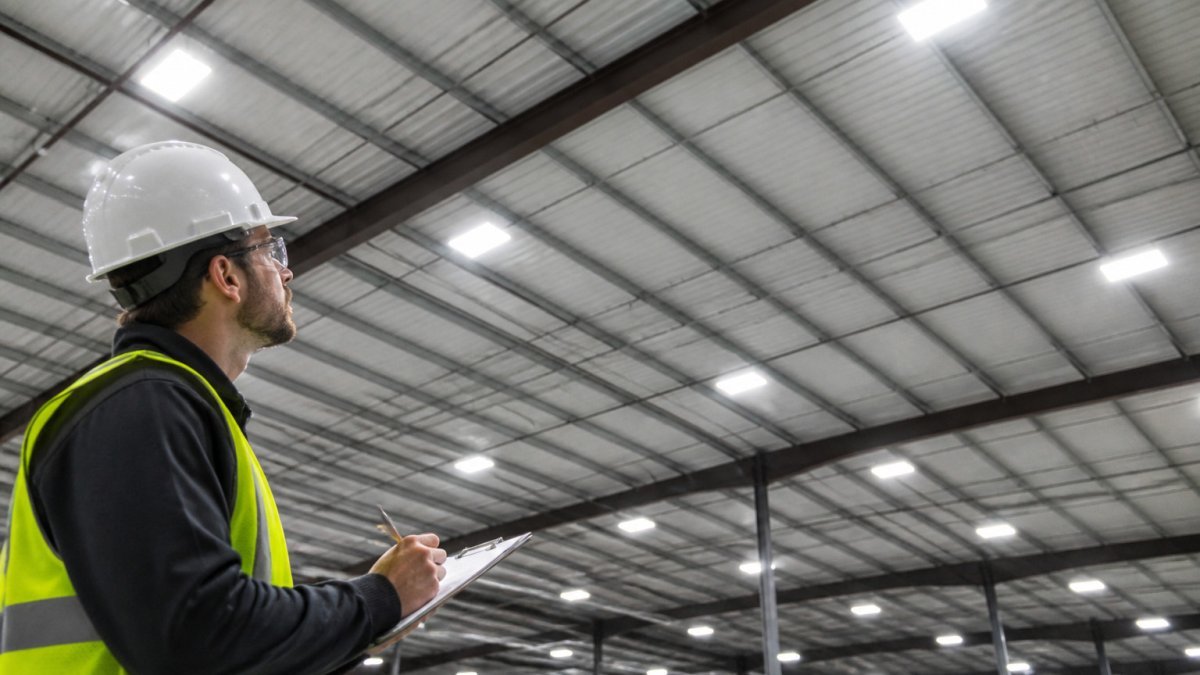
Step 2: On-site inventory (one to two hours for a small building, a full day for a large facility). A technician counts and records fixtures, lamps, controls, and mounting heights. For high-ceiling spaces, we confirm the fixture types and access requirements.
Get a Free Property Assessment →
Step 3: Measurement and modeling. Where possible, we measure light levels and confirm operating schedules. The data feeds an energy model that estimates current and proposed consumption.
Step 4: Findings and options. We present the baseline, the proposed upgrade options, and the estimated savings for each.
Step 5: Proposal and rebate review. Options are priced, and eligible utility programs are identified. We explain which items may qualify and what documentation each program requires.
A common mistake is treating the proposal as final before confirming operating hours. Ask the assessment team to show which assumptions drive the savings figures, and check those first.
Assessment Costs, Free Options, and What Is Included
- Square footage and fixture count. A 20,000 sq ft office with lay-in troffers is a different job than a 200,000 sq ft warehouse with high-bay fixtures and exterior pole lighting.
- Depth of analysis. A walk-through with a fixture count and a rough savings estimate costs less than a modeled report with measured operating hours, light-level readings, and a payback analysis.
- Access and scheduling. Locked electrical rooms, occupied production floors, night-shift-only access, and roof or lift requirements add labor.
Free vs. paid assessments, what the difference usually is:
| Type | Typical scope | What to watch for |
|---|---|---|
| Free walk-through | Fixture count, visual condition check, rough savings range | May be a sales visit; ask whether a written report is included |
| Paid assessment | Measured hours, light-level readings, modeled baseline, written report with options | Confirm the report is yours to keep and usable for rebate applications |
| Utility-program assessment | Funded or subsidized through a utility program | Eligibility rules and pre-approval requirements apply |
- Site inventory of fixtures, lamps, and controls
- Review of 12 months of utility bills and operating schedules
- An energy model with baseline and proposed consumption
- A written findings report with upgrade options
- Estimated savings and simple payback calculations
- Identification of potentially eligible utility rebate programs
What is often excluded, ask before you sign:
- Measurement of light levels (foot-candles) at task surfaces
- Temporary data logging of operating hours
- Rebate application preparation and follow-up
- A post-installation verification visit
- Engineering stamp or utility-program-specific forms
Scope differences are the most common source of surprise on a final bill. Ask whether the quote covers measurement of light levels, rebate paperwork, and any follow-up visit before installation, and get the answer in writing.
How to read the proposal once it arrives:
- Check the baseline assumptions first. Operating hours, wattage per fixture, and control savings are the three numbers that drive everything else. If any is assumed rather than measured, ask why.
- Separate hard savings from soft savings. Energy and maintenance savings are quantifiable; productivity and comfort are real but harder to underwrite.
- Look at payback per measure, not just the project total. A blended payback can hide weak measures that should be phased or dropped.
- Confirm rebate amounts are netted correctly. The proposal should show gross cost, expected rebate, and net cost separately.
- Ask what happens if savings fall short. A credible provider will explain how projected savings will be verified after installation.
Utility Rebates for Commercial Lighting and How They Are Coordinated
New Jersey utilities offer rebates for qualifying commercial lighting upgrades, including programs run through PSE&G. Rebate amounts, eligibility rules, and deadlines change over time, so check the current program terms before committing. Start with PSE&G lighting rebate options in New Jersey and the overview of New Jersey utility lighting rebate programs to see which may apply.
Rebate paperwork is where many projects stall. Applications typically require pre-approval, fixture specifications, installation dates, and proof of completion. Programs may also require that work begin only after approval, so sequencing matters.
NexVolt Energy Group provides utility rebate program assistance and coordination. Read the full guide to rebate application support services to see what that help covers.
Watch out: Installing before rebate pre-approval can disqualify a project. Confirm the approval step before work begins.
Booking Your Assessment With NexVolt Energy Group
If your facility runs high-bay lighting, operates around the clock, or is weighing a rebate-funded upgrade, a commercial lighting energy assessment is the right first step. Gather your utility bills, operating hours, and site details, then request your assessment. NexVolt Energy Group delivers turnkey commercial LED lighting upgrades and energy-efficiency solutions, including comprehensive property assessments and utility rebate coordination.
Contact NexVolt Energy Group to request your assessment.
Frequently Asked Questions
What happens during a commercial lighting energy assessment?
NexVolt Energy Group provides comprehensive property assessments as part of its turnkey commercial LED lighting upgrades and energy-efficiency solutions. It also offers utility rebate program assistance and coordination.
How do I book a lighting assessment for a commercial building?
Contact NexVolt Energy Group to request a Free Property Assessment.
What information should I prepare before a lighting assessment?
NexVolt Energy Group provides comprehensive property assessments and specializes in commercial LED lighting upgrades, occupancy sensors, and smart controls.
What should I ask a lighting assessment provider before booking?
NexVolt Energy Group offers a Free Property Assessment and utility rebate program assistance and coordination. Ask the provider about assessment deliverables, installation logistics, any additional work, and how project results are verified.