
Table of Contents
- What Industrial Lighting Occupancy Sensors Do
- How Occupancy Sensors Work: Passive Infrared vs. Ultrasonic Technology
- Energy Savings and Cost Reduction in Industrial Facilities
- Calculating ROI: Lighting Control System Energy Savings
- Safety, Security, and Fixture Lifespan Benefits
- Occupancy Sensor Placement for High-Bay Lighting Environments
- Common Challenges and How to Avoid False Triggers
- Conclusion
- Frequently Asked Questions
Last Updated: September 23, 2026
What Industrial Lighting Occupancy Sensors Do
Industrial lighting occupancy sensors are automated devices that detect the presence or absence of people in a space and control lighting accordingly, delivering occupancy sensors benefits including energy savings and operational efficiency. When motion or occupancy is detected, lights turn on; when the space becomes vacant for a set duration, lights automatically turn off. This automation eliminates the need for manual switching and ensures lights run only when needed.
For facility managers overseeing warehouses, distribution centers, and manufacturing plants, occupancy sensors represent a shift from fixed-schedule lighting to demand-responsive illumination, adjusting to actual usage patterns rather than preset timers. This is especially valuable where foot traffic varies throughout shifts and 24/7 operations make manual control impractical.
The most effective occupancy sensor implementations combine detection technology with smart lighting controls and LED fixtures as part of a larger energy management ecosystem, not standalone devices.
How Occupancy Sensors Work: Passive Infrared vs. Ultrasonic Technology
The two dominant occupancy sensor technologies operate on fundamentally different principles. Understanding the distinction helps you choose the right sensor for your facility’s layout and use case.
Passive infrared (PIR) sensors detect heat signatures from moving bodies and excel in open areas with clear sightlines. They’re reliable in high-bay warehouses and less sensitive to air currents, but have slower response times (2-5 seconds) and can miss stationary occupants.
Ultrasonic sensors emit sound waves and detect reflections, working through walls and obstacles in cluttered spaces. They respond faster (1-2 seconds) but are prone to false triggers from air movement and vibrating machinery in industrial settings.
Dual-technology sensors combine PIR and ultrasonic detection, requiring both signals to confirm occupancy. This reduces false triggers while maintaining responsive detection across varied industrial environments.
For high-bay lighting environments specifically, PIR sensors often perform better because they’re less affected by the air circulation patterns common in tall spaces. However, mounting height and coverage patterns must be carefully planned, a topic we’ll address in detail below.
Energy Savings and Cost Reduction in Industrial Facilities
Industrial lighting typically represents 20-35% of a facility’s total electrical load. Occupancy sensors reduce this major expense by eliminating wasted illumination in unoccupied zones.
Fixed-schedule lighting consumes energy continuously regardless of actual usage. Occupancy sensors cut runtime to actual occupancy periods, reducing consumption proportionally.
Industrial facilities typically see meaningful energy bill reductions within the first year. Facilities with inconsistent occupancy see larger percentage reductions than those with stable, predictable schedules.
Occupancy sensor systems often qualify for utility rebate programs that recognize dual efficiency gains. NexVolt Energy Group assists with utility rebate program coordination, which can reduce net implementation costs.
Calculating ROI: Lighting Control System Energy Savings
A practical ROI calculation requires three inputs: baseline energy consumption, projected reduction percentage, and total system cost including installation.
Step 1: Establish your baseline. Review utility bills for the past 12 months to identify lighting consumption. For a 50,000-square-foot warehouse with 400 high-bay fixtures at 400 watts each, running 16 hours daily, baseline annual consumption is approximately 1,152,000 kilowatt-hours.
Step 2: Project realistic energy reduction. Most industrial facilities achieve 30-50% lighting energy reductions when converting to occupancy-controlled LED systems. The range depends on baseline efficiency, occupancy patterns, and daylight harvesting integration. Conservative estimates use 30%; facilities with highly variable usage patterns often exceed 40%.
Step 3: Calculate annual savings. Multiply baseline consumption by the reduction percentage, then multiply by your local electricity rate. Using the warehouse example with a 35% reduction and a $0.12 per kilowatt-hour rate: 1,152,000 kWh × 0.35 × $0.12 = $48,384 annual savings.
Step 4: Factor in system costs and timeline. Total implementation cost includes sensors, controls, LED fixtures, wiring, and professional installation. This varies significantly based on facility size, ceiling height, and existing infrastructure. Divide total system cost by annual savings to determine payback period. Most industrial lighting system upgrades achieve payback within 3 to 5 years, after which all savings flow to the bottom line.
This framework applies whether you’re upgrading a single zone or an entire facility. The key is using realistic baseline data and conservative reduction estimates to avoid overselling the financial case.
Safety, Security, and Fixture Lifespan Benefits
Occupancy sensors deliver operational improvements beyond energy savings. In industrial environments, these secondary benefits often justify the investment independently.
Improved workplace safety results from consistent, responsive lighting. When sensors ensure that work areas are always illuminated during occupancy, visibility hazards decrease. Employees navigating warehouse aisles, operating machinery, or working at height benefit from reliable illumination that activates automatically as they move through spaces. This is particularly valuable in facilities where manual lighting control is impractical or where shift changes create lighting gaps.
Get a Free Property Assessment →
Enhanced security comes from the unpredictable lighting patterns occupancy sensors create. Spaces that would otherwise sit dark during off-hours become intermittently illuminated as sensors detect movement. This deters unauthorized access and makes surveillance systems more effective. For parking garages and outdoor industrial areas, occupancy-driven lighting creates the appearance of activity even during low-traffic periods.
Extended fixture lifespan is a direct mechanical benefit. Traditional fixed-schedule lighting runs fixtures continuously, accumulating hours and thermal stress. Occupancy-controlled systems reduce fixture runtime proportionally to occupancy reduction. If a space is unoccupied 40% of the time, fixtures run 40% fewer hours, extending their operational life by years. This reduces replacement frequency and associated labor costs, a compounding benefit in high-bay environments where fixture replacement is labor-intensive and costly.
LED fixtures amplify this benefit. LEDs already offer 50,000+ hour lifespans compared to 20,000 hours for traditional high-intensity discharge lamps. Occupancy control extends that advantage further, potentially doubling the time between replacements.
Occupancy Sensor Placement for High-Bay Lighting Environments
Sensor placement determines detection reliability and false-trigger rates in industrial spaces. High-bay environments, warehouses, distribution centers, and manufacturing facilities with ceilings 20 feet or higher, present specific placement challenges.
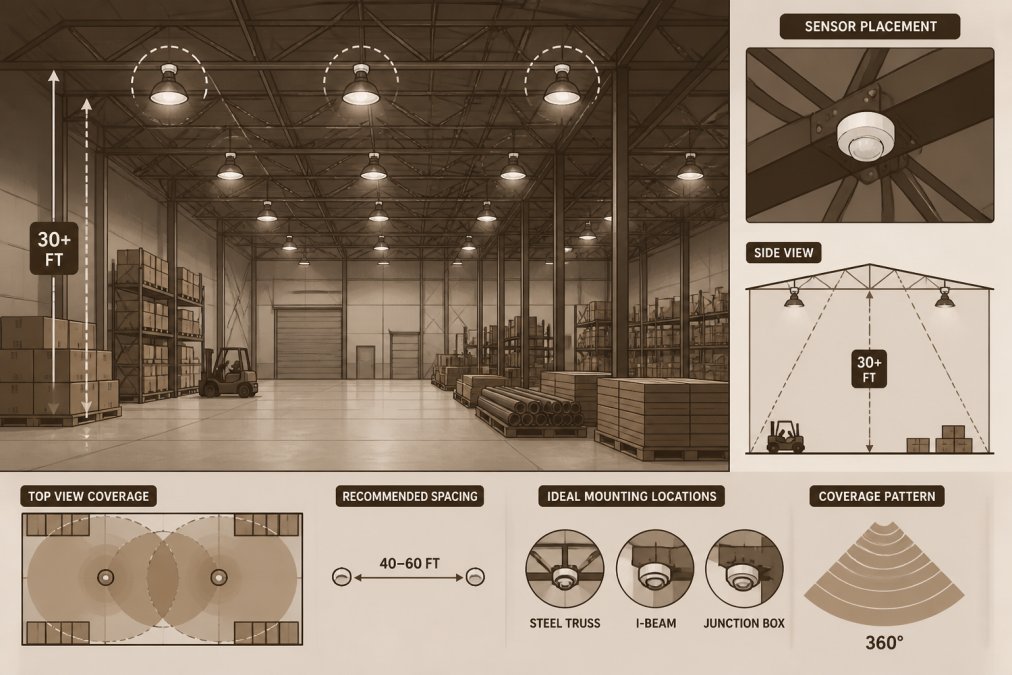
Mounting height and coverage patterns are critical. Sensors must be positioned to detect all occupants within their designated zone without creating dead zones where people can move undetected. For PIR sensors in high-bay spaces, mounting height should not exceed 30 feet; higher placement reduces thermal detection sensitivity. Ultrasonic sensors tolerate higher mounting because sound waves reflect off structural elements and inventory, but they become more prone to false triggers in high spaces.
Zone definition requires understanding actual traffic patterns. Rather than covering an entire warehouse with one sensor, divide the space into logical zones, individual aisles, receiving areas, break rooms, office zones. Smaller zones reduce false triggers and allow granular control. A sensor covering a 3,000-square-foot aisle detects movement more reliably than one attempting to cover 15,000 square feet.
Time-out settings control how long lights remain on after the last detected movement. Industrial facilities typically use 5 to 15-minute time-outs, balancing energy savings against the inconvenience of lights turning off while a space is still in use. Spaces with stationary work (office areas, quality control stations) benefit from longer time-outs; high-traffic areas (aisles, receiving) can use shorter intervals.
Ambient light levels affect sensor performance. In spaces with significant natural daylight, consider daylight harvesting integration, sensors that reduce or disable artificial lighting when natural light is sufficient. This adds another layer of energy optimization, particularly in facilities with skylights or large windows.
Common Challenges and How to Avoid False Triggers
False triggers, lights activating when no occupant is present, undermine both energy savings and user confidence in occupancy systems. Understanding common causes helps prevent them.
Air movement and vibration trigger ultrasonic sensors in industrial environments. HVAC systems, production equipment, and even conveyor belts generate vibrations that ultrasonic sensors interpret as motion. The fix is careful sensor placement away from direct airflow and vibration sources, combined with time-out settings that require sustained motion signals. Dual-technology sensors eliminate many false triggers by requiring both PIR and ultrasonic confirmation.
Reflective surfaces in industrial spaces, metal storage racks, polished concrete floors, large windows, cause ultrasonic signal reflections that create false detections. Positioning sensors to minimize reflections and using sensors with adjustable sensitivity settings reduces this problem.
Inadequate coverage creates the opposite problem: lights that don’t turn on when occupants are present. This occurs when sensor placement leaves blind spots or when time-out settings are too aggressive. Comprehensive facility assessment before installation prevents this by mapping actual movement patterns and traffic flows.
Maintenance and sensor degradation cause performance drift over time. Dust accumulation on sensor lenses reduces detection sensitivity; this is particularly problematic in industrial facilities with airborne particles. Periodic cleaning, quarterly or semi-annually depending on facility conditions, maintains baseline performance. Sensors that fail silently (defaulting to always-on) waste energy; those that fail by not detecting occupancy create safety concerns. Regular testing identifies failing units before they impact operations.
NexVolt Energy Group delivers turnkey commercial LED lighting upgrades and energy-efficiency solutions, expertly managing every stage from comprehensive property assessments and utility rebate coordination to professional installation.
Conclusion
Industrial lighting occupancy sensors deliver measurable energy savings, operational safety improvements, and extended fixture lifespan in warehouses, distribution centers, and manufacturing facilities. The technology is proven, the ROI is quantifiable, and the secondary benefits, improved lighting consistency, enhanced security, and reduced maintenance burden, justify implementation even when energy savings alone might not.
Frequently Asked Questions
What are the primary energy-saving benefits of industrial occupancy sensors?
Occupancy sensors eliminate energy waste by automatically turning off lights when spaces are unoccupied. In industrial facilities, this translates to significant utility cost reduction, especially in warehouses, manufacturing plants, and distribution centers where large areas may sit empty during shifts or after hours.
How do PIR and ultrasonic occupancy sensors differ for industrial applications?
Passive infrared (PIR) sensors detect body heat and work well in enclosed spaces with clear lines of sight. Ultrasonic technology uses sound waves to detect motion and performs better in cluttered environments with obstructions like shelving or machinery. Dual-technology sensors combine both methods to reduce false triggers.
Can occupancy sensors help facilities meet ASHRAE 90.1 energy standards?
Yes. ASHRAE 90.1 (the energy standard for commercial buildings) mandates occupancy-based lighting controls in many space types, including storage areas, restrooms, and break rooms. Installing occupancy sensors with proper daylight harvesting integration helps facilities comply with these requirements while reducing the compliance burden and demonstrating commitment to energy efficiency standards.
What is a common drawback of occupancy sensors in industrial settings?
False triggers and sensitivity misalignment are the most common issues. In high-bay environments with multiple zones, improper sensor placement or incorrect time-out settings can cause lights to turn off while workers are still present, creating safety hazards. Ultrasonic sensors may detect vibrations from machinery, triggering unwanted illumination. Proper sensor selection, mounting height adjustment, and time-out configuration during commissioning prevent most of these problems.