
Table of Contents
- Amresco vs FSG: Side-by-Side Overview
- What Commercial LED Lighting Contractors Deliver
- Service Scope and Project Fit
- Warehouse Lighting Retrofit: Capabilities and Limitations
- Utility Rebates for LED Lighting: Coordination and Support
- Lighting Contractor Comparison Checklist: What to Evaluate
- Making Your Choice: Fit, Coverage, and Total Cost
- Frequently Asked Questions
Last Updated: October 6, 2026
Amresco vs FSG: Side-by-Side Overview
A lighting contractor comparison is one of the most important decisions for your facility’s operational efficiency and long-term costs. Amresco and FSG represent two different approaches to commercial LED lighting upgrades and energy management.
NexVolt Energy Group works with facility managers across industrial warehouses and distribution centers. The choice comes down to service scope, geographic availability, and how actively each contractor manages rebate programs.
| Aspect | Amresco | FSG |
|---|---|---|
| Primary Focus | Large-scale energy services and efficiency | Facility solutions and energy management |
| Service Model | Project-based contracting | Comprehensive facility partnerships |
| Rebate Support | Coordination assistance | Active program management |
| Installation Scope | Commercial and industrial facilities | Warehouses, retail, public facilities |
| Geographic Reach | Nationwide operations | Regional and specialized markets |
| Best For | Multi-facility enterprises | Mid-sized industrial operations |
What Commercial LED Lighting Contractors Deliver
Commercial LED lighting contractors manage the entire journey from assessment to installation: property evaluations, energy-saving identification, utility rebate coordination, and professional installation with minimal disruption.
The core deliverables include:
- Property assessments that quantify your current energy consumption and lighting performance gaps
- Rebate program coordination that handles paperwork, application submissions, and compliance verification
- LED lighting installation using advanced fixtures, occupancy sensors, and smart controls
What separates experienced contractors from generalists is their ability to handle high-bay warehouse installations, manage complex electrical upgrades, and deliver on rebate promises.
Service Scope and Project Fit
Amresco is a large-scale energy services provider spanning HVAC, controls, and lighting across commercial and industrial facilities.
FSG positions itself as a facility solutions partner specializing in warehouse and industrial lighting retrofits.
The practical difference: Amresco excels at managing energy projects across your entire portfolio; FSG excels as a specialist focused on your warehouse retrofit and willing to work around your 24/7 schedule.
Consider your facility’s complexity.
Warehouse Lighting Retrofit: Capabilities and Limitations
Warehouse lighting retrofits present unique challenges: high-bay fixtures mounted 30+ feet up, massive square footage requiring precise calculations, and the need to maintain operations during installation.
Amresco’s strength is managing large-scale logistics across multiple locations, if they’re simultaneously installing at several sites, their supply chain and crew scheduling become advantages.
FSG prioritizes direct coordination with your operations team and will work nights and weekends if needed.
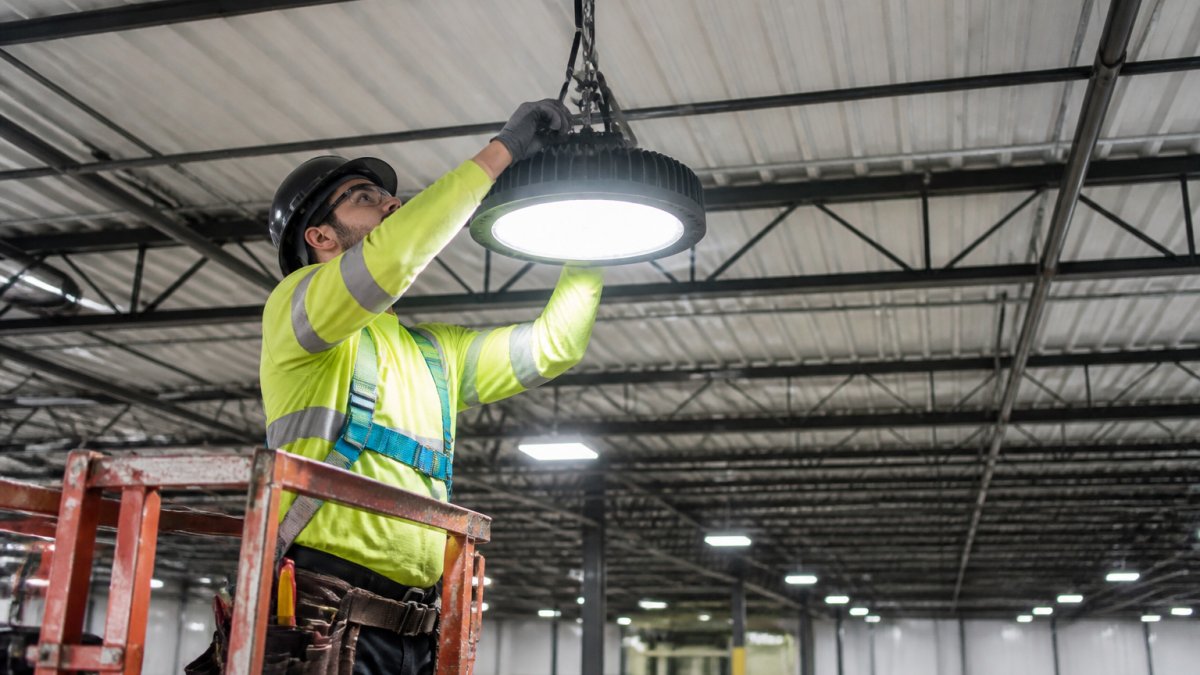
High-bay installations require aerial lifts, rigging expertise, and high-voltage electrical knowledge. Both contractors have this capability.
Ask each contractor these specific questions:
- Can you install fixtures while our facility operates, or do we need to shut down sections?
- Who handles electrical upgrades if your assessment finds code violations or capacity issues?
- What happens if installation uncovers structural problems that complicate fixture mounting?
Utility Rebates for LED Lighting: Coordination and Support
Rebates are the largest variable in an LED retrofit budget and the part most often mishandled. Rebate programs are administered by your utility or a state/regional administrator, not the contractor, and rules are written around measured savings rather than installed fixtures.
How rebates are actually calculated
Most commercial lighting incentives fall into one of three structures:
- Per-fixture or per-lamp rebates, a fixed dollar amount for each qualifying fixture type, wattage reduction, or control device. This is the most common structure for high-bay and linear LED replacements.
- Per-kilowatt-hour (kWh) saved, a payment based on estimated annual energy savings, calculated from your operating hours and the difference between existing and proposed wattage.
- Custom or measured incentives, used for large or unusual projects, where the utility reviews engineering calculations or post-installation measurement.
Because the first two structures depend on your operating hours, existing equipment, and the utility’s current program year, the same fixture package can produce very different rebate values at two facilities in the same metro area. A contractor who quotes a rebate percentage before walking your facility is guessing.
Who owns the application
This is the practical dividing line between contractors, and it is worth asking about in writing:
- Customer-owned application, you sign the utility paperwork, you receive the rebate check, and you carry the risk if documentation is incomplete. The contractor supplies fixture cut sheets, invoices, and installation dates.
- Contractor-facilitated application, the contractor prepares and submits the paperwork on your behalf, but the incentive is still paid to you or assigned to the contractor as a line-item credit on the invoice.
- Assigned incentive, you sign the rebate over to the contractor, who reduces your invoice by the expected amount. This lowers your upfront cost but shifts the risk of denial onto the contractor, which is why some contractors price this conservatively.
Incentives are commonly paid after the utility inspects or verifies the installation, which can take weeks to months. If your contract assumes the rebate arrives before final payment, confirm the timing in writing.
Pre-approval and the reservation trap
Many programs require pre-approval before equipment is purchased or installed. Ordering or installing fixtures before approval can disqualify the project entirely, no appeal, no partial payment.
Some programs also cap total incentive dollars per program year or per customer. Once the cap is reached, applications are waitlisted until the next program year. A contractor who tracks your utility’s remaining budget can tell you whether to move now or wait.
Never let a contractor order fixtures or schedule installation before the utility issues a pre-approval or reservation number. Verbal assurances that “the rebate will be fine” are not a substitute for a written approval.
Questions that separate real rebate support from marketing
- Which specific program and program year are you applying under, and what is the current incentive rate per fixture or per kWh?
- Does the program require pre-approval, and who submits it?
- What is the expected payment timeline after installation and verification?
Both Amresco and FSG operate in markets where utility incentives are standard in the sales conversation, so the differentiator is not whether they mention rebates, it is whether they can name your program, its current rate, and its approval sequence without researching after the meeting.
DSIRE database of state and utility incentive programs
Get a Free Property Assessment →
Lighting Contractor Comparison Checklist: What to Evaluate
When comparing contractors, move beyond headline claims and evaluate the specifics that determine project success.
Project Experience:
Ask for references from warehouses matching your facility size and age.
Rebate Program Knowledge:
Does the contractor understand your utility’s rebate program?
Installation Logistics:
How do they handle 24/7 operations?
Pricing Transparency:
Your quote should break down LED fixture costs, labor, electrical work, rebate coordination, and other services.
Insurance and Liability:
Confirm they carry general liability insurance and workers’ compensation.
| Evaluation Criterion | Why It Matters | Red Flag |
|---|---|---|
| Full-service capability | Reduces your coordination burden and project risk | Contractor only installs; you handle rebates and assessments |
| Warehouse experience | Ensures they understand your specific challenges | Portfolio shows mostly retail or office buildings |
| Rebate expertise | Determines whether you actually receive the rebate | Vague about rebate timeline or percentage |
| 24/7 flexibility | Minimizes disruption to your operations | Only works standard business hours |
| Transparent pricing | Lets you understand what you’re paying for | Single line-item quote with no breakdown |
| Proof of insurance | Protects your facility during installation | Unwilling or unable to provide insurance documentation |
Making Your Choice: Fit, Coverage, and Total Cost
Most comparison articles stop at service scope. What actually determines whether your project pays off is total cost of ownership, which requires reading quotes the way a facility engineer would.
What belongs in a total-cost comparison
A useful side-by-side evaluation normalizes every quote to the same inputs:
- Installed cost per fixture, not cost per project. Divide the total by the number of fixtures replaced so you can compare bids of different sizes.
- Wattage reduction per fixture, which drives both energy savings and rebate value.
- Annual operating hours, which you supply, not the contractor. A warehouse running two shifts has very different economics than one running around the clock.
A simple payback framework
You do not need a proprietary model to compare bids. The calculation is:
Simple payback (years) = Net installed cost ÷ Annual energy savings
Where net installed cost is the quoted price minus the confirmed rebate, and annual energy savings is the wattage reduction multiplied by operating hours and your utility rate.
Two contractors can quote the same fixture package and produce payback estimates differing by years, purely because one used 3,000 operating hours and the other 6,000. Ask each to show the hours and rate they assumed; if they can’t, the payback number is meaningless.
Financing and cash-flow options
Beyond rebates, most commercial lighting projects can be funded through:
- Direct capital purchase, lowest total cost, but requires upfront cash and typically a longer internal approval cycle.
- Equipment or project financing, spreads cost over a term, often structured so energy savings offset the payment. Terms vary widely by lender and credit profile.
- Performance contracts or shared-savings agreements, the provider funds the project and is repaid from measured savings. These carry the highest total cost but the lowest upfront risk.
If a contractor offers only one option, note that limitation. If they offer financing, ask whether the rate is fixed, whether there’s a prepayment penalty, and whether the rebate is applied upfront or returned later.
Geographic coverage and delivery capacity
Coverage matters less as a map and more as a response time. Ask:
- How far is the nearest crew or service hub from our facility?
- What is the typical response time for a warranty call?
- Do you self-perform installation or subcontract it, and if you subcontract, who is our point of contact?
A national contractor may still subcontract local work, affecting quality control and warranty response. A regional contractor may self-perform everything but have limited capacity if you add locations.
Matching the provider to your situation
- Multiple facilities, one vendor preferred, a large energy services provider with consolidated project management is usually the better fit, provided the per-facility scope is not so small that your project gets deprioritized.
- One or two large warehouses, tight operational constraints, a specialist with direct facility-operator relationships tends to respond faster to site-specific scheduling and electrical issues.
- Mixed portfolio with HVAC and controls work, a provider that already handles those systems can bundle scopes and reduce total mobilization cost.
Request a written assessment that states your current energy consumption, the proposed fixture and control package, the assumed operating hours and utility rate, the named rebate program and its approval status, and a payback calculation you can reproduce. If any of those are missing, the quote is not ready to compare against another.
The lowest bid is rarely the lowest total cost. A quote that omits controls, assumes aggressive operating hours, or leaves rebate risk with you looks cheaper on paper and costs more over the installation’s life. Compare normalized numbers, confirm the rebate path in writing, and choose the contractor whose assumptions you can verify.
Frequently Asked Questions
What is the difference between Ameresco and Facility Solutions Group?
Ameresco and FSG operate as distinct energy service companies with different service models and geographic footprints. Ameresco positions itself as a large-scale energy services provider, while FSG focuses on targeted commercial and industrial lighting solutions. The key differences lie in their project scope, contractor network, rebate coordination processes, and service availability in specific regions. Your choice depends on whether you need a national provider or a more specialized local contractor for warehouse lighting retrofit work.
What should I look for in a lighting contractor comparison checklist?
A lighting contractor comparison checklist should cover: project experience with your facility type (warehouse, retail, industrial), proven utility rebate coordination support, insurance and licensing credentials, installation timeline and scheduling flexibility, warranty and maintenance plans, technology offerings (occupancy sensors, smart controls), and transparent pricing or quote methodology. Also verify geographic service area, customer references from similar facilities, and whether they handle the full project lifecycle from assessment through verification and follow-up.
How do lighting upgrades affect energy use and maintenance costs?
LED lighting upgrades typically reduce energy consumption by 40-70% compared to older fluorescent or incandescent systems, directly lowering utility bills. Maintenance costs drop significantly because LED fixtures last 25,000-50,000 hours versus 10,000-20,000 for older technology, reducing replacement frequency and labor. Smart controls and occupancy sensors add further savings by eliminating unnecessary lighting during non-peak hours. Total savings depend on facility size, operating hours, baseline equipment age, and local electricity rates.
Does Ameresco provide commercial LED lighting upgrades?
Ameresco does offer energy services that may include lighting components as part of broader facility upgrades. However, their approach typically focuses on large-scale energy performance contracts rather than specialized LED-only retrofits. If your primary need is a warehouse lighting retrofit with turnkey management and utility rebate coordination, verify whether Ameresco’s service model and pricing align with your project scope and budget before proceeding.
Your facility’s lighting system directly impacts energy costs, workplace safety, and operational efficiency. The right contractor makes that upgrade seamless; the wrong one creates months of headaches. Get a free property assessment from NexVolt Energy Group to understand your specific lighting retrofit needs, rebate eligibility, and the actual cost of upgrading your warehouse or industrial facility.